
A few weeks ago, I wrote about coffee timing and cardiovascular mortality — specifically, the finding that morning drinkers fare better than all-day drinkers. That piece focused on when you drink it. This one addresses the more fundamental question that still makes people nervous: does coffee consumption increase cardiovascular disease risk at all?
The short answer, based on a substantial body of evidence, is no — and for moderate drinkers, the data lean in the opposite direction.
The Harm Narrative Has a Weak Foundation
The worry about coffee and heart health tends to arrive via a few familiar routes: it raises blood pressure, it spikes cortisol, it stresses the cardiovascular system. These concerns aren't entirely invented — caffeine does produce measurable short-term effects — but the leap from acute physiological response to long-term cardiovascular disease risk is where the evidence stops cooperating.
The British Heart Foundation's position, based on its review of the research, is that moderate caffeine consumption is unlikely to cause negative effects on heart health and that habitual moderate intake is not linked to increased risk of long-term high blood pressure. Yes, caffeine can temporarily raise blood pressure — especially in people who don't drink it regularly — but that transient spike doesn't translate into hypertension for regular drinkers. The body adapts.
The cortisol-and-adrenal-fatigue framing that circulates in wellness spaces fares even worse. As Caveat's analysis of the evidence notes, habitual caffeine use blunts the cortisol response over time, and "adrenal fatigue" — the supposed mechanism by which coffee supposedly depletes your stress-response system — is not a recognized endocrine diagnosis. The Endocrine Society doesn't recognize it. The harm story requires a chain of physiological events that doesn't hold up under scrutiny.
What the Large Cohorts Actually Show
The most useful data here comes from population-scale observational research, and it consistently points in a direction that surprises people who've been told to cut back.
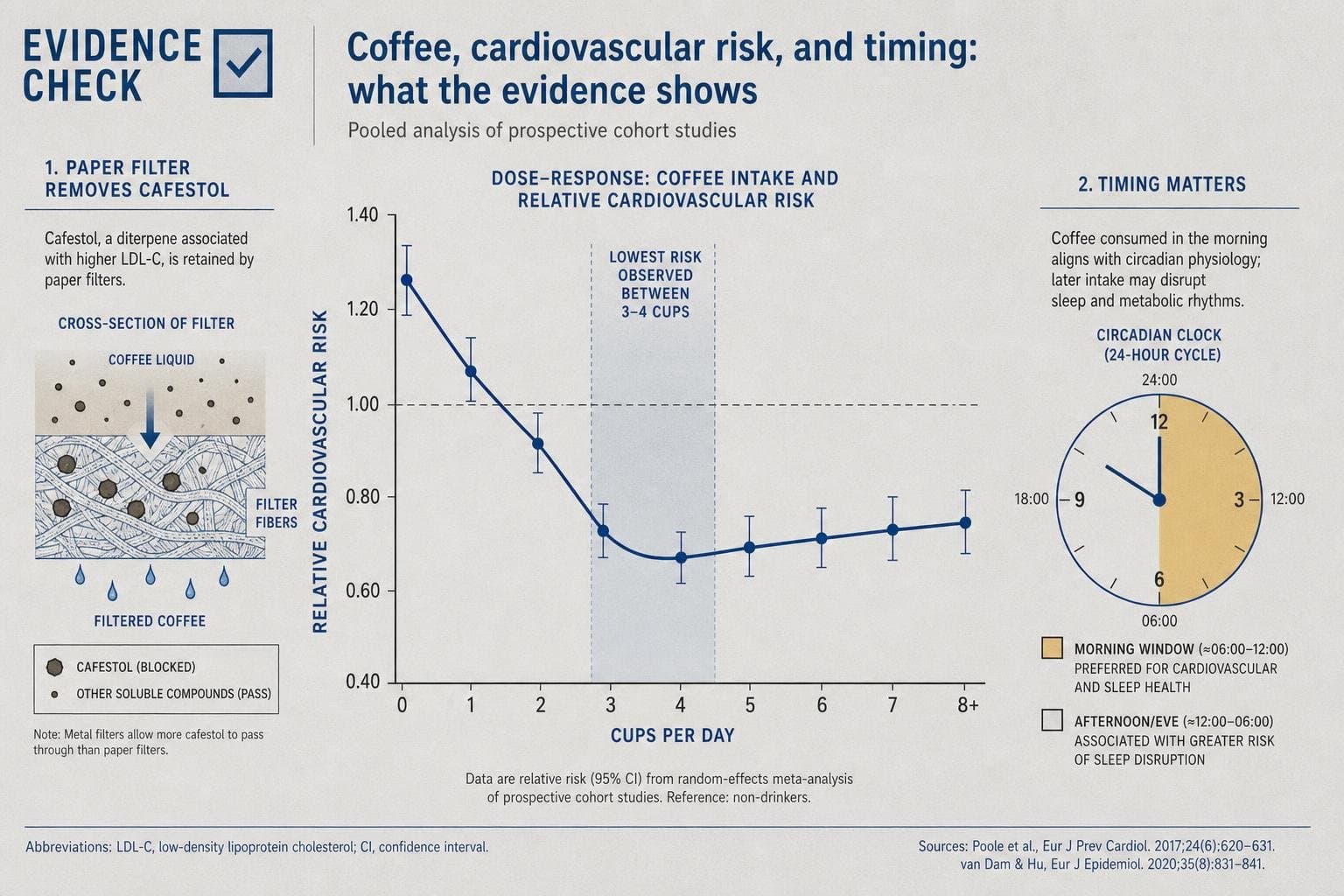
A BMJ umbrella review of 201 meta-analyses — covering 67 unique health outcomes — found that coffee consumption was more often associated with benefit than harm across a wide range of outcomes. For cardiovascular disease specifically, the analysis found a non-linear relationship: the largest risk reduction appeared at three to four cups per day compared to none. That's not a marginal effect buried in statistical noise. It's a consistent, dose-shaped pattern across a large evidence base.
The timing data I covered previously reinforces this. A study drawing on over 40,000 participants from NHANES and two lifestyle validation cohorts found that morning coffee drinkers had lower risks of both all-cause and cardiovascular mortality compared to non-drinkers — with the caveat that the design is observational and causality can't be established.
One mechanism worth noting: coffee is a major dietary source of polyphenols and chlorogenic acids, and the mortality benefits appear in decaffeinated coffee as well, which suggests caffeine itself isn't the only active ingredient. This matters because it undercuts the simple story that coffee's cardiovascular effects are purely about stimulant load.
The Real Caveats Are Specific, Not General
None of this means coffee is unconditionally fine for everyone. The actual caveats are narrower and more specific than the general alarm.
Unfiltered coffee — French press, boiled, espresso — contains cafestol, a compound that raises LDL cholesterol. The fix is simple: use a paper filter. This is a preparation issue, not a coffee issue.
Pregnancy warrants genuine caution, with the NHS recommending a limit of 200mg of caffeine per day. The BHF guidance echoes this. People with arrhythmia concerns or who notice palpitations at higher doses should pay attention to their individual response — the BHF notes that up to 400mg daily should not affect heart rhythm for most people, but sensitivity varies.
And the drink you're actually consuming matters. Black coffee is not the same as a large sweetened latte with whole milk. The BHF points out that added sugar, syrups, and cream introduce calories and saturated fat that carry their own cardiovascular implications — a confound that gets lost when people debate "coffee" as a monolithic category.
What This Means in Practice
The evidence doesn't support recommending coffee as a cardiovascular intervention — association is not causation, and nobody should start drinking it for health reasons if they don't already. But for healthy adults who drink moderate amounts, the data offer genuine reassurance: the case against coffee and heart health is weak, the large cohorts point the other way, and the real risks are specific enough to manage.
Three to four filtered cups in the morning, without the sugar architecture of a dessert drink, is about as well-supported a coffee habit as the evidence allows.


