
I've covered the coffee-heart story three times now — in May, in June, and in July — and each time the headline conclusion has been roughly the same: moderate coffee consumption appears safe for most healthy adults, and may even be mildly protective. A major new meta-analysis published in May 2026 doesn't overturn that picture. But it does sharpen one part of it that keeps getting glossed over.
The Reassuring Part Is Real — and Well-Established
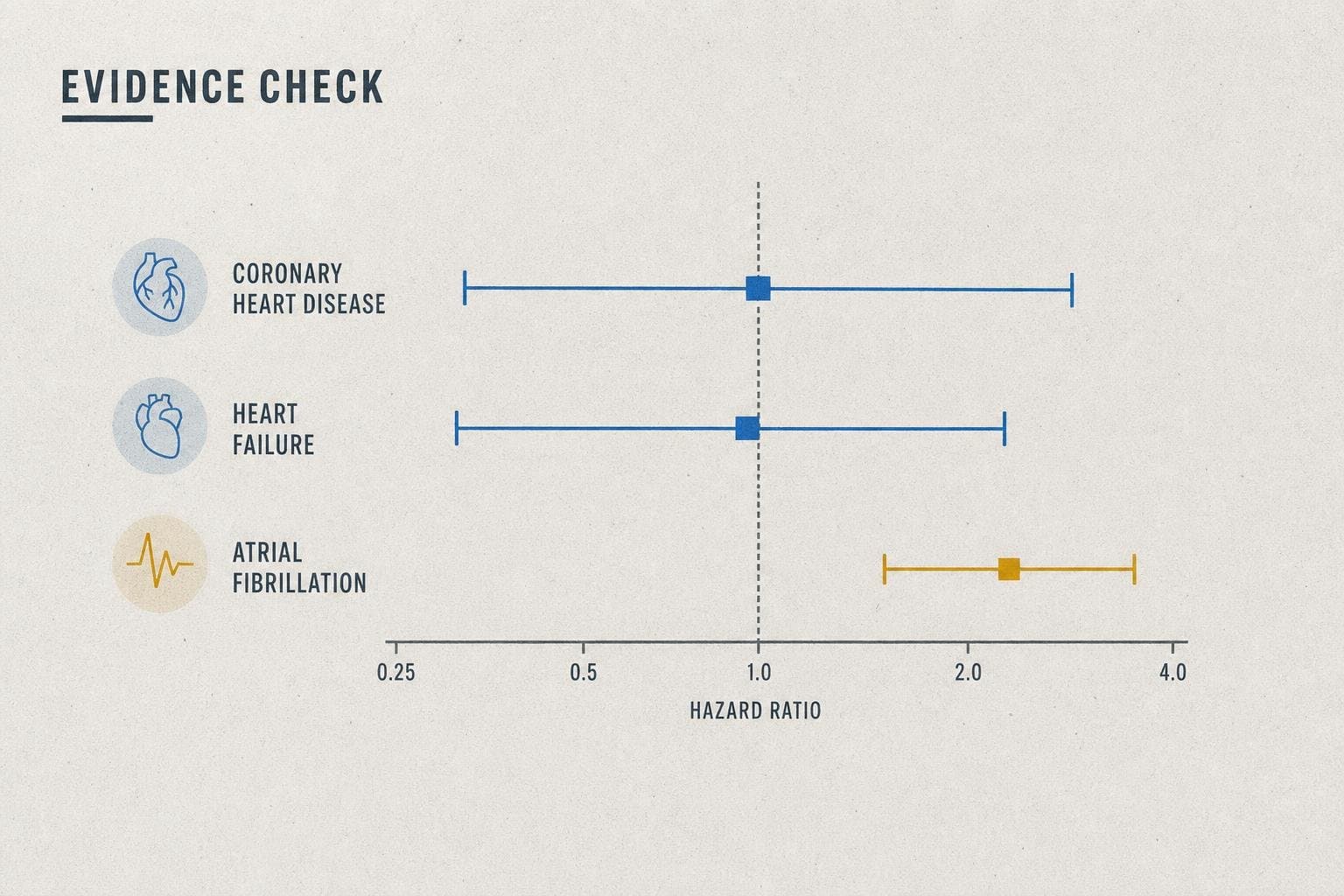
The new systematic review and meta-analysis published in BMC Cardiovascular Disorders analyzed 38 studies covering nearly 2.9 million participants. The pooled results on the two outcomes people worry about most — coronary heart disease and heart failure — were essentially null. Hazard ratios of 0.98 and 1.03, respectively, with p-values nowhere near significance. In plain terms: higher coffee consumption was not associated with increased risk of coronary heart disease or heart failure compared to lower consumption.
This aligns with what a 2017 BMJ umbrella review — still one of the most comprehensive analyses of coffee and health outcomes — found: three to four cups per day was associated with the largest relative risk reduction for cardiovascular mortality, and heavy consumption was not associated with elevated cardiovascular risk. The reassuring headline has been consistent across years of research and millions of participants. That consistency matters.
A separate comprehensive review of caffeine's cardiovascular mechanisms, indexed on PubMed, adds useful mechanistic texture: habitual caffeine use appears to attenuate the acute blood pressure spike through tolerance development, and filtered coffee generally has neutral effects on lipid levels. The acute pressor response that makes cardiologists nervous in occasional drinkers largely disappears in regular consumers.
The Part That Keeps Getting Buried
Here's where the new meta-analysis gets more interesting — and where the "coffee is fine" narrative needs a footnote.
The same BMC Cardiovascular Disorders analysis that found no significant association with coronary heart disease or heart failure did find a significant positive association between higher coffee consumption and cardiac arrhythmia risk. That's a different signal than the general cardiovascular story, and it deserves its own treatment rather than being folded into a blanket reassurance.
A separate meta-analysis published in Pacing and Clinical Electrophysiology specifically examined coffee and atrial fibrillation — the most common sustained cardiac arrhythmia — and found that prospective studies on the association between coffee consumption and AF risk have been inconsistent. Inconsistent is not the same as reassuring. It means the arrhythmia question is genuinely unsettled in a way that the coronary heart disease question largely isn't.
This distinction matters clinically. Atrial fibrillation is not a minor concern — it's a major risk factor for stroke and carries real morbidity. The population of people who already have paroxysmal AF or who are at elevated arrhythmia risk is not small. Telling that population "coffee is fine for your heart" based on the coronary disease literature is a category error.
Why the Causal Question Remains Open
Even the favorable epidemiological associations come with a significant caveat that the PubMed review of caffeine's cardiovascular mechanisms states plainly: Mendelian randomization analyses — which use genetic variants as proxies for caffeine exposure to test causality — generally do not support a clear causal protective effect. The J-shaped curve that shows up in observational studies may reflect residual behavioral confounding rather than a genuine cardioprotective mechanism.
In other words: people who drink moderate amounts of coffee may simply be healthier in other ways that the studies can't fully account for. The association is real and consistent; the causation is not established. That's a meaningful distinction if you're deciding whether to start drinking coffee for cardiovascular benefit — which, based on current evidence, you probably shouldn't.
What the Evidence Actually Supports
The honest summary, as of mid-2026: for healthy adults without arrhythmia history, moderate coffee consumption — somewhere in the range of two to five cups daily — appears neither harmful nor meaningfully protective for coronary heart disease or heart failure. The arrhythmia signal is real and warrants more caution, particularly for anyone with a history of AF or palpitations. And the cardioprotective associations seen in large observational studies probably shouldn't be interpreted as a prescription.
The research on coffee and cardiovascular health has been remarkably consistent for years. The problem is that "consistent" gets translated into "settled" in health media, and the arrhythmia carve-out — the one place where the evidence points in a different direction — keeps getting lost in the reassuring headline. That's the nuance worth holding onto.


