


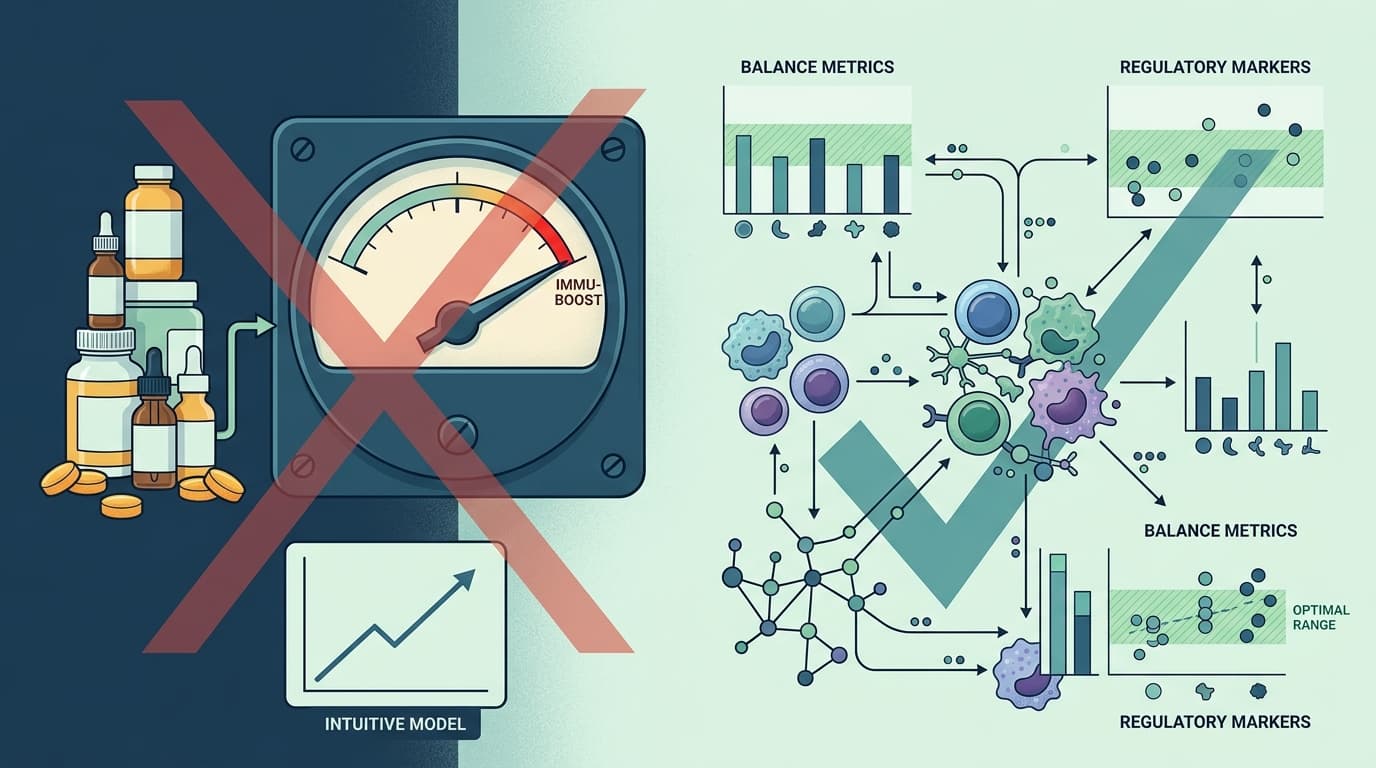

Walk into any pharmacy in January and you'll see it: a wall of supplements promising to "boost" your immune system. Elderberry gummies, zinc lozenges, megadose vitamin C — the implication is always the same. Your immune system is like a battery, and these products charge it up.
That framing is wrong in a way that matters.
The Claim: Supplements Put Your Immune System on High Alert
The popular belief goes something like this: certain nutrients and botanicals can amplify immune function, making your body better at fighting off infections. Take enough vitamin C, zinc, or elderberry, and your immune system becomes more powerful — more capable of defeating whatever pathogen comes your way.
This idea is everywhere. It drives billions in supplement sales annually, gets reinforced every cold season by wellness influencers, and feels intuitively correct. Muscles get stronger when you work them. Why wouldn't the immune system respond to the right inputs?
The Appeal: We Want a Lever to Pull
Part of what makes this belief so sticky is that it offers control. Getting sick feels random and helpless. A supplement routine feels like agency — something you can do rather than just wait and hope.
The muscle analogy also does a lot of work here. We understand strength as a dial that goes up or down. The immune system, in this mental model, just needs the right fuel to turn up the dial.
But as Fred Hutch Cancer Center explained this week, the immune system isn't one thing with one dial. It's two distinct systems with fundamentally different jobs. The innate immune system responds fast and nonspecifically — it attacks anything unfamiliar. The adaptive immune system is slower, highly targeted, and builds memory over time. Vaccination works by training the adaptive system. What would it even mean to "boost" either one?
Here's the uncomfortable answer: if you actually boosted your innate immune system into overdrive, you'd want it to stop. An overactive innate immune system attacks the body's own cells — which is precisely what happens in autoimmune disease. More immune activity is not categorically better. The goal is a well-regulated system, not a hyperactive one.
The Evidence: Deficiency vs. Optimization Are Different Problems
This is where the research gets genuinely interesting — and where the supplement industry quietly conflates two very different things.
The NIH's Office of Dietary Supplements is clear on one point: clinical deficiencies in nutrients like vitamin C, vitamin D, zinc, and selenium do weaken immune function and increase susceptibility to infection. That's well-established. If your body is running low on zinc, your immune response suffers.
What does not follow from that finding is that supplementing above adequate levels provides additional benefit to people who aren't deficient. Correcting a deficit and optimizing a system that's already functioning normally are different interventions with different evidence bases.
Vitamin C is a useful case study. It's a powerful antioxidant that protects neutrophils — cells in the innate immune system — from damage while they're working. But as Fred Hutch notes, vitamin C is water-soluble: cells take what they need, and the rest gets excreted. Megadosing doesn't supercharge your neutrophils; it mostly produces expensive urine. The BMJ has flagged misleading characterizations of the vitamin C and common cold evidence, noting that claims of "no consistent effect" on duration or severity have been overstated in both directions — the picture is genuinely mixed, not a clean vindication of high-dose supplementation.
Zinc has a more interesting evidence profile. Examine's review of the research, updated in March 2026, notes that zinc is most commonly taken to reduce the duration of respiratory infections — and there's some support for this, particularly when taken early. But the tolerable upper intake level for adults is 40 mg per day, and many "immune support" products push close to or past that threshold. Chronic overconsumption can impair copper absorption and create its own problems. The supplement that's supposed to protect you can, at high enough doses, cause harm.
What This Actually Means
The honest takeaway is less exciting than the supplement aisle promises, but more actionable: your immune system doesn't need boosting. It needs consistent support — through diet, sleep, and not being deficient in key nutrients.
If you're eating a varied diet and aren't in a high-risk group for deficiency, the evidence for immune supplements is thin. If you are deficient — common with vitamin D, less so with vitamin C in most Western diets — correcting that deficiency matters. But that's a clinical question worth discussing with a doctor, not something to self-diagnose with a gummy.
The framing shift Fred Hutch suggests is worth holding onto: support, not boost. One is about giving a complex system what it needs to function. The other is a marketing concept dressed up as physiology.