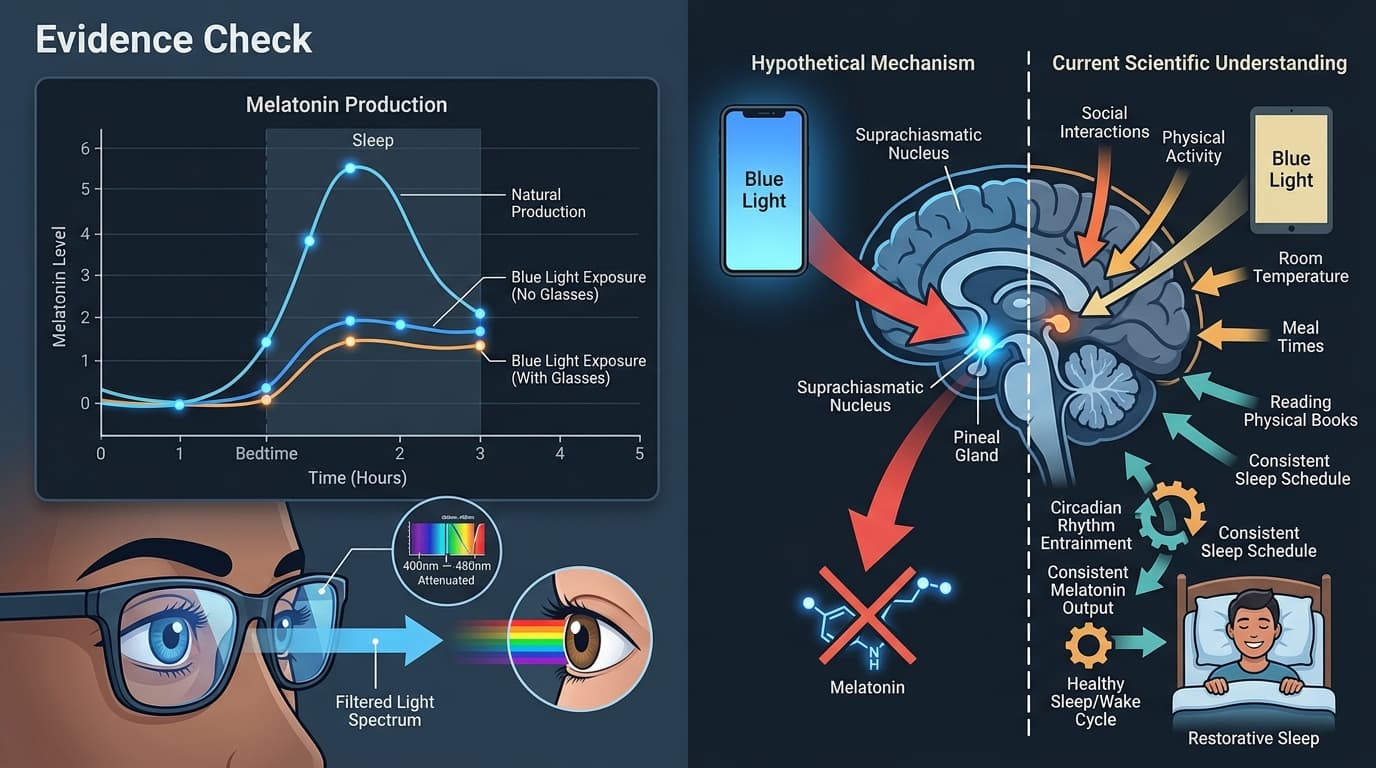

The Claim: Your Screen Is Stealing Your Sleep, and These Glasses Will Give It Back
The pitch has been everywhere for the better part of a decade. Blue light from your phone, laptop, and monitor is suppressing melatonin, wrecking your circadian rhythm, and leaving you staring at the ceiling at midnight. The solution, conveniently, is a $30–$300 pair of tinted lenses that filter out the offending wavelengths before they reach your eyes.
It's a tidy story. It has a villain (blue light), a mechanism (melatonin suppression), and a product. The wellness industry built an entire category around it. And it traces back to a real scientific finding — a 2014 study in which participants who read on an iPad before bed took longer to fall asleep, felt groggier the next morning, and produced less melatonin than those reading physical books. Researchers pointed at the screen's blue-enriched LED light as the culprit. The story spread. The glasses followed.
The Appeal: A Mechanism That Sounds Like Science
Part of what makes this claim so sticky is that it's almost right. Blue-wavelength light really does interact with circadian biology. The underlying photoreceptor science is legitimate. So when someone tells you that your phone is mimicking daylight and confusing your brain, it doesn't sound like pseudoscience — it sounds like a reasonable extrapolation from real research.
The glasses also offer something wellness culture loves: a passive intervention. You don't have to change your habits. You don't have to put the phone down. You just put on the glasses and keep scrolling, protected. That's an extremely appealing proposition, and it's worth being suspicious of it for exactly that reason.
The Evidence: Inconclusive at Best, Probably Null
Here's where the story gets uncomfortable for the blue-light glasses industry.
In 2023, the Cochrane Collaboration — the gold standard of evidence synthesis in medicine — published a systematic review examining whether blue-light filtering lenses reduce eye strain, improve sleep, and protect visual health. The researchers analyzed 17 randomized controlled trials. Their conclusion: these glasses probably make little to no difference.
On sleep specifically, the findings were uncertain — but that uncertainty cuts against the product, not in its favor. As the University of Melbourne research team that conducted the underlying systematic review noted, six studies examined sleep outcomes, and the results were inconclusive. "Possible effects on sleep were uncertain" is not a ringing endorsement for a product category built on the promise of better rest.
There's also a more fundamental problem with the premise. Recent analysis suggests the 2014 iPad study that launched the blue-light panic was, in the words of Stanford sleep researcher Jamie Zeitzer, "an incredibly deceptive piece of work." The amount of blue light emitted by phone and laptop screens is substantially lower than what comes from sunlight or even indoor LED lighting. Filtering a fraction of that already-modest output with lenses that typically reduce blue light transmission by only 10–25% may simply not move the needle on circadian biology in any meaningful way.
The pattern here is familiar: a real mechanism, extrapolated beyond what the evidence supports, packaged into a product, and amplified by wellness media before the replication studies could catch up.
What This Actually Means for You
A few honest takeaways, held with appropriate uncertainty:
The glasses are probably not hurting you. There's no strong evidence of harm — just weak evidence of benefit. If you already own a pair and feel better wearing them, that's not nothing; placebo effects on subjective comfort are real. But you shouldn't buy them expecting a sleep transformation.
The real issue is likely bigger than wavelength. The more compelling hypothesis — supported by the same researchers raising doubts about blue light — is that screen use before bed keeps your brain engaged, delays sleep onset through cognitive stimulation, and exposes you to the general brightness of modern indoor lighting, all of which matter more than the specific spectral composition of your phone screen. Dimming your overall light environment in the evening, not just filtering one wavelength, is where the evidence points.
If you want better sleep, the intervention is behavioral, not optical. Dimmer lights, earlier screen cutoffs, cooler room temperatures — these are the levers with actual support behind them. The glasses are a more comfortable solution precisely because they don't require you to change anything. That's also why they probably don't work.


