
Cortisol has become the wellness world's favorite villain. People talk about "cortisol face," "cortisol belly," and "high cortisol" the way earlier generations talked about bad karma — a vague, all-purpose explanation for feeling bad. Ashwagandha has ridden that wave into becoming one of the most widely sold adaptogens in the supplement aisle, showing up in capsules, gummies, teas, and "calm" drinks everywhere you look (healthyinfo.substack.com). So it's worth asking plainly: does it actually move the needle on stress hormones, or just on vibes?
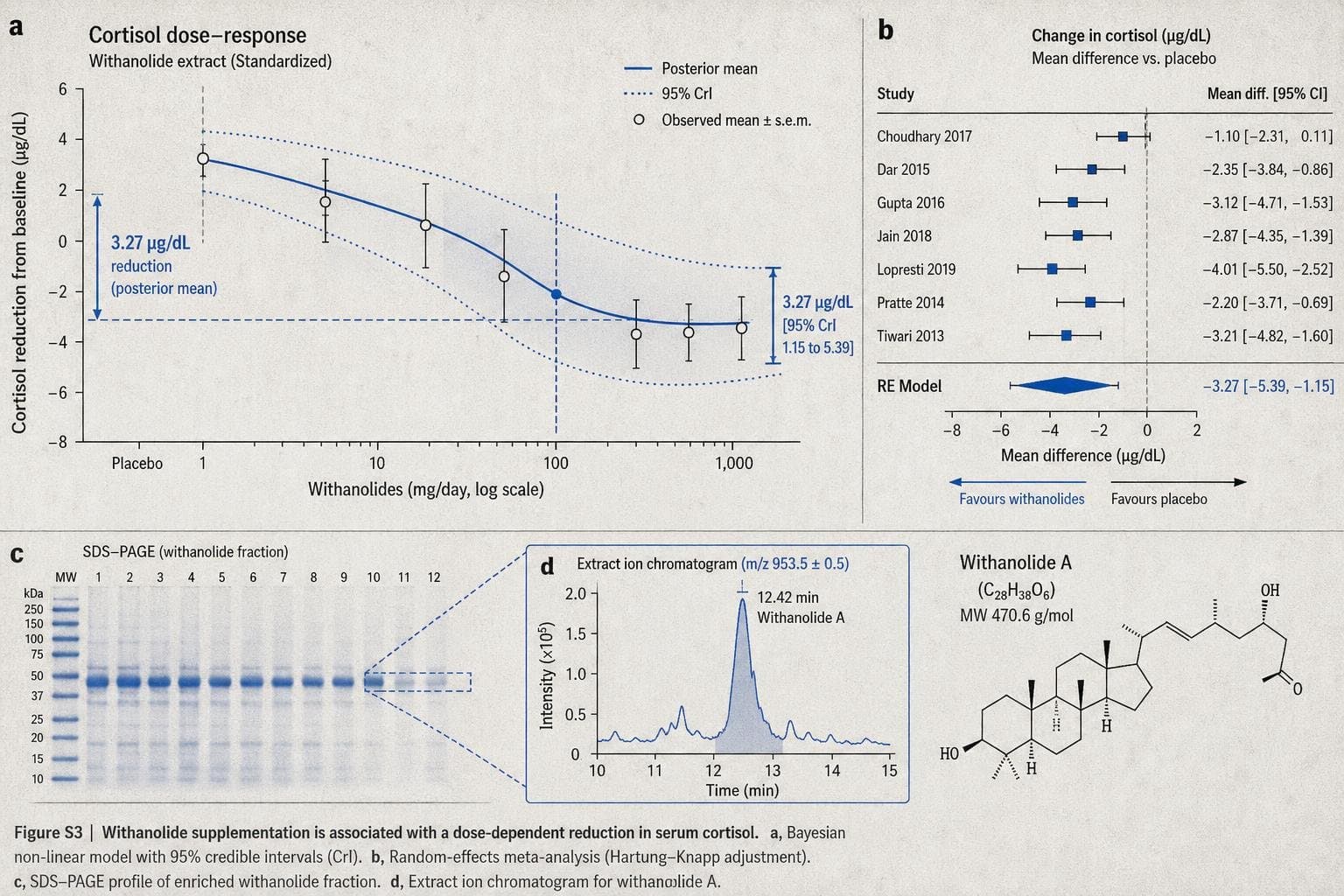
A systematic review published in October 2026 gives us the most current answer we have. Researchers pooled 14 ashwagandha trials — part of a larger review that also covered saffron — following PRISMA guidelines and a pre-registered protocol (PubMed). Across those trials, ashwagandha produced a pooled cortisol reduction of 3.27 µg/dL, alongside improvements on anxiety and stress scales, using doses ranging from 30 to 600 mg/day of withanolide-standardized extract (PubMed). That lines up with an earlier 2024 meta-analysis of 9 trials in 558 people that similarly found lower stress, anxiety, and cortisol with supplementation (drstanfield.com).
That's a real effect, not nothing. But the size of it matters less than the quality of the evidence behind it, and that's where the enthusiasm needs tempering.
The Evidence Is Real, But It's Not Strong
The review's own authors graded the certainty of their findings as moderate at best, and found low risk of bias in only 10 of the 31 trials they examined across both herbs — most of the rest raised at least some concerns (PubMed). That's a pattern I see constantly in supplement research: a genuine signal sitting on top of a shaky foundation of small trials, inconsistent dosing, and study designs that leave room for bias to creep in. One physician reviewing the broader ashwagandha literature put it bluntly: the anxiety evidence is inconsistent and the trials are small enough that he doesn't think it yet justifies adding another pill to your routine (drstanfield.com).
The dosing range itself is a tell. A 20-fold spread — from 30 mg to 600 mg daily — covers everything from a token dose to a substantial one, and the review doesn't give us a clean dose-response relationship within that range (PubMed). When a supplement works across wildly different doses, it often means the studies themselves are too heterogeneous to pin down what the "real" effective dose is, if one exists at all. A 2025 trial in 41 healthy non-athlete men, for instance, found that 600 mg a day added nothing to the fitness gains from eight weeks of HIIT training — a reminder that positive findings in one domain don't automatically generalize to another (drstanfield.com).
There's also a conspicuous gap: despite ashwagandha's reputation as a burnout cure, the review found zero randomized controlled trials testing it for burnout or PTSD specifically (PubMed). The mechanistic story — that it normalizes the hypothalamic-pituitary-adrenal axis and calms neuroinflammation — comes almost entirely from preclinical work, not human trials (PubMed). A plausible mechanism is not the same as a demonstrated clinical effect, and the gap between the two is exactly where supplement marketing likes to live — ashwagandha is currently being sold to treat everything from poor sleep to low testosterone to weak brain function, far outpacing what the trial evidence actually covers (healthyinfo.substack.com).
The Safety Signal Nobody's Putting on the Label
The part of this story that gets buried under stress-relief marketing is liver safety. The same review flags ashwagandha-associated hepatotoxicity as a real concern warranting liver enzyme monitoring during prolonged use (PubMed). That tracks with case reports of rare but serious liver injury, including acute liver failure, with one case series noting that all three deaths occurred in people who already had liver disease (drstanfield.com). The National Institutes of Health's Office of Dietary Supplements, in its health professional fact sheet on ashwagandha, catalogs it as a plant with a long history in Ayurvedic use that is now being studied — carefully — for modern clinical claims around stress, anxiety, and sleep (NIH). That fact sheet exists precisely because the evidence base is thin enough, and the safety questions serious enough, that health professionals need a sober reference point rather than relying on supplement packaging. Beyond the liver, there are known interaction risks with sedatives, thyroid hormone, immunosuppressants, and diabetes medications, plus a documented case report linking it to kidney transplant rejection (drstanfield.com).
None of this means ashwagandha is dangerous for most people at typical doses. But "mostly fine for most people" and "clinically proven cortisol reducer" are different claims, and the gap between them is where a lot of supplement marketing quietly operates.
What I'd Actually Tell Someone Asking
If a friend asked me whether ashwagandha would lower their cortisol, I'd say: probably a little, based on trials that are individually small and collectively inconsistent in quality, with a safety profile that includes a real if uncommon liver risk worth knowing about before you start. That's a far less exciting pitch than what's on the bottle, but it's the honest one.
The bigger pattern here is familiar from every adaptogen I've looked at: a plausible biological story, a handful of small positive trials, and a certainty rating that tops out at "moderate." That's not nothing — but it's also not the confident, settled science the marketing implies. Watch for whether anyone runs the larger, better-controlled trials the review's authors say are needed, particularly for the high-burden conditions — burnout among them — where no RCT evidence exists yet.


