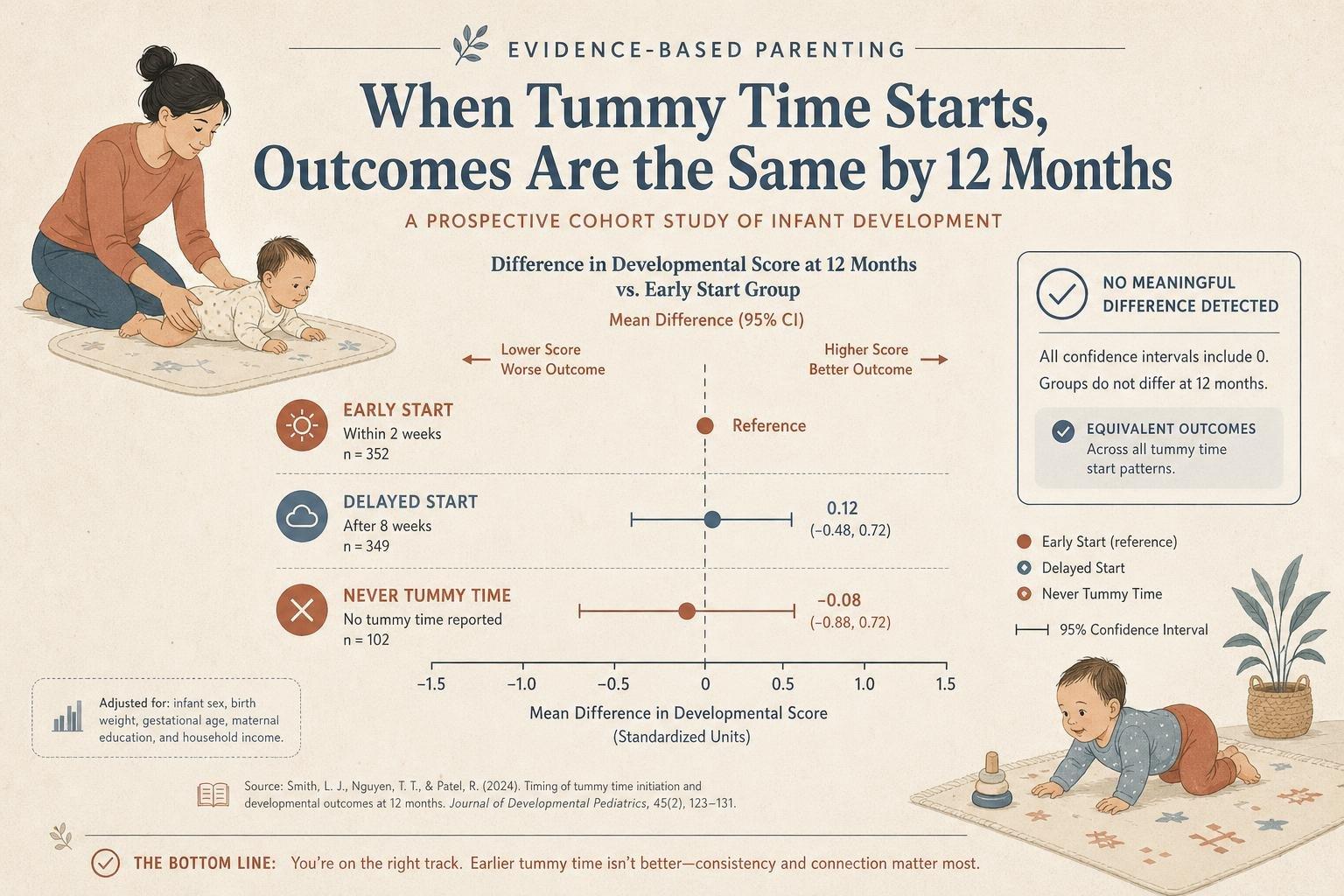

Somewhere in a hospital discharge folder, a new parent is reading that tummy time should start right away — maybe even in the first two weeks. The instinct to treat day one as a deadline is understandable. Early intervention logic runs deep in pediatric advice: earlier is better, missed windows don't reopen. A new pilot study suggests that instinct may not hold up for this particular milestone, at least not in the way parents have been told.
What the New Study Actually Tested
A team led by Anne Zachry at the University of Tennessee Health Sciences followed 58 infants from early infancy through their first birthday, sorting them by when caregivers reported introducing tummy time: within the first two postnatal weeks, after two weeks, or never intentionally introduced at all (bioengineer.org). Development was measured at 3, 6, 9, and 12 months using the Ages and Stages Questionnaire, a standard parent-completed screening tool covering communication, gross motor, fine motor, problem-solving, and personal-social skills (PubMed).
This is a small study, and the researchers are upfront about it. Complete five-domain data existed for only 32 infants at the earlier timepoints and 30 at 12 months, and the three timing groups were uneven — 22, 21, and 15 infants respectively (PubMed). That's not a sample size that should settle anything on its own. But the statistical handling here is worth noticing, because it's the part most coverage of pilot studies skips: the team ran Kruskal-Wallis tests across three groups and five developmental domains at four ages — twenty comparisons — and then applied a correction to account for the fact that running that many comparisons will produce some false positives by chance alone (bioengineer.org).
Before correction, three comparisons showed p-values under .05. After correction, none survived. The largest effect, for communication at 9 months, had a wide enough confidence interval that the researchers themselves call it inconclusive (PubMed). In plain terms: if you throw a question at the data twenty different ways, you'll usually find something that looks interesting. The honest move is to check whether it survives once you account for how many chances you gave it to look interesting. Here, nothing did.
Where the Timing Advice Actually Comes From
This matters because "start early" has quietly become part of the tummy-time script, even though the American Academy of Pediatrics' own guidance is built around a different variable: total daily minutes, not start date. The AAP's 2022 safe sleep policy sets a target of 15 to 30 minutes of supervised tummy time per day by around seven weeks of age, accumulated across short sessions rather than done all at once (Idaho DMI).
The studies behind that target are themselves a useful lesson in reading evidence carefully. A US study of 66 two-month-olds found that at least 15 minutes of daily tummy time was linked to earlier head-lifting and steadier sitting at two months — but not to earlier gross motor milestones at four or six months. A separate Taiwanese study of 288 infants found that more than 30 minutes a day, as reported by parents, was associated with earlier acquisition of some gross motor milestones. A third study, of 380 infants in the Netherlands, focused specifically on tummy time's relationship to flat spots on the head rather than motor skills at all (Idaho DMI). The flat-spot concern isn't incidental — positional skull flattening is a recognized pediatric issue distinct from the more severe, structural condition where skull sutures fuse too early, which the CDC tracks separately as a birth defect requiring medical evaluation (CDC). None of the three AAP-cited studies, notably, tested when tummy time should begin — they tested how much, and found modest, domain-specific, not-always-durable effects.
The Dose Question Is Still Open, Which Is Different From Settled
Put the new pilot data next to that older evidence base and a pattern emerges: the research has always been thinner on timing than the advice implies, and now there's a study, however small, pointing toward no detectable difference by start date at all. That's not the same as saying tummy time doesn't matter. The broader rationale for prone play — strengthening neck, trunk, and arm muscles, giving infants practice with antigravity control — rests on a wider body of observational work, including a systematic review spanning 16 studies and over 4,000 infants across eight countries that associated more cumulative tummy time with better gross motor outcomes (bioengineer.org). Prone positioning as a concept has traction well beyond healthy-infant motor development, too — clinicians studying NICU discharge protocols in India describe it as a cost-effective, evidence-based developmental care practice they're trying to integrate into routine follow-up (Wiley), and the term shows up in entirely different pediatric contexts, like trials testing prone positioning's effect on ventilation outcomes in critically ill infants and children (JAMA Network) — a reminder that "put the baby on their stomach" means different things in different clinical settings and shouldn't be read across contexts.
What the new pilot study does is narrow the anxiety around one specific question. If your baby's first tummy-time session happens at ten days instead of three, the evidence does not currently suggest that gap will show up on a developmental screen a year later. The researchers themselves call for larger prospective studies that track timing alongside cumulative exposure before anyone draws firmer conclusions (PubMed). Until then, the more defensible thing to track isn't the calendar date you started — it's whether you're getting anywhere close to those daily minutes, spread across the day, however late you got going.


