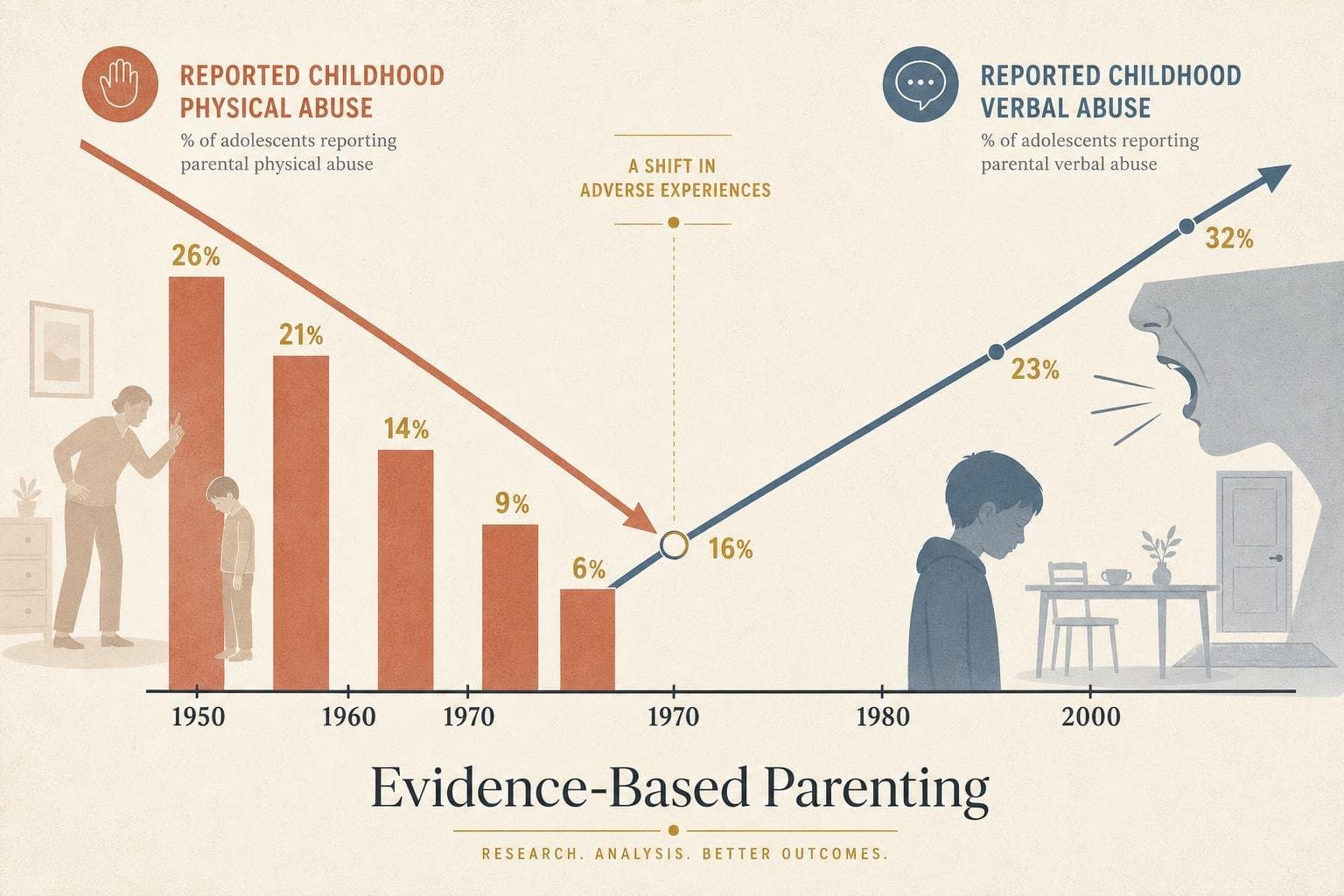

Three times in the past year I've written about physical punishment and the evidence against it. Each time, I've gotten some version of the same pushback: "But what about culture? What about frequency? What about the difference between a swat and abuse?" These are fair questions. And a pair of recent studies give us better answers than we've had before — answers that complicate the headline without softening the conclusion.
The Core Finding Hasn't Moved
Start with what the research collectively says, because it's not actually contested anymore. Systematic reviews spanning decades and more than 150,000 children consistently find associations between spanking and worse outcomes: higher aggression, more antisocial behavior, and elevated rates of mental health problems in adulthood. The same body of work finds no evidence of positive long-term effects. The World Health Organization has stated that physical punishment carries measurable health risks; the research consensus behind that position is not thin.
What's newer — and more useful for parents who want to think carefully rather than just comply with a headline — is the granular work on how these harms accumulate, and whether they look the same across different families and cultures.
Verbal Abuse Tracks Alongside Physical Punishment — and Is Rising
A 2025 secondary analysis published in BMJ Open by Bellis and colleagues examined data from seven cross-sectional surveys covering more than 20,000 adults in England and Wales. The design is worth understanding: researchers used an Adverse Childhood Experiences framework to capture self-reported childhood physical and verbal abuse, then measured adult mental well-being using the Warwick-Edinburgh Mental Wellbeing Scale.
The findings are striking on two fronts. First, physical and verbal abuse produced similar independent associations with low adult mental well-being — adjusted odds ratios of 1.52 for physical abuse alone and 1.64 for verbal abuse alone, with exposure to both compounding the effect to 2.15. Second, the trend data showed something counterintuitive: reported rates of childhood physical abuse have dropped substantially over recent decades — from around 20% in those born between 1950 and 1979 to roughly 10% in those born after 2000. But verbal abuse moved in the opposite direction, rising from about 12% in those born before 1950 to nearly 20% in those born after 2000.
This matters for how we think about discipline reform. Parents who have moved away from spanking haven't necessarily moved toward lower-harm alternatives. Shouting, humiliating, and threatening — the verbal tools that often fill the gap — carry their own measurable costs.
The "Culture Moderates Everything" Claim Is Partially Right
The most common sophisticated objection to the spanking literature is that effects are culturally contingent — that physical discipline carries different meaning and therefore different consequences in different communities. This argument has some empirical support, and a study published in Child Psychiatry & Human Development in August 2026 is the most recent attempt to test it rigorously.
The study examined parental disciplinary approaches — specifically inductive techniques versus power assertion — across 865 caregivers in 14 countries, with children averaging around 27 months old. Using multilevel modeling to separate within-culture from between-culture variance, the researchers found that shouting, hitting, and taking away privileges all predicted total behavior problems and internalizing problems across the sample. Externalizing problems were predicted by shouting and privilege removal. So far, that's consistent with the broader literature.
The culture-specific piece: random slope effects were significant for parental hitting and privilege removal in predicting internalizing problems — meaning the strength of the association varied across cultural contexts, even if the direction didn't. The authors conclude that the evidence supports "more universal and some culture-specific prediction." In plain terms: hitting predicts worse outcomes everywhere in this sample, but how much worse varies by context.
That's a meaningful nuance. It doesn't mean physical punishment is harmless in some cultures. It means the magnitude of harm isn't identical across settings — which is actually what you'd expect from any complex developmental outcome shaped by multiple factors simultaneously.
What Parents Should Actually Take From This
The CDC's framework on adverse childhood experiences emphasizes that ACEs rarely operate through a single pathway — risk accumulates across individual, family, and community factors. That framing is useful here. The research on spanking isn't telling you that a single incident determines your child's trajectory. It's telling you that coercive discipline — physical and verbal — is a consistent predictor of worse outcomes across large populations, and that the alternatives matter.
The Bellis data in particular should shift where parents focus their attention. If you've already stopped spanking but replaced it with yelling, the evidence suggests you haven't fully solved the problem. The JAMA Pediatrics piece on relational health makes a related point: translating ACE research into clinical practice means building toward positive relational experiences, not just eliminating the most visible harms.
The research has settled on the direction. The work now is understanding the mechanisms well enough to actually change course — and recognizing that "I stopped hitting" is a floor, not a ceiling.


