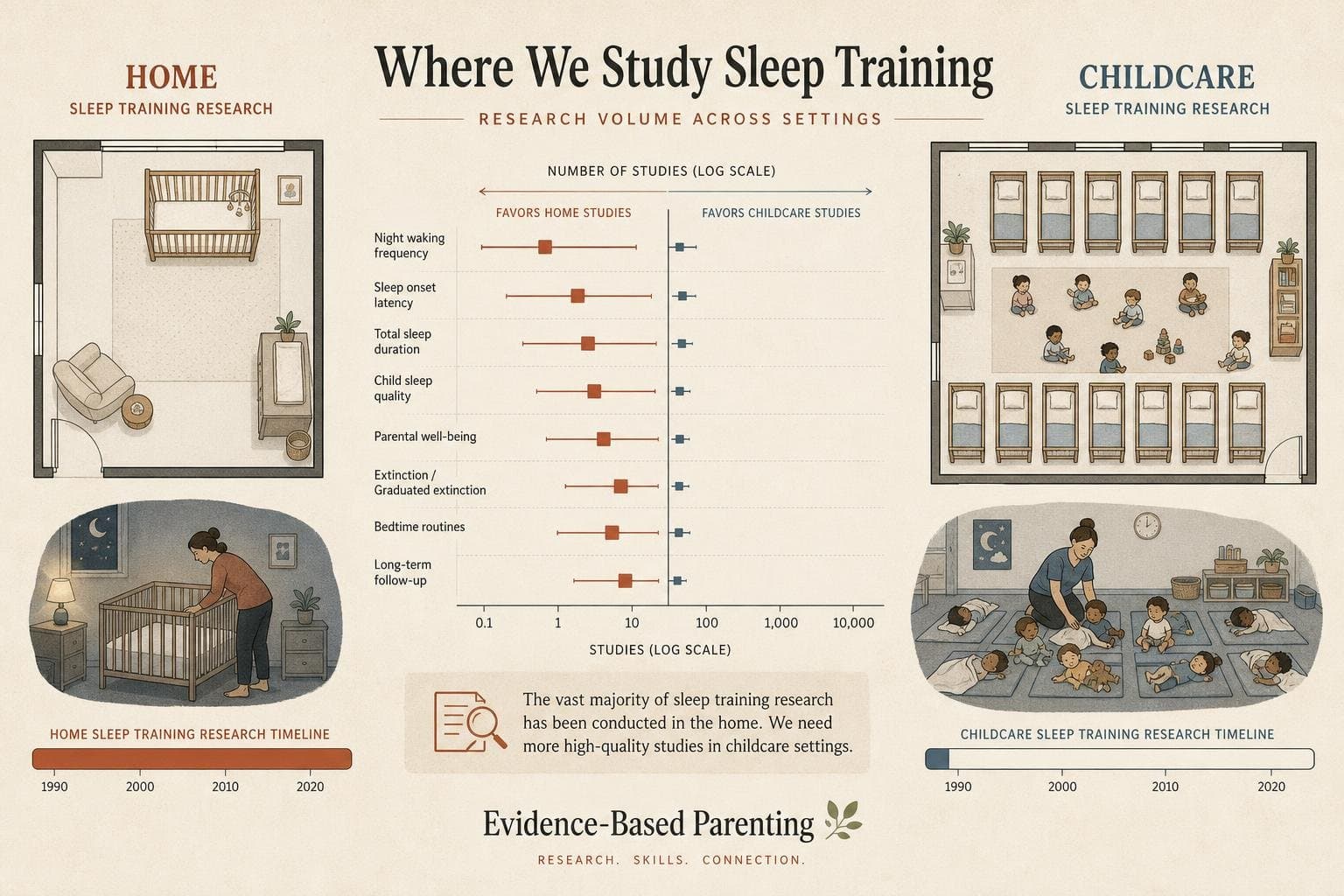

Every argument about cry-it-out — whether it harms attachment, whether it works, whether the cortisol data is damning or overread — takes place in the same imagined setting: a nursery, two parents, one baby, one night. The research largely assumes this too. Which is part of why a systematic review published in Frontiers in Sleep this month landed with a quiet thud: when researchers looked at what we actually know about sleep promotion in childcare settings, they found almost nothing.
That gap is worth sitting with.
The Evidence Base Is Thinner Than Anyone Admits
The Frontiers in Sleep review, conducted by Belinda O'Hagan at Brown University's School of Public Health, searched PubMed, PsycINFO, and CINAHL — a thorough sweep — and turned up 3,528 unique articles. After applying eligibility criteria (children under five, at least one quantitative sleep outcome, at least one sleep promotion strategy), six studies met the bar.
Six.
The strategies those six studies examined were: mandatory naptime (four studies), music (one study), and massage therapy (one study). The findings were modest. Mandatory naptime was associated with more napping — which is roughly what you'd expect when you require children to lie down. One study found mandatory naptime was also associated with reduced nighttime sleep and lower total daily sleep duration, which is the kind of tradeoff that gets lost when we treat "nap policy" as straightforwardly good. Music and massage reduced how long it took children to fall asleep for naps, but the review doesn't tell us whether those effects persisted, generalized, or mattered for nighttime sleep at home.
What's absent is everything the home-based sleep training literature has spent decades arguing about: graduated extinction, bedtime fading, parental presence protocols, the role of consistent response. None of it has been studied in childcare contexts with enough rigor to make the eligibility cut.
Why This Matters More Than It Sounds
The review flags something that deserves more attention than it usually gets: children from historically disadvantaged backgrounds often depend on naps at childcare to meet their total daily sleep needs. The sleep training conversation, as it's typically conducted, is a conversation about parents who have the time, stability, and private space to implement a consistent behavioral protocol over several nights. That describes a specific slice of families.
For children in full-time childcare — which describes a substantial portion of children under five — the adults making decisions about sleep environment, nap timing, and soothing responses during the day aren't the parents. They're providers operating under institutional constraints, staff ratios, and licensing rules that have nothing to do with what the attachment literature recommends. The question of whether a caregiver should respond immediately or wait isn't a parenting philosophy choice in that context; it's a staffing and policy question.
This doesn't invalidate the home-based research. But it does mean the evidence base has a significant blind spot about where a lot of infant and toddler sleep actually happens.
What We Can Reasonably Conclude
The home-based literature — which I've covered in prior issues on cry-it-out and attachment and sleep training measurement problems — has its own limitations: small samples, high attrition, outcome measures that don't always track what parents actually care about. But it has something. The childcare literature, by this review's accounting, has almost nothing beyond naptime mandates.
Sleep problems and crying are among the most common difficulties parents report in the first year, and between 25 and 50 percent of babies over six months wake during the night — a range wide enough to remind you how much individual variation exists even in the home context. Translate that to a room of twelve toddlers at a childcare center and the complexity multiplies fast.
Meanwhile, the behavioral sleep intervention literature for home settings has been growing. A parent-facing online program targeting behavioral sleep problems in preschoolers found that parents valued strategies most when they addressed their child's specific problem — a finding that sounds obvious but actually cuts against the one-size-fits-all framing that dominates most sleep training advice. And a systematic review of nonpharmacological sleep interventions found that earlier bedtimes were among the most effective tools for increasing total sleep duration in healthy children — a finding that applies in both home and childcare contexts, and yet barely registers in the cry-it-out debate.
The practical takeaway for parents isn't that childcare sleep is a crisis. It's that when you're evaluating sleep advice — whether it's a pediatrician's recommendation, a sleep consultant's protocol, or a study your partner texted you at 2 a.m. — it's worth asking: who was studied, and where? The evidence that exists is mostly about home environments, mostly about families with enough stability to run a consistent protocol, and mostly silent about what happens during the eight to ten hours a day many children spend somewhere else entirely.
That silence is the finding.


