


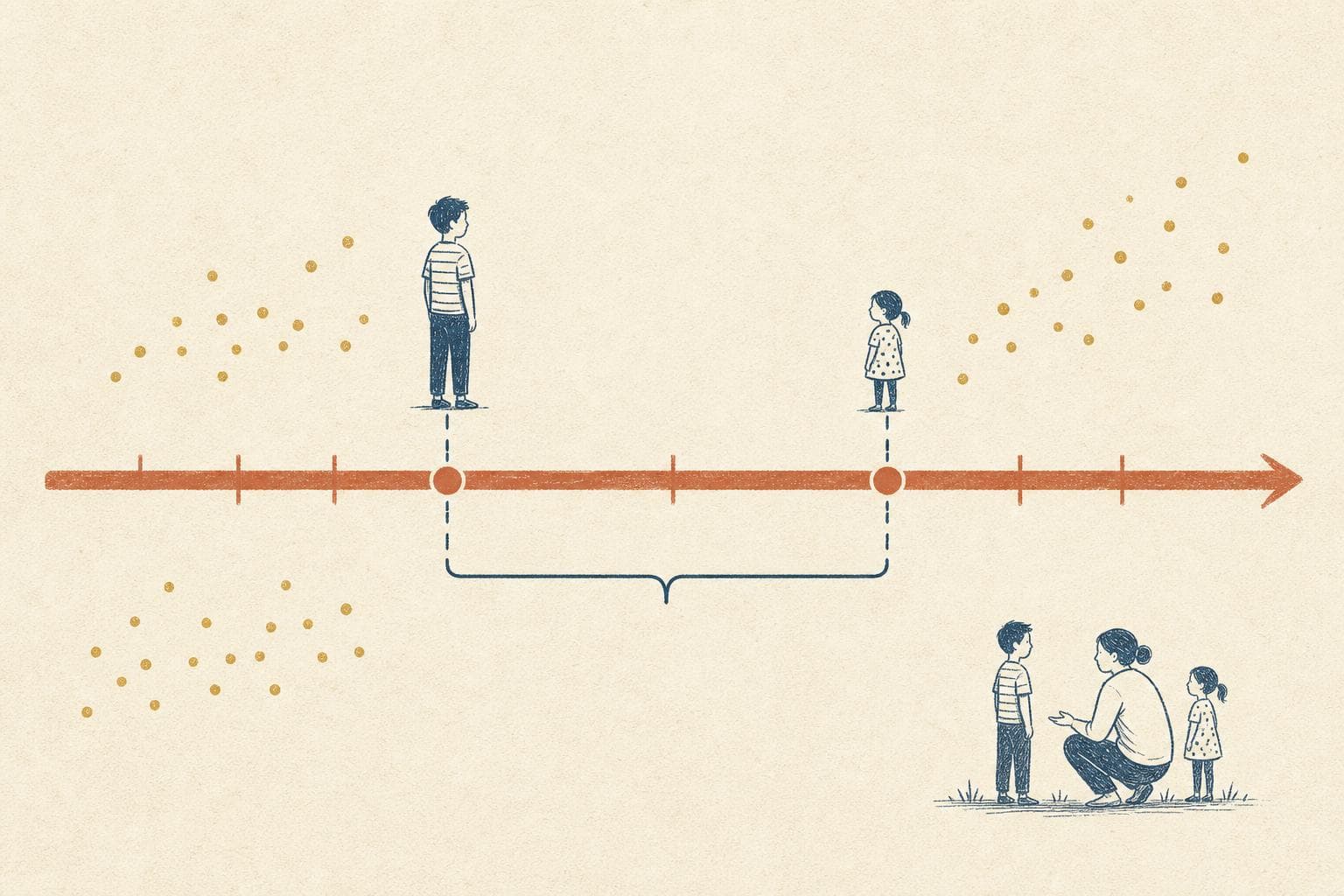

Here's the conversation that happens in roughly every pediatrician's waiting room, every family holiday, every parenting group chat: How far apart should we space our kids? Two years? Three? Close together so they'll be friends? Far apart so you can give each one more attention? The advice is everywhere and it contradicts itself completely.
The honest answer from the research: spacing matters, but probably not in the ways the advice columns suggest — and the effects are smaller and more conditional than anyone wants to admit.
What the Research Actually Measures (and What It Doesn't)
Most sibling spacing research doesn't study spacing in isolation. It studies birth order, family size, and resource allocation together — which makes it genuinely hard to untangle what's doing the work.
The birth order literature is the most robust piece of this puzzle. Research consistently shows firstborn advantages in academic outcomes and earnings, and the leading explanation isn't spacing per se — it's that firstborns receive undivided parental attention before a sibling arrives, and then often take on a teaching role that reinforces their own learning. The "teaching effect" is real: explaining things to a younger sibling consolidates knowledge in ways that benefit the older child.
But here's what that finding doesn't tell you: whether a two-year gap versus a four-year gap changes those outcomes in any meaningful way. The research establishes that having a sibling changes the firstborn's experience. It doesn't establish that the precise timing of that sibling's arrival is the lever parents should be optimizing.
Each Child Is Growing Up in a Different Family
The more useful frame — and the one that holds up across different study designs — is that siblings in the same household are not having the same childhood. Birth order shapes not just academic outcomes but the hidden roles children adopt within the family system: the responsible one, the funny one, the helper. These roles form early, they're reinforced by how parents and siblings respond, and they follow children into adult relationships and workplaces.
This is worth sitting with. The question isn't just "how does spacing affect development?" It's "how does each child's position in the family shape who they become?" And that question has less to do with the number of months between births than with how parents consciously manage the roles and comparisons that emerge.
The comparison trap is particularly well-documented. Siblings compare themselves to each other constantly — it's developmentally normal and probably inevitable. What varies is whether parents amplify that comparison or interrupt it. A three-year gap doesn't protect a younger child from feeling measured against an older sibling's achievements. Parental awareness does.
Where Spacing Does Show Up in the Evidence
There are two areas where spacing has clearer, more direct effects — and neither is about cognitive development.
The first is maternal and infant health. Interpregnancy intervals shorter than 18 months are associated with elevated risks for preterm birth and low birth weight. This is a medical consideration, not a parenting philosophy one, and it's worth discussing with an OB rather than a parenting podcast.
The second is the tandem nursing context. A 2026 study in Scientific Reports examined the psychological dimensions of tandem breastfeeding — nursing two children of different ages simultaneously — and found it raises distinct questions about attachment and socio-emotional development that researchers are only beginning to map. The study used qualitative interviews with tandem-nursing mothers, which means it's hypothesis-generating rather than conclusive. But it's a reminder that close spacing creates specific caregiving situations that haven't been studied as thoroughly as we might assume.
The Practical Takeaway
If you're trying to optimize sibling spacing for developmental outcomes, the research doesn't give you a clean target. What it gives you instead is a set of dynamics to watch for regardless of when your children were born.
Firstborns benefit from the teaching role — but only if it doesn't collapse into parentification. Younger siblings find their niche by differentiating from older ones — which is adaptive, but can calcify into roles that don't fit them as they grow. Every child in a family is navigating a different set of parental expectations, resources, and sibling relationships, and those differences matter more than the calendar distance between birth dates.
The more useful question isn't "did we space them right?" It's "do I know which family role each of my kids has quietly adopted, and is that role serving them?" That's a question you can actually do something about — at any spacing.