
The conventional screen time conversation focuses on one number: how many hours per day is your child watching. The AAP has a limit. Your pediatrician has a limit. The laminated poster in the waiting room has a limit. And for years, the research has been frustratingly vague about whether that number actually predicts anything meaningful for language and cognitive development.
Two studies published in 2026 have sharpened the picture considerably. The finding that should get your attention isn't about your toddler's tablet. It's about your phone.
The Norwegian Cohort Study Changes the Frame
A prospective cohort study published in JAMA Pediatrics followed 747 Norwegian children from ages 5 to 7, tracking screen use on both sides of the parent-child relationship — children's device ownership and daily screen time, plus maternal and paternal social media use and primary parent smartphone screen time. The outcome measures were receptive vocabulary and grammar development across three annual waves.
The child-side findings went roughly as expected: children who owned a digital device at ages 4 to 5 scored lower on baseline receptive vocabulary and grammar than children who didn't. More device time, lower scores. The direction of association was consistent.
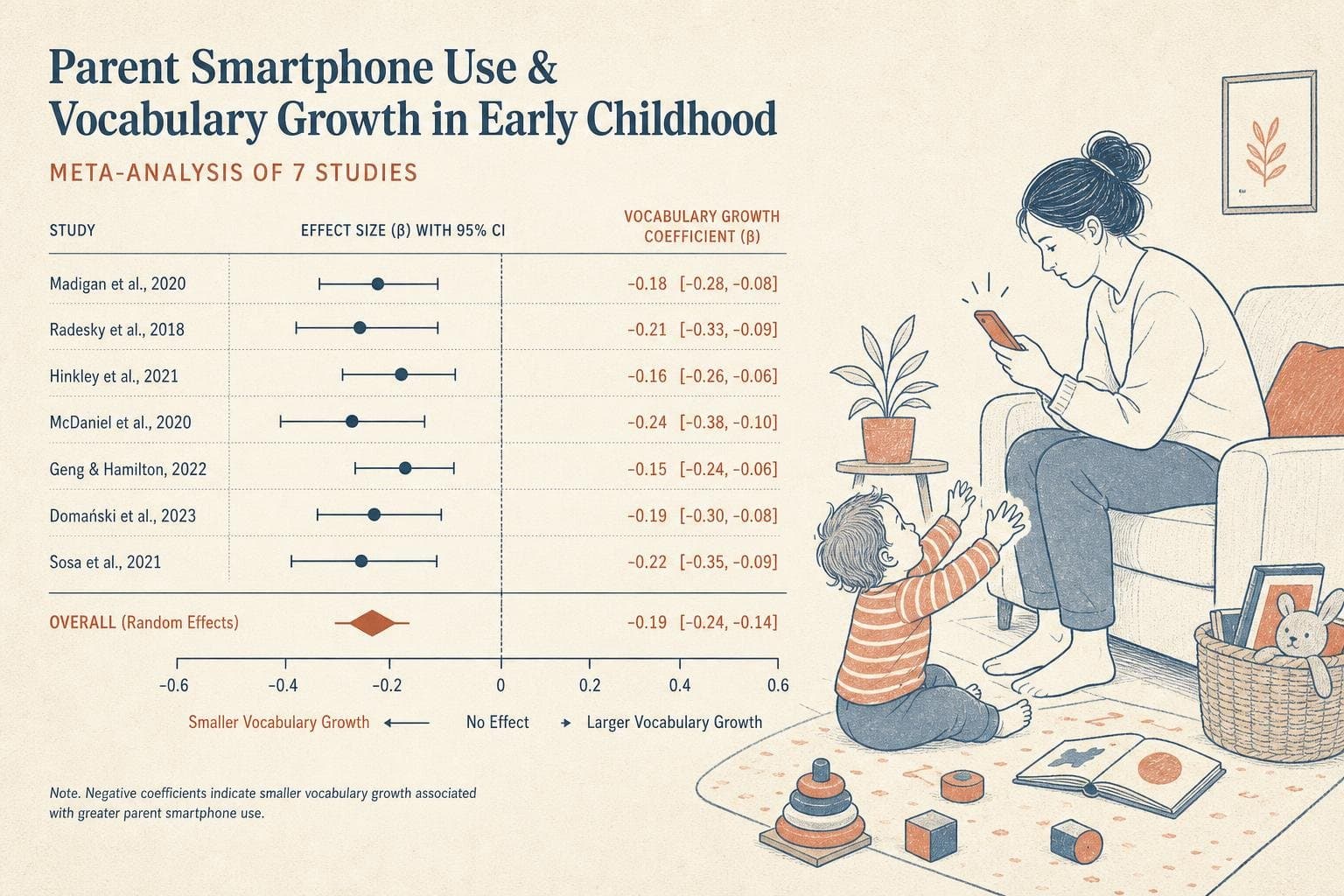
But the parental finding is what makes this study worth examining closely. Each additional hour per day of the primary parent's smartphone use was associated with slower receptive vocabulary growth in the child — specifically, 0.42 fewer points of annual vocabulary growth per additional hour of parent smartphone use, according to the study's reported findings. The mechanism the researchers point to is straightforward: parent phone use interrupts the back-and-forth exchanges that drive early language acquisition. A child reaches for connection, gets no response, and eventually stops reaching. The contingent conversation that builds vocabulary — "look at that," "what's that called," "you did it!" — simply doesn't happen when a parent is mid-scroll.
This is an observational study, so the association doesn't establish causation. The researchers can't rule out that families with more screen use differ in other ways that also predict language outcomes. But the direction of the finding is consistent with what we already know about how language develops: it requires responsive interaction, not passive exposure.
The Parental Technology Meta-Analysis Adds Weight
A systematic review and meta-analysis published in JAMA Pediatrics from University of Wollongong researchers examined 21 studies across 10 countries, involving nearly 15,000 children under five. The focus was parental technology use in a child's presence — not co-viewing, not educational content, but a parent using a device while the child is nearby and not engaged with the same screen.
The associations found were generally small in magnitude but consistent across cognitive and behavioral outcomes. Parental device use in a child's presence was associated with poorer cognition and social behavior, and with increased screen time among the children themselves. The researchers were careful not to overstate the effect sizes, and the study's lead researcher explicitly framed the findings as a call for awareness rather than parental guilt.
What the meta-analysis adds is breadth: the Norwegian cohort study is one population, one country, one age range. Twenty-one studies across ten countries, converging on similar directional findings, is harder to dismiss as a sampling artifact.
What This Means for How You Think About the Limit
The standard screen time guidance — no screens before 18-24 months, limited and co-viewed content for toddlers, one hour per day for ages 2-5 — focuses almost entirely on the child's consumption. That framing made sense when the research was primarily about what children were watching. These newer studies suggest the more important variable for language development may be what's happening in the relational space around screens, not just the screen time tally itself.
A child who watches an hour of age-appropriate content while a parent is present and engaged is in a different developmental environment than a child who watches the same hour while a parent is absorbed in their phone across the room. The hour count is identical. The language-learning opportunity is not.
The JAMA Network Open secondary analysis of a large Scottish birth cohort, published in August 2026, examined screen use and emotional, behavioral, and social development — a related but distinct set of outcomes. The pattern of findings continues to point toward screen use as a marker of disrupted interaction rather than a direct toxic exposure.
None of this means the daily limit is meaningless. It means the limit is probably measuring something real — the degree to which screens are displacing interaction — rather than being harmful in itself. The mechanism matters for how you intervene.
If you're going to track one number, the research increasingly suggests it should be your own pickup count, not your child's viewing minutes. That's a harder thing to put on a waiting room poster. It's also, at this point, what the evidence actually supports.


