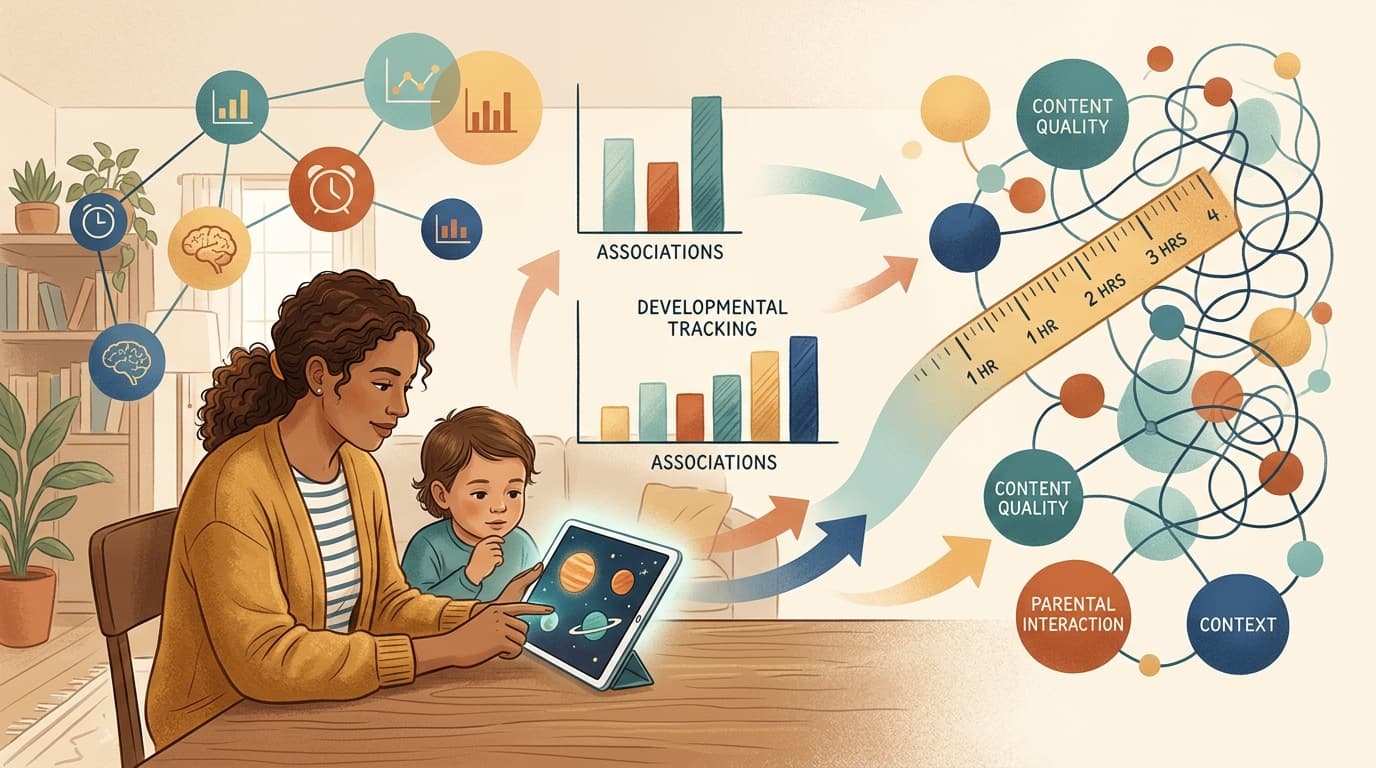

The American Academy of Pediatrics says no screens before 18 months (video chat excepted), limited high-quality programming from 18 to 24 months, and one hour per day for ages 2 to 5. Those numbers feel authoritative. They get printed on pediatrician handouts, cited in parenting books, repeated at well-child visits.
Here's what the research actually supports: an association between heavy screen time and some developmental outcomes in young children — with enough methodological caveats that "one hour per day" is more policy heuristic than scientific precision. That distinction matters, because parents who go slightly over the limit don't need to panic, and parents who stay under it shouldn't assume they've handled the whole question.
Let's walk through what the studies actually show.
The Association Is Real, But "Predicts" Is Doing Heavy Lifting
The most-cited finding in this space comes from a study published in JAMA Pediatrics that tracked children at ages 2, 3, and 5. Higher screen time at age 2 was associated with poorer developmental outcomes at age 3; higher screen time at age 3 was associated with poorer outcomes at age 5. The researchers framed this as screen time "predicting" delays.
That framing is worth interrogating. Longitudinal association is not the same as causation, and the word "predicts" in observational research means something narrower than it sounds in a headline. What the study found is a correlation across time — which is more meaningful than a single cross-sectional snapshot, but still leaves open the question of what's driving what.
Children who watch more screens may do so because caregivers are under more stress, have fewer resources for enrichment activities, or are managing circumstances that independently affect development. The screen time itself may be a marker for those conditions rather than the mechanism. Most observational studies in this area struggle to fully disentangle these threads, even with controls.
The Vocabulary Finding Is More Specific — and More Useful
A more recent study, published in October 2025 and covered by the Detroit News, followed families over time and found that children who spent more time with digital media at age 2 tended to have smaller vocabularies at age 3. Notably, this association held regardless of the child's temperament or the caregiver's personality traits — two variables that often confound this kind of research.
That's a meaningful finding. It doesn't prove screens cause vocabulary delays, but it does suggest the association isn't simply an artifact of anxious parents or difficult children. The mechanism that makes most theoretical sense: screen time displaces conversation. Language acquisition in toddlers is heavily dependent on back-and-forth verbal exchange — what researchers call "serve and return" interaction. A screen doesn't serve and return. It talks at children, not with them.
This is probably the strongest evidence-based argument for limiting passive screen consumption in the 18-month to 3-year window. Not because screens are toxic, but because that developmental period is when conversational input matters most, and screens are a particularly effective displacement activity.
The Parent Screen Time Variable Gets Underweighted
One finding that rarely makes the parenting-advice headlines: research from the University of Wollongong highlights that around seven in ten parents use their phones during play or mealtimes, and nearly nine in ten report checking their phone at least once in front of their children daily.
The developmental concern here isn't about children watching screens — it's about children losing access to a present, responsive caregiver. The same serve-and-return logic applies. If a toddler reaches for a parent's attention during play and gets a distracted half-response because the parent is scrolling, that's a missed interaction. Multiply that across hundreds of daily moments and the cumulative effect on language and social development is plausible, even if the research is still catching up to the specific mechanisms.
I'd argue this variable is more actionable for most families than the child screen time limits. A parent who puts their phone away during the 45-minute post-dinner play window is probably doing more developmental good than one who enforces a strict 60-minute daily cap while remaining half-present throughout.
Older Kids: The Evidence Shifts
The picture changes meaningfully for school-age children. A review of 35 studies published between 2020 and 2025, examining children roughly ages 8 to 10, focused on the relationship between unstructured free play, digital play, and development. The concern at this age isn't primarily vocabulary acquisition — it's the displacement of unstructured physical and social play, which serves different developmental functions: executive function, emotional regulation, peer negotiation skills.
The research on older children is less about screen time as a direct harm and more about what it crowds out. An 8-year-old who spends three hours on a tablet instead of playing outside or with neighborhood kids isn't necessarily being damaged by the screen — they're missing the developmental inputs that come from unstructured, child-directed play. That's a different framing than "screens are bad," and it leads to different practical conclusions.
What the Evidence Actually Supports
Here's the honest summary: the research most consistently supports limiting passive, solo screen consumption for children under 3, with the strongest rationale being displacement of conversational interaction rather than any direct harm from screens themselves. For older children, the more useful question is what screen time is replacing, not how many minutes it totals.
The one-hour guideline isn't wrong, exactly — it's a reasonable policy anchor given the available evidence. But treating it as a precise threshold backed by dose-response data overstates what the research shows. A toddler who watches 75 minutes of Bluey while a parent cooks dinner is in a meaningfully different situation than one who watches 75 minutes of autoplay YouTube while a caregiver is disengaged in the same room.
The variable that deserves more attention in your own household audit: how present are you when you're present? That question has better research support than the minute count, and it's harder to game with a screen time app.


