


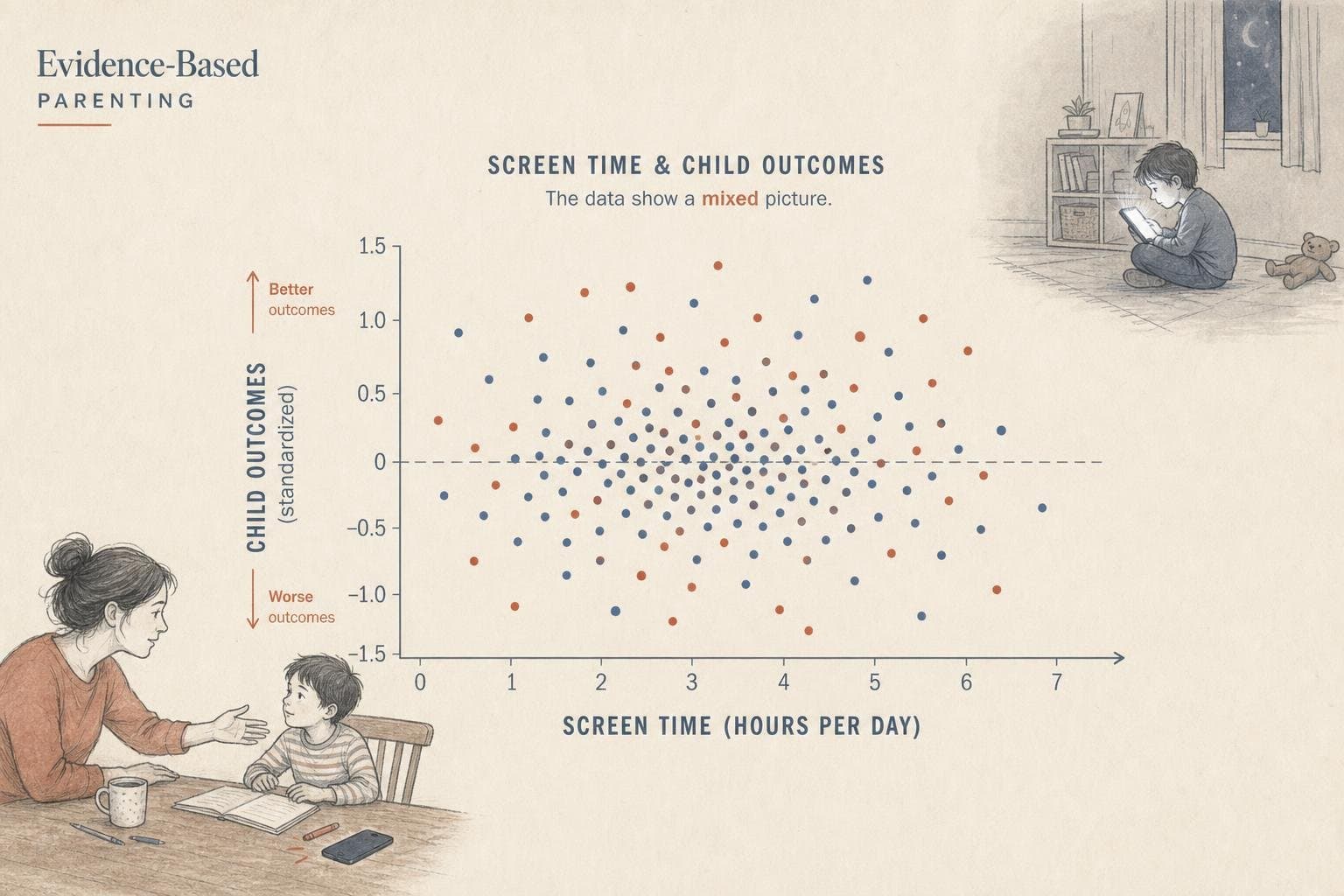

Every few months I revisit this topic, and every time the research has moved somewhere I didn't expect. Last July I wrote about how when children use screens matters more than daily totals. Last June, about how the guidelines don't map cleanly onto the evidence behind them. Now two new reviews are pushing the conversation further — and in the same direction. The number on the clock may be the least useful thing you're measuring.
"How Much" Is the Wrong Question
A narrative review published in July 2026 in Clinical Child and Family Psychology Review synthesized findings from 52 systematic reviews and meta-analyses on youth digital media use. The headline finding is worth sitting with: problematic media use is consistently linked to adverse outcomes across cognitive, emotional, social, and physical domains. General digital media use — the kind measured by daily hour counts — shows mixed effects, shaped by content, context, individual traits, and why the child is using the screen in the first place.
That's a meaningful distinction. The research isn't saying screens are fine. It's saying that the variable "hours per day" is too blunt to predict much. A child watching an hour of interactive educational content with a parent present is doing something categorically different from a child using screens to self-regulate distress for an hour alone. Both register identically on a time log.
The review calls for moving beyond "simplistic screen time metrics toward dynamic, person-centered models" — identifying which children are at risk, through what mechanisms, and under what conditions. That's harder to operationalize than a daily limit, which is probably why the guidelines haven't caught up yet.
The Parent's Phone Is Also a Variable
The second piece of new research shifts the frame further. A systematic review and meta-analysis published in JAMA Pediatrics, led by University of Wollongong researcher Marcelo Toledo-Vargas, examined 21 studies across 10 countries involving nearly 15,000 children under five. The focus: not the child's screen use, but the parent's.
When parents used devices in their child's presence — not watching together, just present and on their phone — researchers found associations with poorer cognitive development, worse social behaviour outcomes, and higher child screen time. Effect sizes were generally small, but consistent across studies and across countries.
The mechanism Toledo-Vargas points to is interaction disruption. Young children are acquiring language and social skills through the back-and-forth of adult engagement. When a device interrupts that flow — even briefly, even repeatedly — it chips away at the quality of those interactions. The child isn't watching a screen. The parent is. But the developmental signal still degrades.
This matters for how we think about the guidelines. Most screen time recommendations are addressed to parents about their children. This research suggests parents' own device habits belong in that conversation too.
What This Means in Practice
Neither of these reviews offers a clean replacement rule. That's the honest answer, and I think parents deserve to hear it plainly rather than have it papered over with a new number.
What the evidence does support:
Content and context matter more than duration. Co-viewing, interactive content, and screens used for connection behave differently than passive solo consumption. Tracking hours without tracking those variables tells you less than you think.
Problematic use has a different profile than heavy use. The Clinical Child and Family Psychology Review synthesis is explicit: it's the compulsive, distress-driven, or displacement pattern that predicts bad outcomes — not the total. If your child can put it down, that's informative.
Your own phone is part of the equation. The JAMA Pediatrics meta-analysis found consistent associations between parental device use during child-present time and worse developmental outcomes. Toledo-Vargas is careful not to frame this as guilt — the goal is awareness of which moments of connection are being interrupted.
The daily limit isn't useless. But if it's the only thing you're tracking, you're measuring the easiest variable, not the most important one.