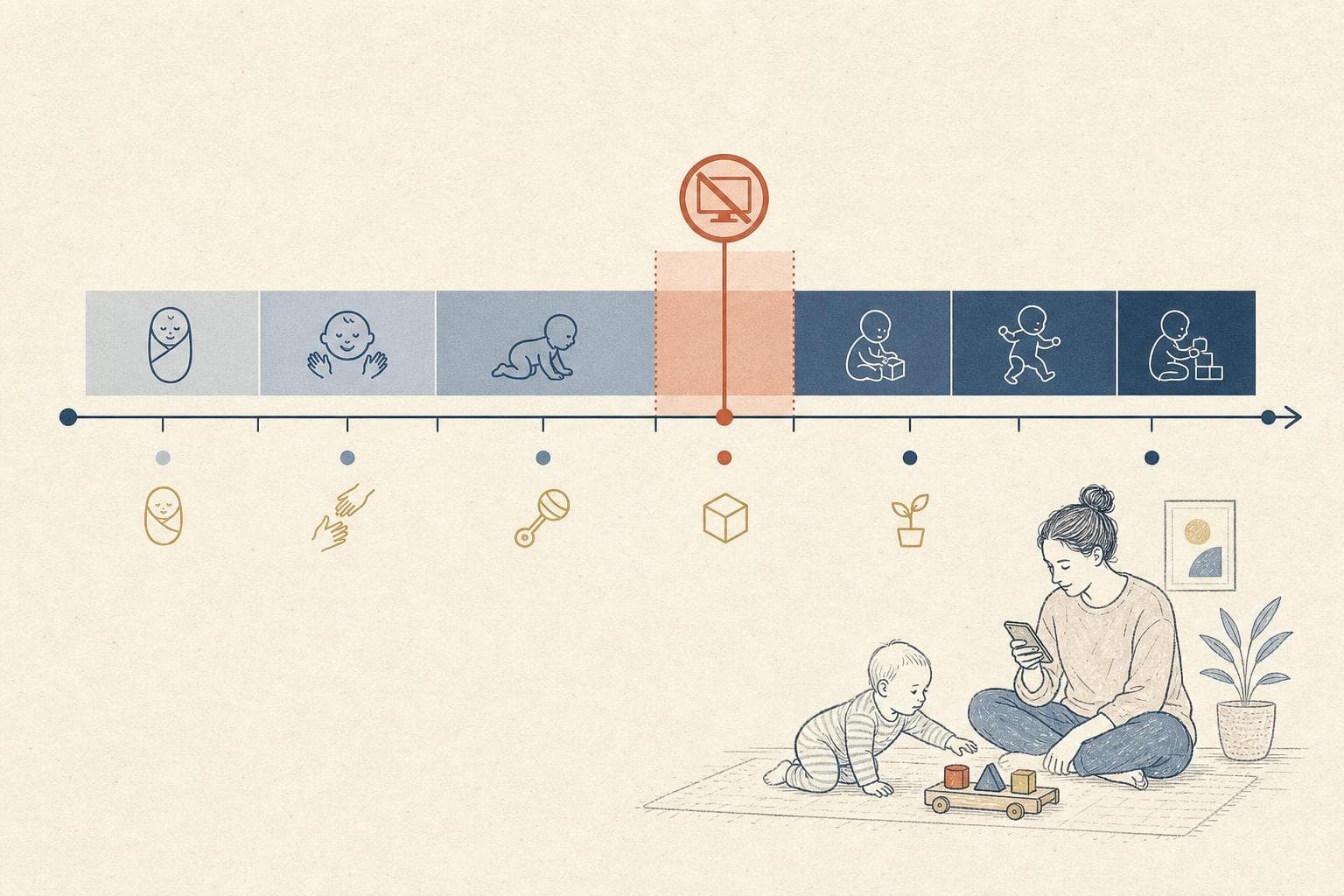

Every pediatrician's office has the poster. Under two: no screens except video chat. Two to five: one hour a day, high quality only. The American Academy of Pediatrics guidelines read like settled science. They aren't.
That's not a reason to hand your toddler an iPad and walk away. But it is a reason to understand what the research actually shows — and where the honest uncertainty lives.
The Evidence That Holds Up
Start with the strongest signal: screens displacing sleep and human interaction in infants are genuinely associated with worse outcomes.
A systematic review published in May 2026, commissioned by the 1001 Critical Days Foundation and conducted by researchers from four UK universities, reviewed thousands of studies on screen use in babies under two. The findings are worth taking seriously: higher screen use in infants was associated with increased risk of obesity, sleep difficulties, language delay, and later social challenges. One in ten babies now regularly falls asleep with a screen. Over 70% of babies and under-twos are using screens at some level, with some exposed to up to eight hours per day.
The researchers are careful to frame these as associations, not causes — and that distinction matters enormously for how you interpret the guidance. But the pattern is consistent enough across studies that the concern is legitimate, not manufactured.
A meta-analysis in JAMA Pediatrics attempting to synthesize evidence on digital media use across ages 0–18 found negative associations between excessive screen use and developmental and health outcomes — though the full methodology isn't publicly available, which limits how precisely we can evaluate it.
The developmental logic is straightforward: the period from birth to age two involves roughly one million new neural connections per second, built primarily through responsive human interaction. A screen can't respond to a baby's cues. Time spent passively watching is time not spent in the back-and-forth exchanges that build language and attachment. The opportunity cost is real even when direct harm is hard to isolate.
Where the Science Gets Genuinely Murky
Here's what the guidelines don't always communicate clearly: "screen time" is not one thing.
Scientific American reported on this directly, quoting University of Michigan education researcher Elizabeth Milovidov and AAP co-author Cori Cross: the studies showing negative effects typically involve more than five or six hours of passive entertainment viewing. That's a very different exposure than a two-year-old doing a 20-minute video call with a grandparent, or a three-year-old watching an adult name objects in a well-designed educational program.
The research on educational content for toddlers is genuinely mixed. Some studies suggest children under 18 months struggle to transfer learning from screens to real-world contexts — they can watch an action demonstrated on video and not replicate it the way they would if a person showed them. But by age two or three, that transfer gap narrows, particularly with interactive or co-viewed content where a parent is present and engaged.
The honest summary: passive solo screen time in infants has the most consistent negative associations. Interactive, co-viewed, or educational content in toddlers has a much weaker and more contested evidence base — in both directions.
The Gap Between Guidance and Reality
The 1001 Critical Days study found something that deserves more attention than the headline numbers: parents aren't using screens because they're indifferent to their children's development. They're using them because they're exhausted, undersupported, and trying to get through the day. One parent described their baby's screen time as "a survival skill in my house."
The researchers explicitly argued against blame. That's the right call — and it points to a real limitation in how the guidelines get communicated. Telling a sleep-deprived parent of a nine-month-old to eliminate all screens isn't a public health intervention. It's a guilt delivery mechanism.
The more useful frame: the evidence supports protecting sleep and protecting interaction time. If a screen is replacing neither — if it's running in the background while you fold laundry and your toddler is also playing with blocks — the research doesn't give us strong grounds to panic. If it's replacing bedtime routines or the back-and-forth conversations that build vocabulary, that's where the associations with worse outcomes are actually coming from.
What to Actually Do With This
The AAP guidelines aren't wrong. They're just more conservative than the evidence strictly requires, which is a defensible position for a public health body trying to communicate simply. The underlying research supports a few things with reasonable confidence: avoid screens as a sleep aid for infants, protect the interaction time that builds language, and watch the passive solo hours.
For everything else — the 20-minute show, the video call, the educational app — the evidence is thin enough that your own judgment about your child's behavior and your family's context is doing most of the work. That's not a failure of the science. That's what the science actually says.


