
Last May I wrote about how the AAP's screen time limits are real recommendations built on genuinely messy science. The core finding held up: the guidelines exist, but the research behind them is more complicated than the "no screens before two" framing suggests. Since then, a wave of new reviews and one significant policy moment have added texture to that picture — not overturning it, but making the mechanism clearer and the parental levers more specific.
Here's what's changed, and what it means practically.
The Surgeon General Just Made This a Headline Issue Again
JAMA reported that the U.S. Surgeon General released an advisory in June 2026 warning against excessive screen use in children. That's a notable escalation in official posture — advisories carry more rhetorical weight than guidelines, and they signal that federal health leadership views the evidence as settled enough to act on publicly. The summary available doesn't detail the advisory's specific recommendations, so I won't overstate what it says. But the fact of it matters: this is no longer just pediatricians debating in journals.
Around the same time, the Children and Screens Evidence Council voted 7–2 in favor of screen-free Pre-K classrooms, citing displacement of play, peer interaction, and movement as the primary concerns — not just content quality. The two dissenting members didn't dispute the general concern; they argued for limited, purposeful use under direct teacher guidance rather than a blanket prohibition. That's a meaningful distinction, and it maps onto what the research actually shows.
Duration Is the Wrong Variable to Optimize Alone
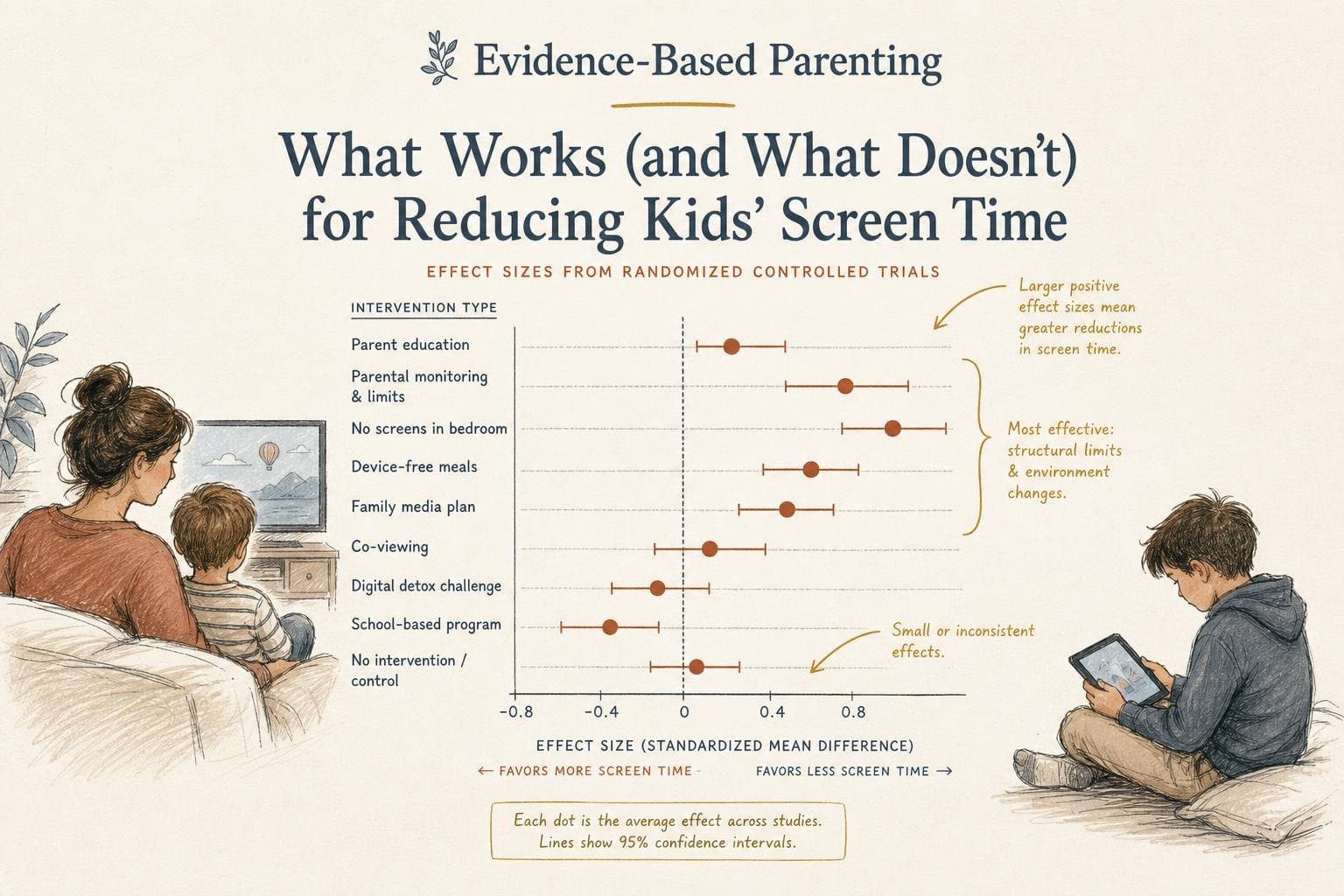
The most useful new finding comes from a systematic review and meta-analysis published in the International Journal of Behavioral Nutrition and Physical Activity, which examined parent-focused interventions targeting screen use in children under six. Across eight studies with roughly 1,776 participants, interventions that reduced screen time showed meaningful reductions in social-emotional problems (effect size –0.32) and externalizing behaviors (effect size –0.31). Those are modest but real effects.
The catch: nearly all of the interventions targeted duration only. Almost none addressed content quality or timing (screens before bed being the obvious high-risk case). The authors flag this directly — future interventions should consider what children are watching and when, not just how long. This is the same limitation that made the original AAP guidelines feel blunt: they set a time threshold without distinguishing between a toddler watching a video call with grandparents and one watching algorithmically-served autoplay content alone.
A systematic review of 15 studies on early childhood development reinforces the mechanism: excessive screen exposure reduces opportunities for the kind of developmental stimulation — physical, social, linguistic — that young children need during a critical window. The harm isn't the screen itself; it's what the screen displaces. That framing matters for how parents think about the problem.
Parent-Child Interaction Is the Actual Moderator
The most practically useful finding from the recent literature is about what buffers the risk. A June 2026 study in Frontiers in Psychiatry examined 806 children aged 5–6 and found that higher screen exposure was associated with lower emotion regulation abilities — but that the association was significantly weakened when parent-child interaction quality was high. Specifically, the negative relationship between screen exposure and executive function was weaker in children whose parents were more engaged. For children with high-quality parent interaction, the direct association between screen exposure and emotion regulation was no longer statistically significant.
This aligns with what a scoping review on Joint Media Engagement found: the communication strategies parents use during screen time matter for developmental outcomes. Watching with your child and talking about what's on screen is categorically different from handing over a device and leaving the room.
None of this means unlimited screen time is fine as long as you're present. The effect sizes in the meta-analysis are real. But it does mean that parents who are anxious about every minute of screen exposure may be optimizing the wrong variable. The question isn't only "how long?" — it's "what, when, and with whom?"
What This Actually Changes
The guidelines haven't moved. The AAP's age-based thresholds remain the official framework. What the new research adds is a clearer picture of the mechanism and the modifiers.
If you're managing screen time in a household with young children, the evidence now points to three levers worth paying attention to: duration (still matters, especially in aggregate), timing (before bed is higher risk than other windows), and co-viewing quality (your presence and engagement genuinely appear to buffer some of the developmental risk). A neuroimaging review notes that while excessive or unregulated screen exposure is associated with less favorable developmental outcomes, targeted digital engagement may support specific cognitive functions — which is a careful way of saying that content and context aren't irrelevant.
The Surgeon General's advisory will probably generate another round of "screens are destroying our children" coverage. The research says something more specific and more actionable: the risk is real, the mechanism is displacement of developmental activity, and the quality of parental engagement is a genuine buffer. That's not a reason to ignore the guidelines. It's a reason to understand what they're actually protecting against.


