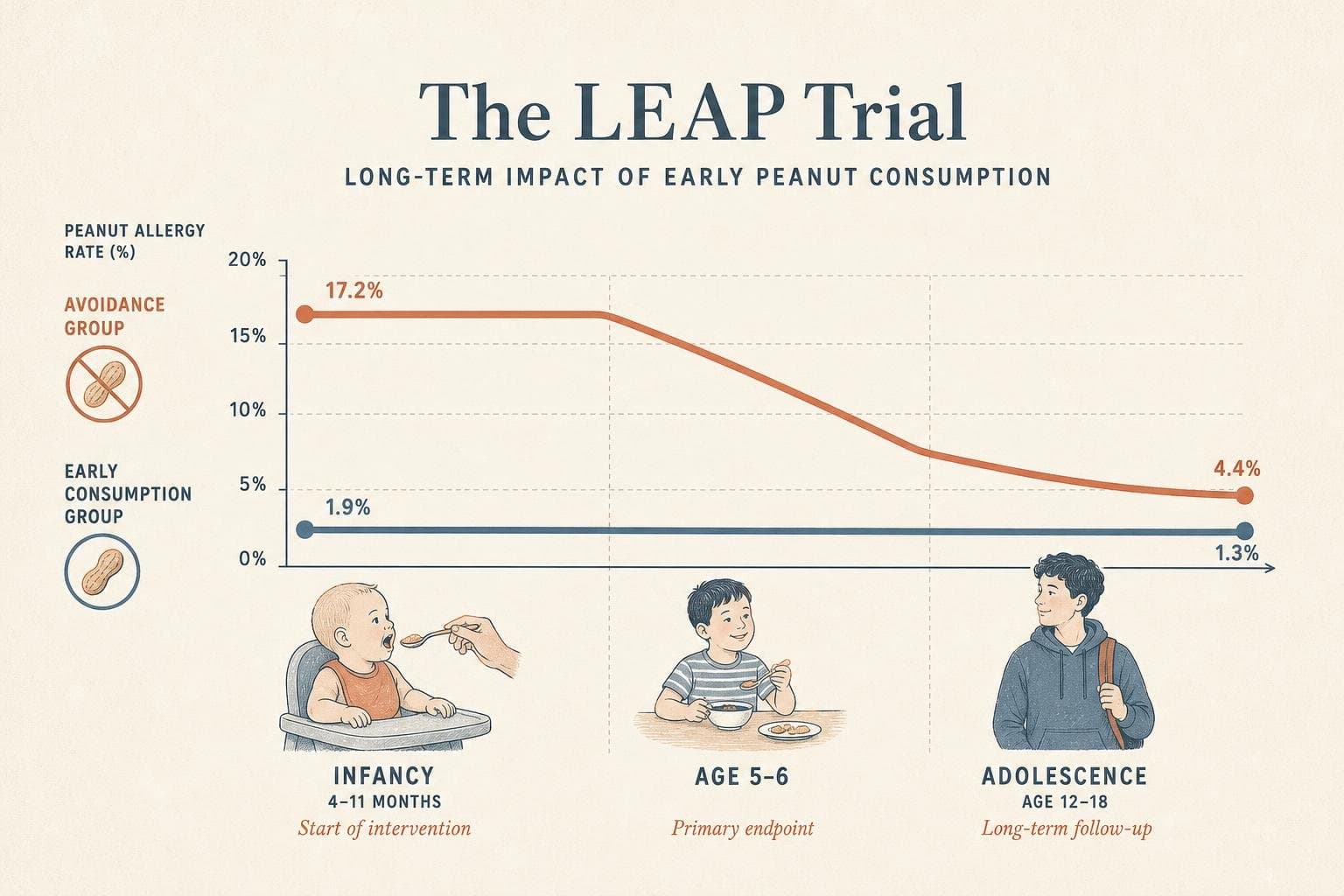

Most pediatric trials never get interesting again after their initial write-up. The babies grow up, the grant money moves on, nobody checks back in. The original Learning Early About Peanut Allergy trial was different from the start — it found something large enough that researchers kept following the same kids for over a decade. The results of that follow-up, published this year, are the rare case where a landmark study's long-term data actually confirmed the headline instead of complicating it.
What LEAP Actually Measured
The original LEAP trial randomized infants at high risk for peanut allergy (because of severe eczema or egg allergy) to either regular peanut consumption or avoidance, starting in infancy and continuing to age 5. The avoidance group developed peanut allergy at a rate 81% higher than the consumption group by age 5, according to NIH's summary of the findings. When the same children were then asked to avoid peanut entirely between ages 5 and 6 in a follow-up called LEAP-On, most of the early consumers stayed protected — the effect wasn't erased by a single year of abstinence.
The new piece is LEAP-Trio, which tracked down 508 of the original 640 participants — nearly 80%, a retention rate longitudinal researchers dream about — and tested them again as teenagers, averaging 13 years old, via supervised oral food challenges rather than questionnaires or blood tests (NIH). Crucially, between age 6 and adolescence, these kids ate peanut however much or little they wanted. No protocol, no mandated minimums. The early-consumption group still had peanut allergy at a rate 71% lower than the avoidance group. That is a genuinely durable effect, measured with the gold-standard diagnostic and a sample large enough to trust.
Why a Second Trial Complicates the "Just Feed Them Peanut" Story
If LEAP were the only trial in this space, the lesson would be simple. It isn't. The EAT study, a UK trial of 1,303 exclusively breastfed infants randomized to early introduction of six allergens (including peanut) versus the standard approach of waiting until around 6 months, found something messier. In the intention-to-treat analysis — comparing the groups as randomized, regardless of how well families actually followed the protocol — there was no significant difference in food allergy rates between groups, per the trial published in NEJM. Only when researchers looked at the subset who actually ate the target amount (2 grams per week of peanut or egg protein) did the protective effect show up clearly, with peanut allergy dropping from 2.5% to 0% in that per-protocol group.
The lesson isn't that EAT contradicts LEAP. It's that early introduction only works if it's consistent, and getting a 3-month-old to actually eat measured amounts of six allergenic foods every week turned out to be logistically hard for a lot of families — the EAT authors say as much. LEAP's population was also narrower: infants already flagged as high-risk, fed peanut as a primary intervention rather than one of six foods competing for a baby's attention and stomach capacity.
The Window Appears to Be After Birth, Not Before
A separate question — whether a mother can front-load this protection during pregnancy by eating allergens herself — got a clear negative answer this year. The PrEggNut trial, an Australian study of 2,137 pregnant women at elevated family risk for allergy, randomized participants to a high-egg-and-peanut diet (at least 6 eggs and 60 peanuts weekly) versus a restricted one, continuing through the first four months of breastfeeding. Infant allergy rates at age 1 were nearly identical between groups, as reported by Vida Lab's write-up of the NEJM trial. Maternal diet doesn't appear to be the lever. The infant's own gut has to meet the protein directly.
That distinction matters because it tells parents where their effort is actually well spent. JAMA Pediatrics' patient guidance now points to introducing peanut, egg, and other common allergens around 6 months as the window with proven payoff — describing roughly a 40% drop in peanut allergy and a 30% drop in food allergy overall with early introduction. Other proposed allergy-prevention strategies haven't fared as well under scrutiny: an updated Cochrane review found insufficient evidence that infant probiotics reduce food allergy, asthma, or allergic rhinitis, with effects on eczema still unclear after decades of trials.
Put together, the allergen-prevention research has narrowed to a surprisingly specific claim: feed your baby real amounts of peanut, directly, starting around 6 months, and keep it up. Not during pregnancy, not through a handful of exposures, not through a probiotic shortcut. The evidence for that specific window is as solid as pediatric prevention research gets — a randomized trial, replicated findings at 6 months, intact protection at 6 years, and now confirmation into adolescence. What's worth watching next is whether pediatric practice actually catches up to it, since JAMA's own patient page exists largely because many parents still haven't gotten the message.


