



Ask new parents what they've heard about pacifiers and you'll get two warnings in rapid succession: it'll ruin your nursing relationship, and don't even ask about what it'll do to your kid's teeth later. The breastfeeding fear turns out to have real evidence behind it — and the evidence says the fear is largely misplaced. The other claims pediatric parents hear about pacifiers are harder to pin down from what's been rigorously tested, and I'd rather tell you that plainly than manufacture certainty I don't have.
What the Cochrane Review Actually Measured
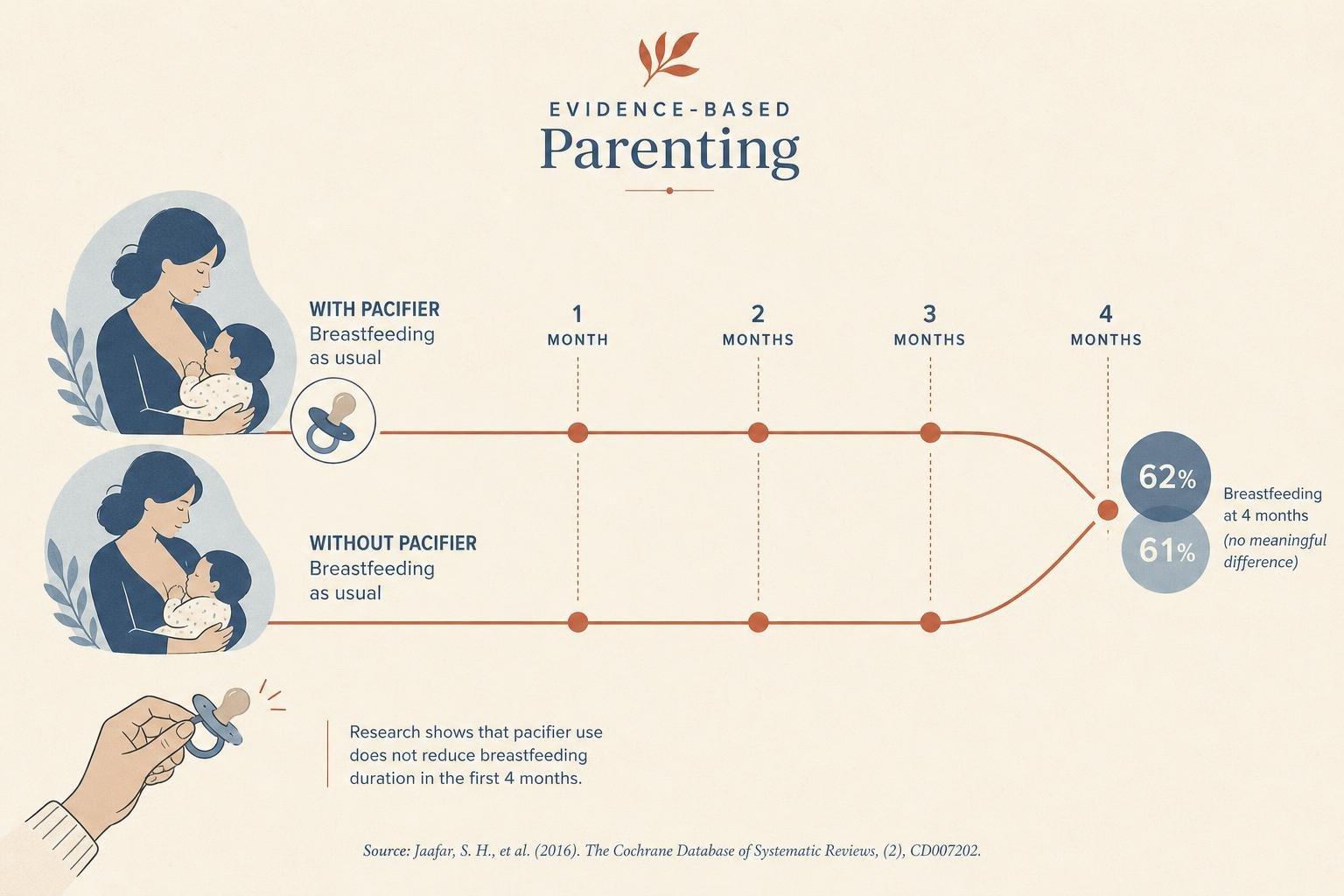
The strongest piece of evidence in this space comes from a systematic review published in the Cochrane Database of Systematic Reviews, summarized by Contemporary OB/GYN. Researchers led by Sharifah H. Jaafar pooled two trials covering 1,302 healthy, full-term infants, looking specifically at mothers who intended to breastfeed exclusively. That's the detail that matters methodologically: this isn't a study of pacifier use in general, it's a study of pacifier use in a population already motivated to establish breastfeeding, which is exactly the group most likely to be harmed if pacifiers interfered with latch or supply.
The outcome tracked was breastfeeding duration at three and four months — both exclusive and partial. The finding was unambiguous within that window: no significant difference in the proportion of infants still breastfeeding, regardless of whether the pacifier was introduced before or after breastfeeding was established, per Contemporary OB/GYN's summary of the review. The old advice — wait until breastfeeding is "established" before offering a pacifier, usually cited as somewhere around three to four weeks — doesn't appear to be protecting anything, at least not within four months.
Four Months Is a Real Boundary, Not a Technicality
I want to sit on that four-month window, because it's the kind of limitation that gets dropped when a finding gets repeated in a pediatrician's office or a parenting forum. The review's authors were explicit that evidence was lacking on two fronts: short-term breastfeeding difficulties pacifiers might cause, and long-term effects on infant health beyond the four-month mark, according to Contemporary OB/GYN. That's not a minor caveat. A null result at four months tells you pacifiers probably aren't derailing breastfeeding in its early, fragile phase — it doesn't tell you anything about breastfeeding at six months, or about the kinds of subtle nursing difficulties that wouldn't necessarily show up as an outright stop.
This is the pattern I keep running into with pacifier research broadly: the questions parents actually want answered — does it affect SIDS risk, does it affect dental development, does it affect speech — sit outside what this particular trial pool was designed to measure. The breastfeeding question got a well-powered answer because two trials happened to ask it directly. Other questions haven't been tested with comparable rigor in the sources I can point to today, and I'd rather say that than stretch this one review to cover ground it doesn't.
Why I'm Not Giving You a Verdict on SIDS or Teeth Today
Parenting advice has a habit of bundling claims together — pacifiers are good for sleep safety, bad for teeth, neutral for feeding — as if they were all established with the same level of evidence. They're not. The breastfeeding question happens to have a tidy systematic review behind it, with a decent sample size and a clear, falsifiable outcome measure. The dental and sleep-safety questions involve different study designs entirely — long-term orthodontic follow-up for one, population-level sleep epidemiology for the other — and I don't have strong sources in front of me today that let me walk through their methodology the way I just did with the Cochrane trials. Rather than summarize secondhand impressions of that literature, I'm going to leave those threads for a future issue where I can actually interrogate the cohort sizes and follow-up windows.
What I can tell you is this: if you're choosing to offer a pacifier because your baby is fussy or because it helps everyone sleep, you don't need to delay it out of fear that it'll sabotage your breastfeeding timeline. That fear had a plausible mechanism and a specific testable prediction, and when researchers checked, the prediction didn't hold up at three or four months. That's a real answer, even if it's a narrower one than the conversation around pacifiers usually pretends to need.