
Somewhere between the viral parenting infographics and the preschool teacher training modules, "praise effort, not ability" became gospel. Say "you worked hard" instead of "you're so smart," the logic goes, and you inoculate your kid against giving up when things get difficult. It's tidy advice. It's also built on a much smaller and messier evidence base than the confidence of its advocates suggests.
I went looking for what the underlying studies actually measured, not just what they're cited as proving. The honest answer: a few well-designed but small experiments, one genuinely useful longitudinal study, and a real counterexample that rarely makes it into the parenting content built on this research. It's worth noting, too, that this is how evidence-based guidance generally works — major bodies like the American Academy of Pediatrics update their own clinical recommendations as new data accumulates rather than treating any single finding as final, as seen in a 2026 AAP clinical report on congenital infection management, which revises prior guidance in light of newer follow-up data. Praise research deserves the same patience.
The Original Finding Was a Small Lab Study, Not a Parenting Trial
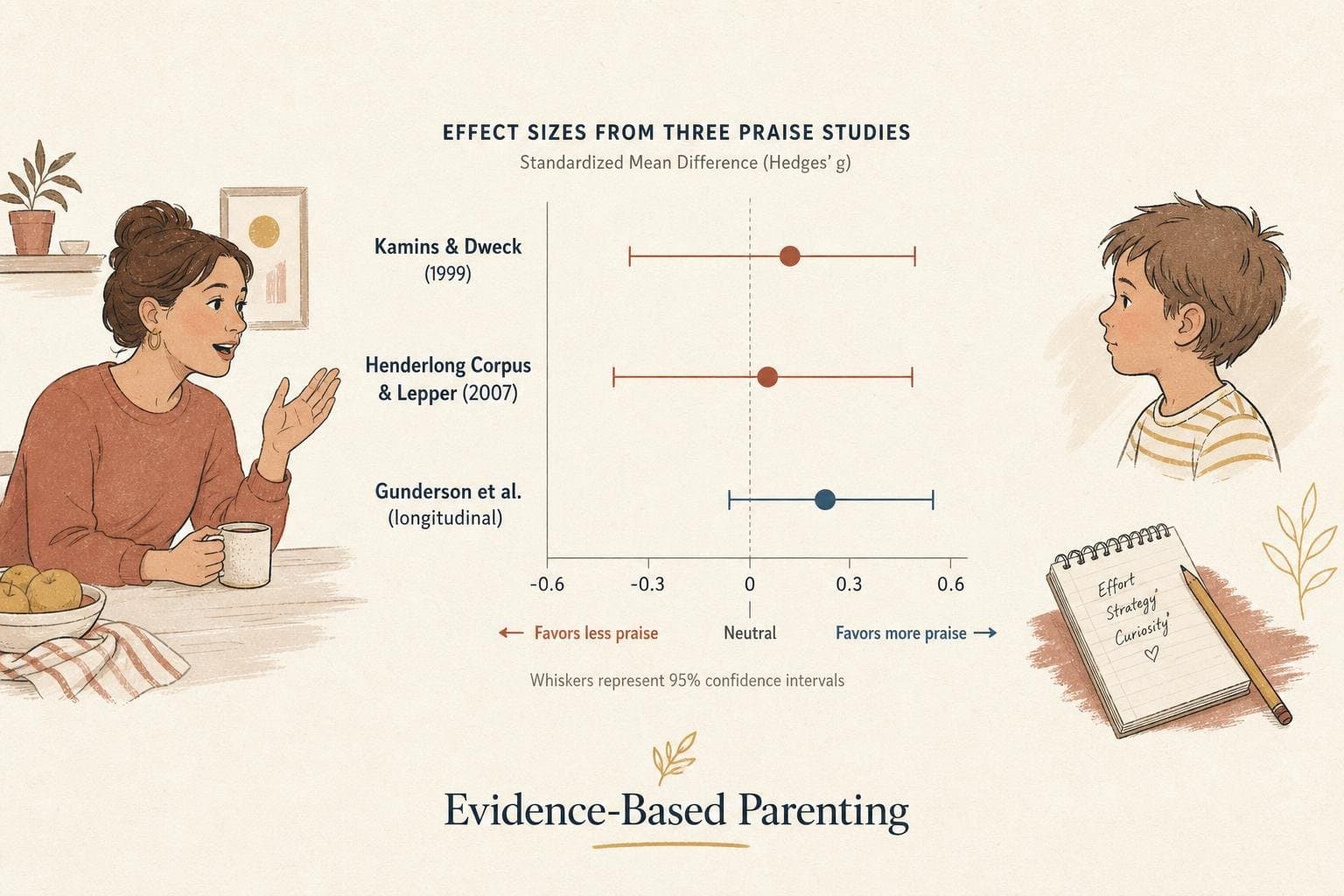
The study most people are actually invoking when they repeat "praise effort, not intelligence" is Kamins and Dweck's 1999 experiment, which tested preschoolers' responses to a role-play scenario after they received either person-focused praise ("you're a good girl") or process-focused praise ("you found a good way to do it"). After a simulated failure, kids who'd gotten person praise showed more helpless, self-critical responses than kids who'd gotten process praise.
That's a real and interesting result. It is also, per the design documented, a brief experimental role-play with a small sample — not an observation of how parents actually talk to kids over months or years, and not evidence about outcomes beyond that single lab session. Treating it as proof that a household's praise vocabulary reshapes a child's long-term relationship to failure is more than the study can carry.
A Later Study Complicates the Simple Rule
Here's the part that rarely survives the trip from journal to Instagram tile: a 2007 follow-up by Henderlong Corpus and Lepper tested person praise, product/outcome praise, and process praise against a neutral-feedback control, again in preschoolers. The finding — all three praise types, including the "wrong" kind, boosted motivation relative to no praise at all.
If the simple version of the growth-mindset rule were right, person praise should have looked worse than the other types here. It didn't, at least not in this age group and this task. That's not a reason to throw out the whole idea. It's a reason to hold the claim more loosely — the effect of praise type looks like it depends on age, task, and context more than a universal rule would predict, the same way major health guidelines often hedge recommendations until enough converging evidence exists, as the World Health Organization's cautious phased approach to a different pediatric-adjacent therapy area illustrates in a 2026 JAMA commentary on WHO's obesity guideline process.
The Study Worth Actually Weighing Is Longitudinal — and Modest
The strongest piece of evidence in this literature, by my read, is Gunderson and colleagues' observational study that followed toddlers from ages 1 to 3 and tracked the praise their parents naturally used at home, then checked in five years later. A higher proportion of process praise in toddlerhood predicted a more incremental (growth-oriented) motivational framework later on. Notably, person praise in the early observations wasn't associated with a fixed mindset later in the same straightforward way — the effect ran through process praise, not against person praise.
This is the design I actually trust more: it's naturalistic, it's looking at real parent speech rather than a lab script, and it has real follow-up time built in — the same principle that makes long-running federal data systems, like the CDC's provisional surveillance tracking, more trustworthy than a single snapshot survey. But it's also a small, observational sample, which means it shows a predictive association, not a demonstrated cause. A 2018 extension of the same line of work carried the thread further, linking toddler praise patterns to fourth-grade academic achievement through children's incremental mindsets — again prediction through a proposed mechanism, not an intervention that proves changing your praise changes your kid's trajectory.
What This Actually Means for Dinner-Table Praise
Put together, the evidence supports a modest claim: parents who naturally lean toward process-oriented language seem to have kids who, years later, show more growth-oriented motivational patterns. It does not support the stronger claim parenting culture has run with — that swapping "smart" for "worked hard" in your vocabulary is a lever you can pull to engineer resilience.
I'd treat this the way I treat most of the growth-mindset literature: worth doing, not worth anxiety. Praise the process when it's true and specific. Don't panic the next time "you're so smart" slips out at the dinner table. The studies that exist suggest direction, not a dosage you need to get exactly right.


