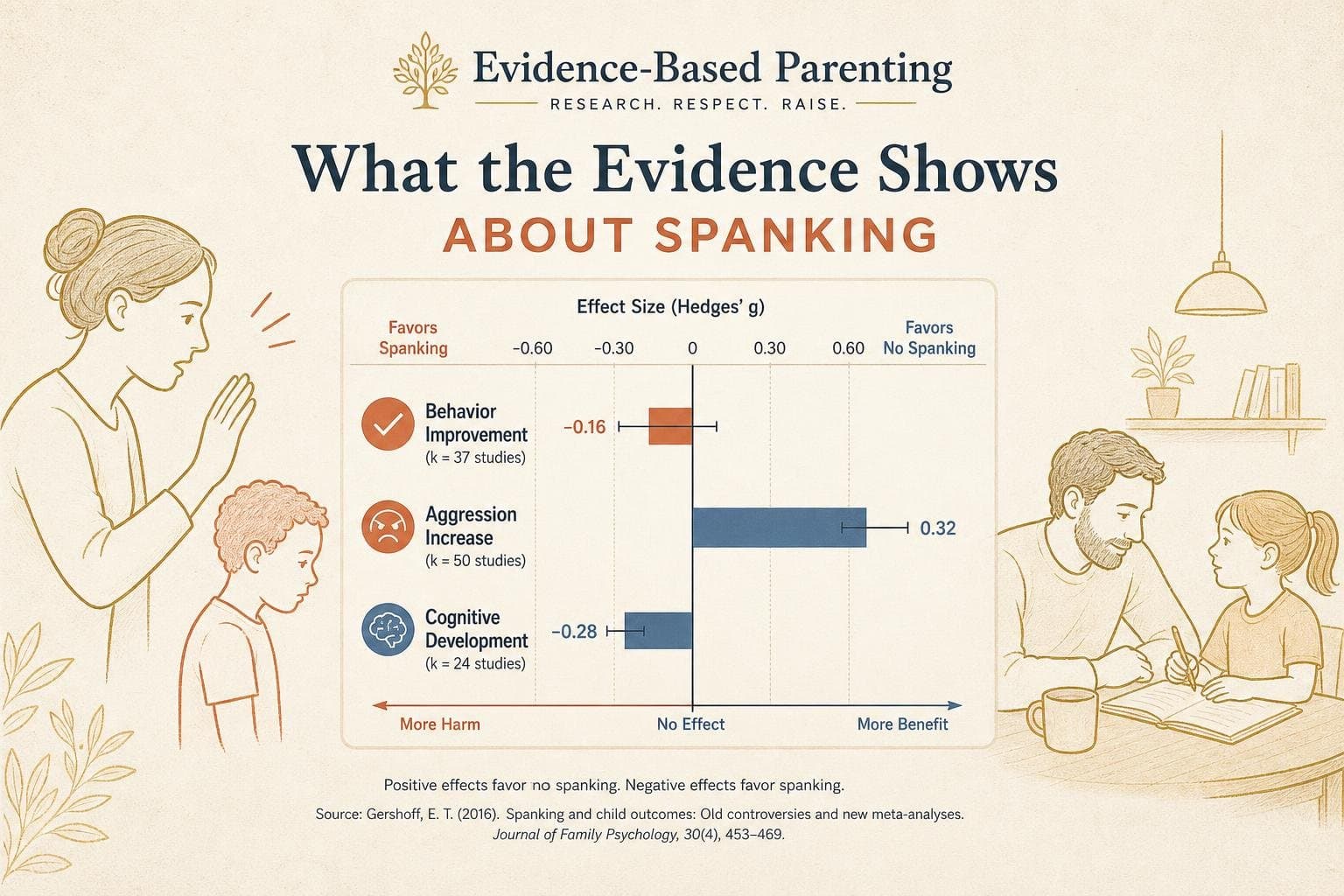

I've covered this ground before. Back in April, I wrote about the research consensus on physical punishment — that spanking reliably fails to improve behavior and reliably increases aggression. That piece drew more responses than almost anything else I've published, most of them from parents who wanted to know: how certain is certain?
The answer, as of this summer, is more certain than it was then.
The WHO Called It. The New Research Confirms It.
In 2025, a World Health Organization report cited what it described as "overwhelming scientific evidence" that physical punishment is linked entirely with harms and no benefits to children — framing it explicitly as a public health concern. A BMJ analysis published July 16, 2026 synthesizes that evidence base and lands on four findings worth examining carefully.
First: physical punishment does not improve children's behavior, either short-term or long-term. Second: children who are physically punished tend to become more aggressive and develop more behavior problems than those who aren't. Third — and this is the specific number that should give parents pause — a recent analysis of UK representative data found that adolescents who experienced physical punishment in early childhood were 35% more likely to report having hit, pushed, or shoved someone at age 14. That's not a small effect. That's a finding with real behavioral signal.
The mechanism matters here. Spanking doesn't teach children what to do — it teaches them that physical force is how adults handle frustration and noncompliance. Children are excellent observers. They generalize.
Genetics Complicates the Story — But Doesn't Rescue Spanking
Here's where the science gets genuinely interesting, and where I want to spend a moment, because this is the kind of nuance that gets flattened in most parenting coverage.
A 2026 study published in Nature Communications used a clever methodological approach to separate genetic from environmental effects on the parenting-aggression link. They applied a children-of-twins design using the Norwegian Mother Father and Child Cohort Study, then cross-validated with an adoption sample from the U.S.-based Early Growth and Development Study — where parents and children share no genetics, which lets you isolate environmental transmission directly.
The findings show that the picture is genuinely bidirectional: children's behavior influences parenting as much as parenting influences children's behavior. Aggressive kids elicit harsher discipline. Harsher discipline produces more aggression. The arrow runs both ways. Importantly, the association between positive parenting and reduced aggression appeared to be partly explained by shared genetics in the Norwegian sample — meaning some of what looks like "good parenting producing good outcomes" is actually "genetically similar people sharing traits."
This is not a reason to throw up your hands. It's a reason to be precise about what the evidence actually claims. The environmental effect of physical punishment on aggression is real and replicated across both samples in this study. Genetics doesn't explain it away — it just means the effect size estimates from studies that ignore genetic confounding are probably somewhat inflated. The direction of the finding holds.
The Intergenerational Pattern Is Stubborn
One more piece of recent data worth sitting with. A YouGov survey published June 29, 2026 found that among British adults who were physically punished themselves, roughly 65% reported having physically punished their own children — compared to a lower rate among those who weren't punished as children. Parents who were spanked are more likely to spank. Parents who were spanked are also more likely to believe spanking improves behavior.
This is the part that makes the research feel less like an academic debate and more like a public health problem. The belief that spanking works is itself transmitted across generations, alongside the behavior. You can't separate the practice from the conviction that it's effective — and the conviction is wrong.
A cross-national study using over 10,000 observations of children aged 5–14 in Thailand found a statistically significant negative association between exposure to physical and psychological punishment and the probability of achieving minimum cognitive proficiency. The harms extend beyond behavior into development more broadly.
What This Means for the Conversation You're Actually Having
If you're a parent who spanked and is now reconsidering, the research doesn't require you to conclude you've caused irreversible damage. Single incidents are not what the literature is measuring. The studies track patterns, frequency, and context — not one moment of losing your temper.
What the evidence does require is honesty about the mechanism: spanking doesn't work as a behavior-modification tool. It produces short-term compliance through fear and longer-term increases in aggression through modeling. The systematic review literature on parenting interventions consistently shows that approaches focused on parenting self-efficacy and stress reduction — rather than punishment — produce better outcomes for families without special risk factors.
The science here has settled more than most parenting debates do. The question now is whether the cultural conversation catches up.


