



Every few months, a parent tells me some version of this: "We've stopped pressuring her at meals, we offer without forcing, we eat together — and it's actually working. But then she spends the weekend at my mother-in-law's house and we're back to square one."
The research on pressure-versus-responsive-feeding is fairly settled at this point. I've written about it twice — the original piece on why pressure backfires and the follow-up on what the alternative actually requires. What those posts didn't address is a structural reality that shapes feeding practices in millions of households: grandparents are often running the kitchen too, and their approach to feeding may not match yours.
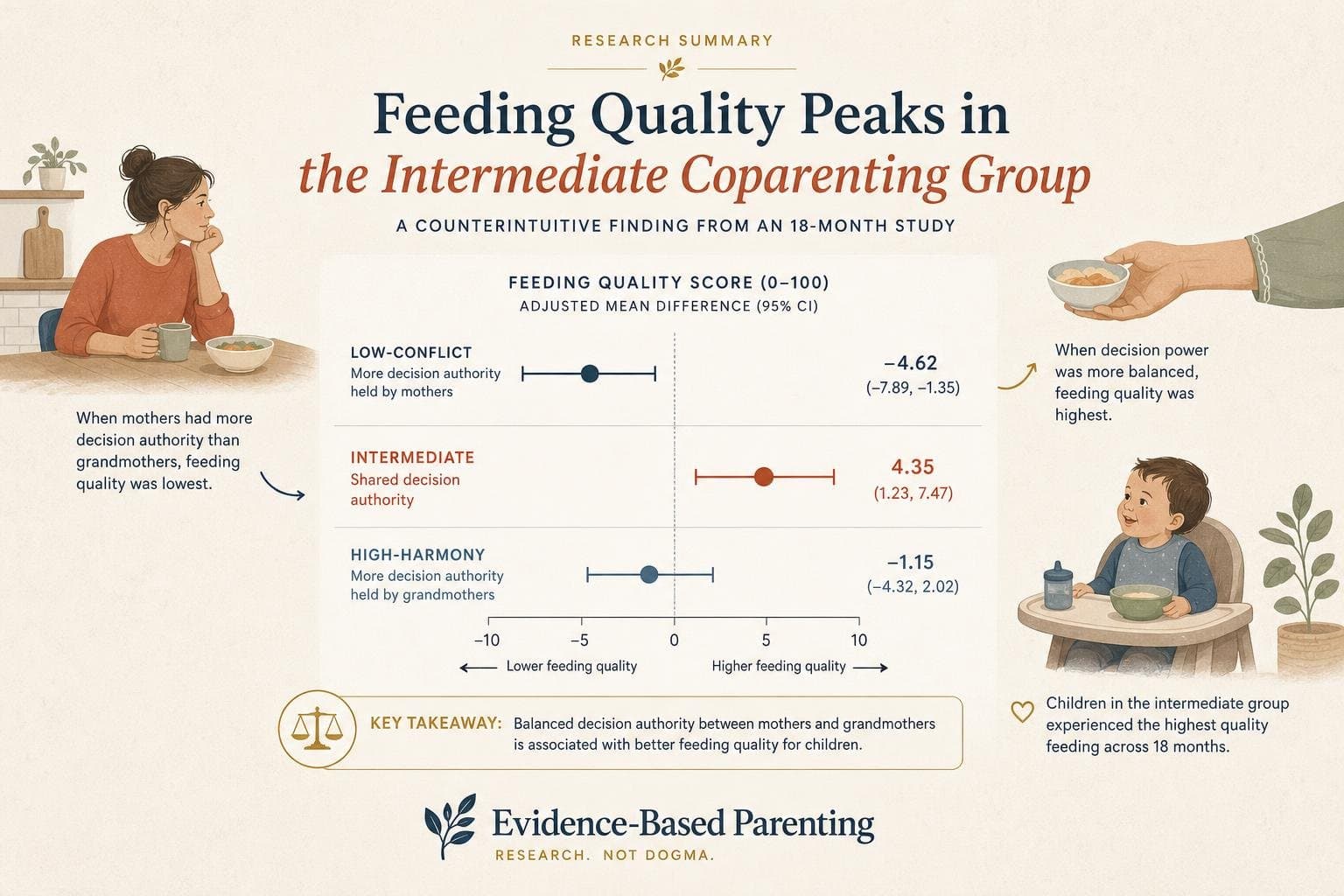
A study published in December 2026 in Appetite offers the most direct look at this dynamic I've seen in the literature. Researchers in Hangzhou, China examined 334 families with infants and toddlers aged 6–24 months, using a mixed-methods design that combined latent profile analysis with semi-structured interviews. The goal was to map how different intergenerational coparenting arrangements — specifically, how grandparents and mothers share (or contest) feeding decisions — affect the quality of maternal feeding practices.
The Non-Linear Finding That Matters
The study identified three coparenting profiles: low-involvement conflict (about 16% of families), an intermediate group (roughly 48%), and high-involvement harmonious (about 36%). The intuitive prediction would be that more harmony equals better feeding. That's not what they found.
Mothers in the intermediate group showed significantly better responsive feeding quality — less pressure to eat, less instrumental feeding (using food as reward or comfort) — than mothers in both the high-harmony and high-conflict groups. The high-involvement harmonious families, despite their cooperative atmosphere, didn't produce the best feeding outcomes.
The qualitative interviews explained why. What the intermediate group had was what the researchers called "bounded collaboration": grandparents provided support, but mothers retained clear decision-making authority over feeding. The high-harmony families, by contrast, often blurred those boundaries in the name of keeping the peace — which meant grandparents' more pressure-oriented feeding instincts (rooted in a different era's food scarcity concerns) quietly shaped what happened at the table.
This is a finding worth sitting with. The problem in many households isn't conflict or lack of support. It's the opposite: a harmonious arrangement that inadvertently cedes feeding decisions to whoever is most insistent.
Why Pressure Persists Across Generations
The Psychology Today piece by feeding therapist Lara Dato frames the pressure problem from the child's side: eating requires coordinating more than 50 muscles, involves sensory processing that varies enormously between children, and for anxious eaters, unfamiliar foods register as genuinely unpredictable. Pressure doesn't reduce that unpredictability — it adds a social threat on top of a sensory one. This is practitioner perspective rather than a systematic review, but it maps onto what the coparenting data shows from the parent side: pressure is a response to anxiety, not just the child's.
Grandparents who pressure children to eat aren't being malicious. They're often responding to their own anxiety — about nutrition, about waste, about a grandchild who seems too thin. The WHO complementary feeding guidance emphasizes responsive feeding as a core principle during the 6–23 month window, but that guidance reaches pediatricians and new parents more reliably than it reaches grandparents who raised children under different norms.
Meanwhile, a cross-sectional study of children aged 6–35 months in Beijing found that while 95% of caregivers recognized the importance of food education, only 32.2% frequently conducted food education activities at home. The awareness-practice gap is real — and it's likely wider across generations than within them.
What This Means for the Division-of-Responsibility Approach
The division-of-responsibility model — parents decide what and when, children decide whether and how much — is well-supported as a framework for reducing mealtime conflict and expanding food acceptance over time. But the model assumes a single consistent feeding environment. In households where grandparents are primary or frequent caregivers, that consistency is structurally harder to achieve.
The Hangzhou study's practical implication is specific: the goal isn't to exclude grandparents from feeding or to demand perfect alignment. It's to maintain clear maternal (or parental) decision-making authority over feeding approach, even within a cooperative arrangement. Harmony that comes at the cost of that authority tends to produce