
A mother packing bottles at 7:30 in the morning while wondering whether returning to work is harming her baby. That image, offered by maternal mental health clinician Kate Kripke, isn't a thought experiment — it's the daily reality for millions of parents navigating a question that gets weaponized more often than it gets answered honestly.
The honest answer, built on decades of longitudinal research, is this: daycare itself is not the variable that matters most. What matters most is a cluster of factors that the culture war version of this debate almost never mentions.
The Landmark Data Doesn't Say What the Alarmists Claim
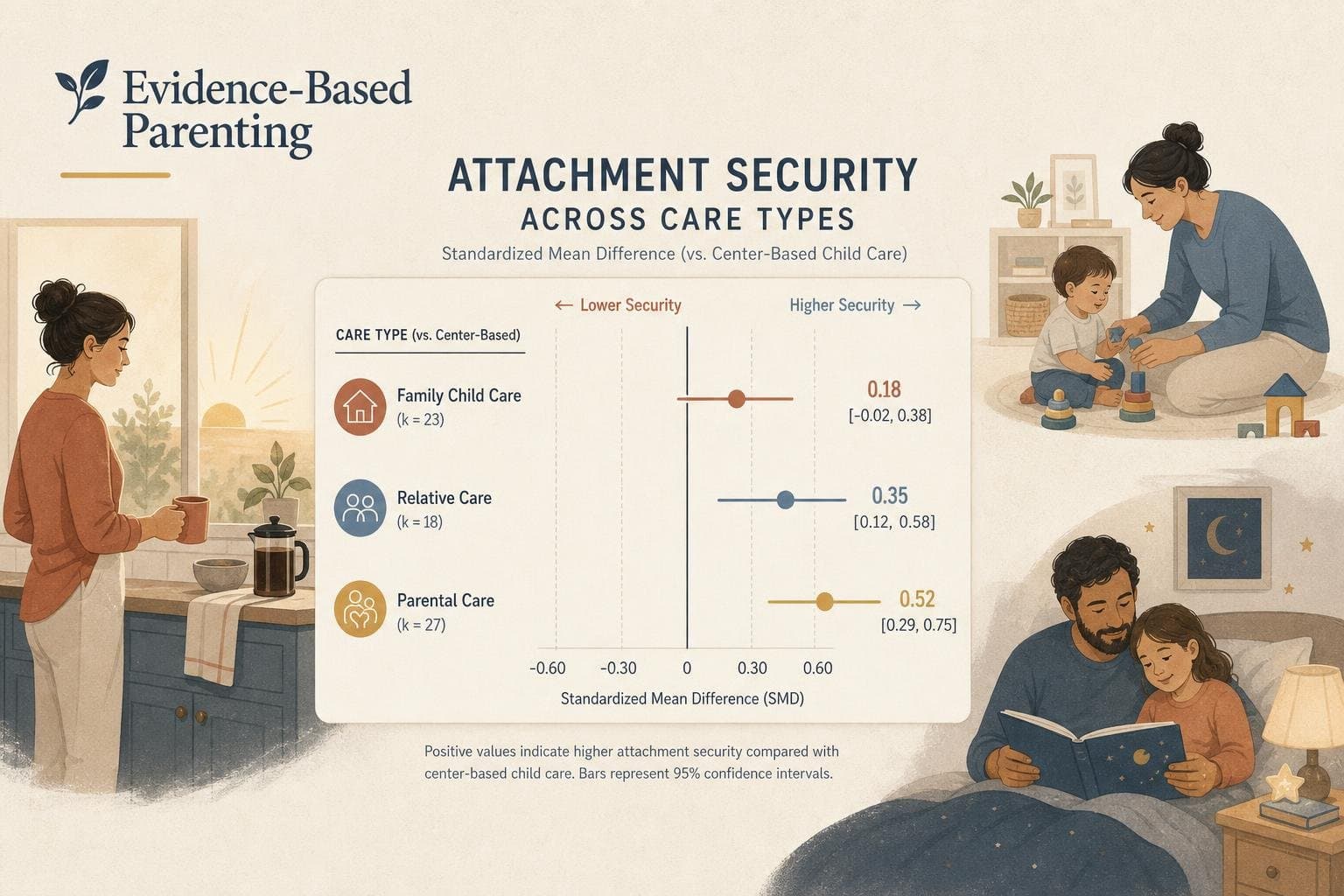
The largest sustained study of this question is the NICHD Study of Early Child Care and Youth Development, which followed more than 1,000 children beginning in infancy. Researchers tracked type of care, hours in care, age of entry, quality of arrangements, and stability of caregivers — essentially everything a rigorous study could measure. Then they looked at infant-mother attachment outcomes.
Their finding: childcare itself did not independently predict whether a child developed a secure attachment to their mother. The strongest predictor of attachment security was maternal sensitivity and responsiveness.
That's a significant result, and it rarely survives the trip from research summary to parenting discourse intact. The NICHD data did contain important nuance: when lower maternal sensitivity combined with poor-quality care, extensive hours, and multiple childcare arrangements, the likelihood of insecure attachment increased. That combination matters. But notice how different that conditional finding is from the flat claim that daycare damages children. The study points toward an interaction between factors, not a verdict about care settings.
Quality Is the Variable That Actually Moves Outcomes
If the NICHD study settles the "is daycare bad" question, a more recent body of research sharpens the follow-up question: bad compared to what, exactly?
A 2026 study published in PubMed examined home caregiving quality among vulnerable children aged 0–3 and found that early caregiving quality had both immediate and lasting effects on psychological and behavioral development — and that those effects operated through a chain, with early developmental outcomes shaping later ones. The authors found that children who showed developmental delay at baseline carried elevated risk of subsequent delay, while children with normal development at baseline showed substantially lower risk. The mechanism was quality of caregiving, not the setting in which caregiving occurred.
This is the finding that should reframe the whole debate. The question isn't "daycare or home" — it's "what is the quality of care the child is actually receiving?" A responsive, consistent daycare environment can outperform an under-resourced, isolated home environment. A present, sensitive parent provides something no daycare replaces. The research treats this as a dimensional question. The parenting culture mostly treats it as a binary.
The Confound That Rarely Gets Named
There's a structural problem with almost every study in this area: the families who choose each option differ systematically. Higher-income families have more access to high-quality care. Families under severe economic stress may use whatever arrangement is cheapest and most convenient, regardless of quality. Mothers who experience work disruptions from childcare unreliability — a 2022–2023 survey found that 27 percent of mothers reported childcare-related work disruptions, compared with under 3 percent of fathers — are often managing cascading stressors that affect parenting quality at home too.
You can't isolate the effect of daycare from the conditions that determine who uses what kind of daycare. A mother managing unreliable childcare, reduced income, and the cognitive load of ongoing work disruptions is not in the same situation as a mother with stable, high-quality childcare support. Treating "daycare" as a monolithic exposure ignores everything that varies underneath that label.
Similarly, a longitudinal study out of the University of Rochester published in Child Development — tracking 310 families across six waves over eight years — found that parenting quality before COVID moderated children's mental health trajectories during the pandemic. Low paternal structure and low parental secure-base provision amplified children's internalizing problems under high stress. The implication: what parents do when they are present matters enormously, which cuts against the idea that more hours at home is automatically protective.
What to Actually Watch For
If you're a parent making this decision, the research narrows the question considerably. The relevant factors are: quality of the care arrangement (caregiver responsiveness, consistency, ratio of adults to children), stability of that arrangement over time, and your own capacity to be a responsive, sensitive presence during the hours you are together. Hours in care alone, by the NICHD evidence, is a weaker predictor than any of those.
The culture war version of this debate asks "daycare or home?" The research asks something more useful: "What is this child experiencing, from whom, and how consistently?" Those are harder questions. They're also the ones worth answering.


