


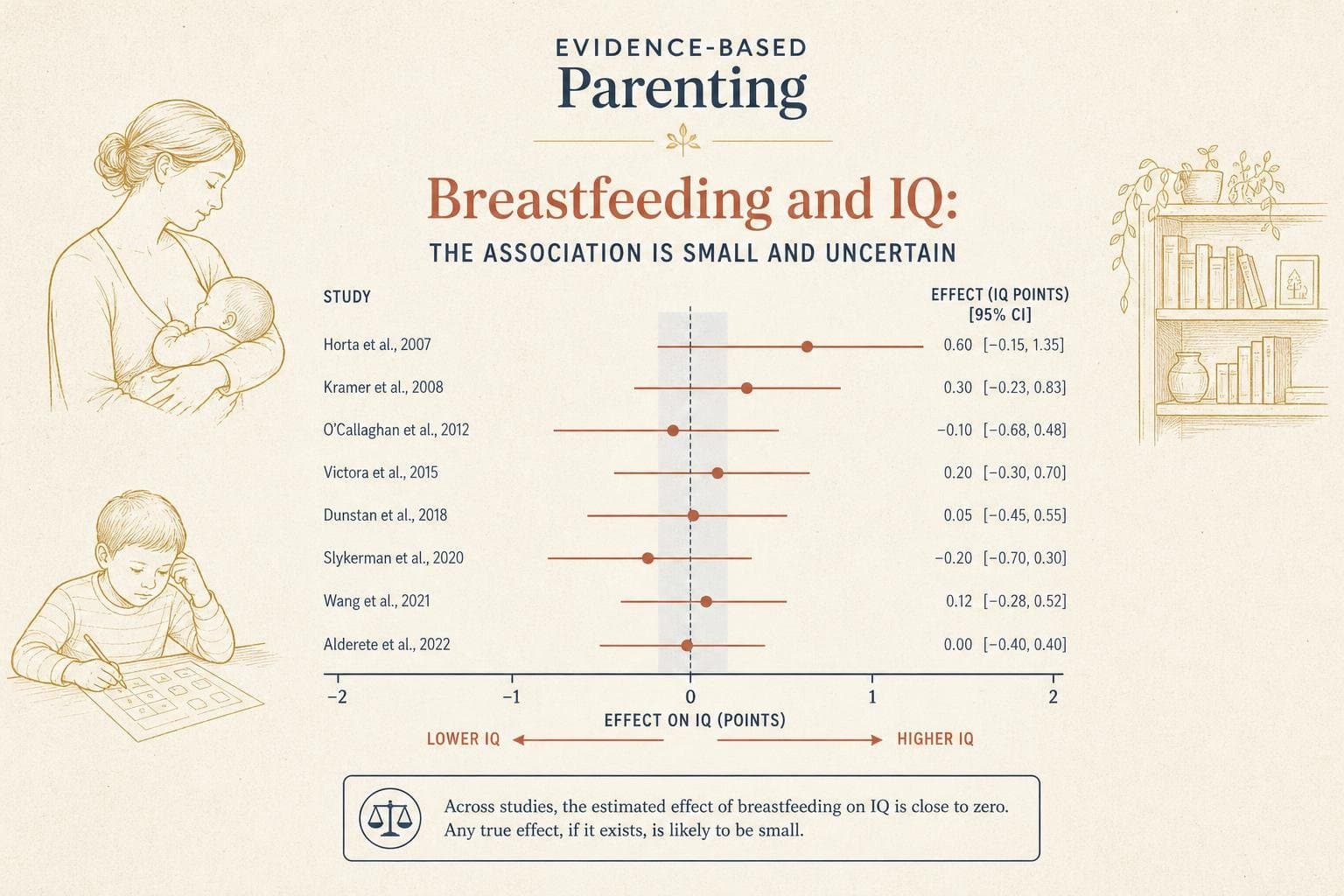

Somewhere in a UK twin registry, there's a dataset that should have settled the breastfeeding-IQ question a decade ago. It didn't, mostly because the answer it produced — "not much" — doesn't make for a compelling headline on a formula can or a lactation consultant's pamphlet.
I keep coming back to study design on this topic because the breastfeeding-IQ literature is a case study in how easy it is to confuse "babies who were breastfed score higher" with "breastfeeding causes higher scores." Those are different claims, and untangling them requires exactly the kind of data that's hard to collect: large samples, repeated measurement over years, and some way to control for the fact that parents who breastfeed longer also tend to differ in education, income, and home environment from parents who don't.
The Twin Study That Should Have Mattered More
The strongest piece of evidence in this space is older than you'd expect for a topic this contested. Researchers led by Sophie von Stumm at Goldsmiths, University of London, used more than 7,000 families from a UK twins study — 62% of the children breastfed for at least four months — and gave the kids IQ tests repeatedly from birth through age 16, as reported in Contemporary Pediatrics back in 2015. The design matters here: twin studies are useful precisely because they let researchers hold genetics and much of the home environment constant while varying an exposure like breastfeeding duration.
What they found was a largely null result. There was "no reliable association between breastfeeding and intelligence quotient latent growth factors," tracked across the full cognitive growth trajectory from infancy to adolescence. There was one wrinkle — girls who were breastfed scored modestly higher on IQ tests by age 2 — but the authors themselves called that effect "statistically weak and not observed in boys," which is researcher-speak for "don't build a parenting philosophy on this." Von Stumm's own read on the data was that cognitive development tracks far more strongly with socioeconomic status, parental education, and the broader home environment than with infant feeding method.
That's a longitudinal design with real statistical power, following the same children for sixteen years. It's about as close as this literature gets to a definitive answer, and the answer is: breastfeeding duration doesn't appear to move the needle on long-term IQ in any way that survives adjustment for everything else going on in a child's life.
The Newer Numbers Point the Same Direction
A more recent attempt to rank cognitive exposures by evidence quality — compiling findings across multiple cohort analyses — put the fully adjusted IQ difference attributable to breastfeeding at a confidence interval spanning roughly -0.19 to 1.23 points, according to ACIS's review of IQ-affecting exposures. A confidence interval that straddles zero that tightly is the statistical equivalent of a shrug. Compare that to lead exposure, where a pooled analysis of over 1,300 children found a roughly 7-point IQ difference between low and high blood lead levels in the same review — a gap an order of magnitude larger and one that doesn't cross zero. If you're looking for childhood exposures that reliably move IQ, breastfeeding duration sits nowhere near the top of that list.
None of this touches the other reasons breastfeeding gets recommended. The American Academy of Pediatrics and ACOG's guidance on exclusive breastfeeding for six months rests substantially on maternal health outcomes — reduced risk of type 2 diabetes, certain cancers, and cardiometabolic disease — documented in a review in Contemporary OB/GYN. Those benefits are real and separate from the cognitive claim. It's worth decoupling them, because a parent who can't or doesn't want to breastfeed for extended periods is giving up something real on the maternal-health side, not failing to optimize her child's intelligence.
What Would Actually Change This Answer
The honest caveat is that the von Stumm study is a decade old and no landmark replication of its size has displaced it. What's changed recently isn't the evidence so much as the infrastructure for producing better evidence: a 2026 mapping effort identified 104 international pregnancy and birth cohorts, spanning more than 1.17 million children across 41 countries, that already collect breastfeeding data alongside neurodevelopmental outcomes, as described in iScience02941-X). The authors frame this as groundwork for future pooled analyses, not a new finding — the harmonization work hasn't happened yet.
If it does, watch for whether a federated analysis across those cohorts can do what no single study has: separate breastfeeding's effect from the thicket of parental education, income, and home environment that tends to travel alongside it. Until then, the best longitudinal evidence we have says breastfeed for the reasons that are actually supported — maternal and infant health — and let go of the IQ math.