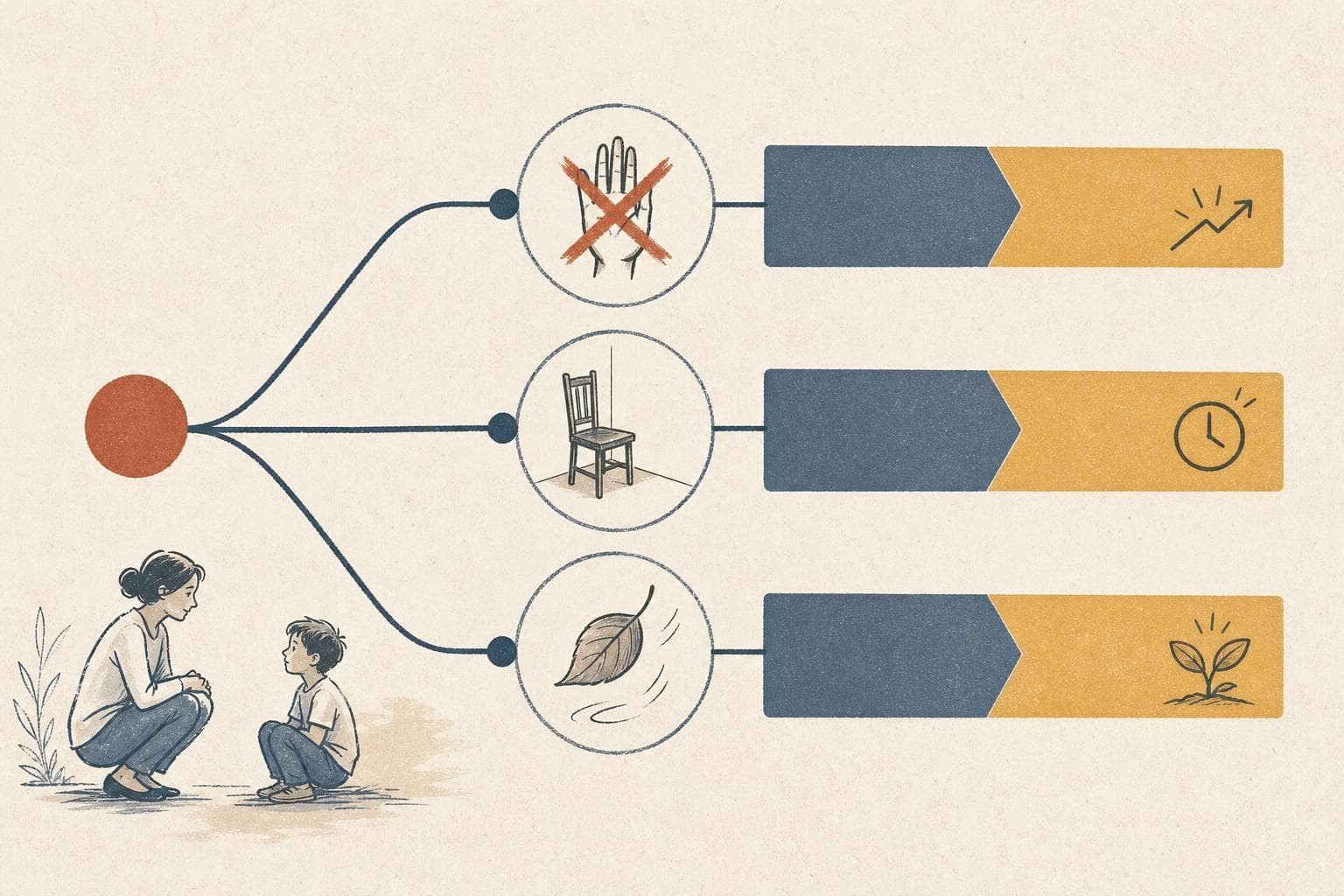

The research on physical punishment is about as settled as pediatric behavioral science gets. A meta-analysis published in Nature Human Behaviour examined 195 studies across 92 low- and middle-income countries and found physical punishment was significantly associated with negative outcomes in 16 of 19 measured categories — worse parent-child relationships, impaired executive function, increased likelihood of perpetrating violence in adulthood, and more. Crucially, this held even in countries where physical punishment is culturally normative, directly challenging the "cultural normativeness hypothesis" that had given some researchers pause about generalizing findings across contexts.
So: spanking is out. The evidence is unusually consistent on this point.
What's less settled — and what parenting culture has been less honest about — is what actually works instead.
The Problem With "Natural Consequences"
Natural consequences have become the respectable alternative for parents who've moved past spanking but are skeptical of time-outs. The logic is appealing: let the child experience the real-world results of their choices. Don't want to wear a coat? You'll be cold. Won't eat dinner? You'll be hungry. The world teaches the lesson so you don't have to.
The problem is that natural consequences have a narrow range of application and a significant failure mode. They work reasonably well for low-stakes, immediately felt outcomes. They fail almost entirely when the consequence is delayed, abstract, or too severe to allow. You can't let a four-year-old experience the natural consequence of running into traffic. And "you'll struggle in school someday" is not a consequence a six-year-old can process.
There's also a subtler issue. Natural consequences, as typically practiced, often involve a parent stepping back and waiting — which means the child's behavior goes without any immediate response. From a behavioral science standpoint, that absence of consequence can itself function as reinforcement. If a child throws a toy and nothing happens, the throwing behavior hasn't been extinguished — it's been permitted.
What the Evidence Actually Supports
The behavioral approaches with the strongest empirical track record are less philosophically satisfying than natural consequences but considerably more effective: consistent, immediate, calm responses that make the connection between behavior and outcome unmistakable to a young child.
Time-outs, when implemented correctly, fall into this category — though "correctly" is doing a lot of work in that sentence. The research-supported version involves a brief, non-punitive removal of attention and stimulation, applied consistently and immediately after the target behavior. What most parents actually do — a lengthy, emotionally charged banishment — is a different intervention with different effects.
Response cost, the calm removal of a privilege or token the child has already earned, has strong support in applied behavior analysis research and is frequently collapsed, unfairly, into the same category as harsh punishment in popular parenting frameworks. It isn't harsh. It's just clear.
Parent training programs that teach these behavioral tools show real results. A large prospective cohort study of over 3,200 four-year-olds in Finland found that a structured parent training program produced measurable reductions in disruptive behavior at six-month follow-up — with better outcomes for children whose problems were identified earlier and whose parents engaged more consistently with the program. The children who improved least were those with longer-duration problems and callous-unemotional traits, which tells you something important: these tools work, but they work better early and they're not magic.
The Gentleness Trap
There's a version of this conversation that gets framed as "gentle parenting vs. behavioral parenting," as though warmth and consequences are in opposition. They aren't. The StatPearls review of parenting styles — updated this month — describes authoritative parenting (warm, responsive, and consistent with expectations) as the approach most consistently associated with positive child outcomes. That's not the same as permissive parenting, which is warm without structure, or authoritarian parenting, which is structured without warmth.
The research problem with "gentle parenting" specifically is that it remains largely unmeasured. The first systematic empirical study of the approach, published in 2024, measured parent experience rather than child outcomes. That's not nothing — parental wellbeing matters — but it's a different claim than "this produces better-regulated children."
The practical takeaway isn't that you need to be harsher. It's that warmth without consistent, immediate, calm consequences leaves children without the feedback loop they need to build self-regulation. Natural consequences are a useful tool in a narrow range of situations. For everything else, the evidence points toward structure: clear expectations, predictable responses, and a parent who stays calm enough to deliver them consistently.
That last part — staying calm — turns out to be one of the strongest predictors of whether any of this works. Which is, admittedly, its own kind of challenge.


