
Every pediatrician's office has the same laminated poster: no screens before 18–24 months, under an hour a day for ages 2–5. Parents internalize the number. They count minutes. They feel guilty when they go over.
But a longitudinal study published this spring suggests the number you're watching may be the wrong variable entirely.
The Window Problem
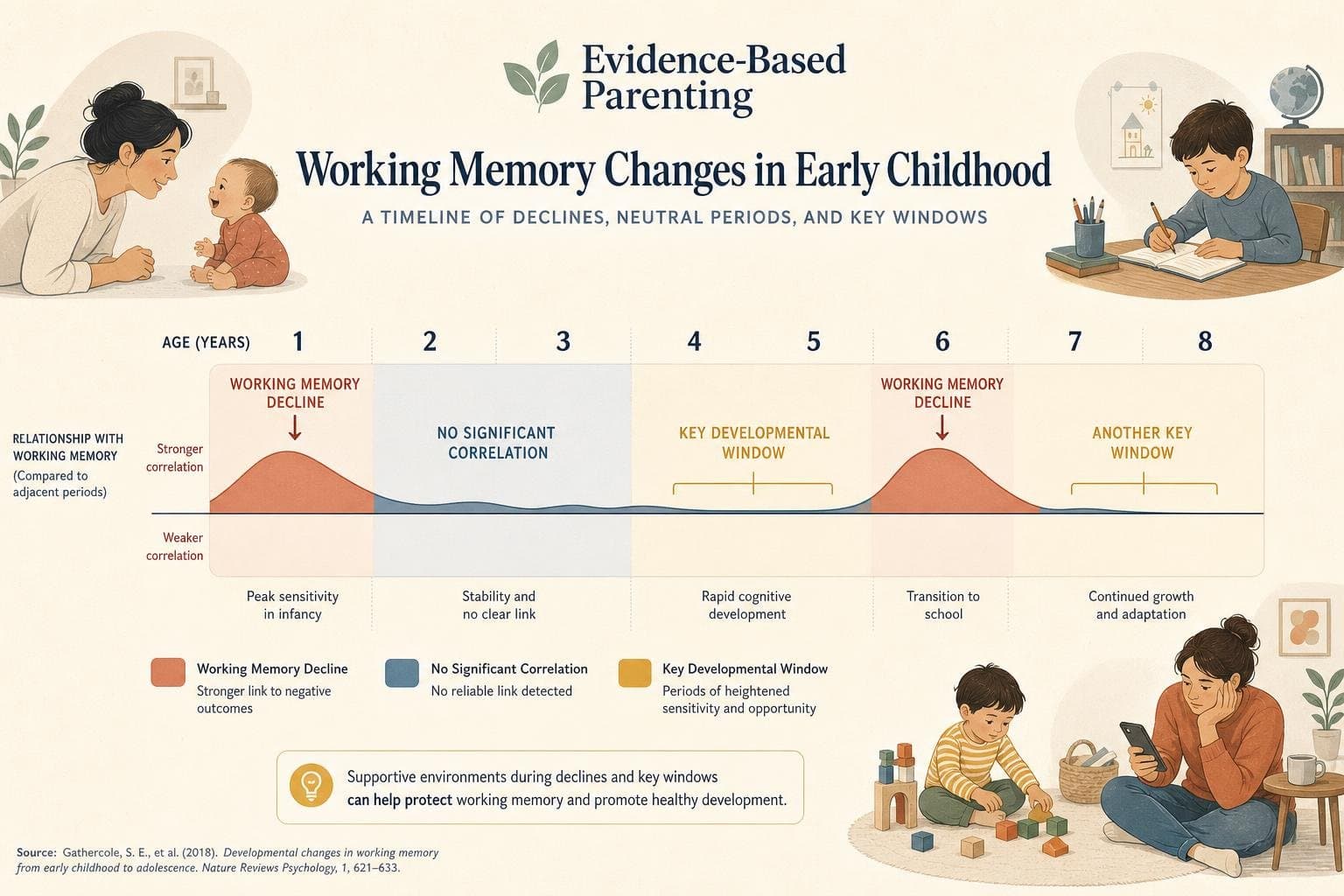
Researchers from Inserm and the National University of Singapore followed 502 children from age 1 through age 8, measuring screen habits at six distinct points across early childhood. The outcome data came later: academic performance at age 9, working memory at age 10.5. What they found complicates the standard advice considerably.
Higher screen time during infancy — around age 1 — and again around school-entry age (6) was consistently associated with weaker working memory and lower academic performance years later. Screen time at ages 2 and 3, by contrast, did not produce statistically significant long-term academic correlations. Same children. Same general exposure levels. Different developmental windows, different outcomes.
This is the kind of finding that should make us pause before reaching for a simple rule. The WHO and American Academy of Pediatrics recommend no screen time before 18–24 months and under an hour daily for ages 2–5 — guidelines the study's authors note many children already exceed. Those thresholds aren't wrong. But they treat all early childhood as a single developmental block, when the data suggest infancy and school-entry may be particularly sensitive windows that deserve specific attention, not just a shared daily limit.
The mechanism the researchers point to is plausible: screens during infancy displace the contingent, back-and-forth interactions that wire early social cognition. At school-entry, the concern shifts — screen time competing with the consolidation of attention and working memory at exactly the moment formal learning demands those capacities most.
Your Screen Time Also Counts
Here's the finding that tends to get less airtime in parenting conversations: it's not only what children watch, but what parents do while children are present.
A systematic review and meta-analysis published in JAMA Pediatrics, led by University of Wollongong researcher Marcelo Toledo-Vargas, examined 21 studies from 10 countries involving nearly 15,000 children under five. The focus was parental technology use — a parent using a device while the child is present but not engaged with the same content. The associations with poorer cognition and social behavior outcomes were small in magnitude but consistent across studies.
The lead researcher's framing is worth quoting directly: "Kids might feel ignored or like they're competing for their parents' attention. This can disrupt the natural flow of interactions, which is particularly important as young children are acquiring critical social and language skills."
The effect sizes here are modest, and the researchers are careful to say so. This isn't evidence that checking your phone during dinner will derail your child's development. It's evidence that the interaction quality surrounding screen use — not just the screen time itself — is part of what matters. A parent absorbed in their phone during play is a different developmental environment than a parent co-viewing an educational program with a toddler.
Quality and Context, Not Just Quantity
A 2026 synthesis in Policy Insights from the Behavioral and Brain Sciences makes this point most directly for language development. Reviewing evidence on screen use and second-language learning in bilingual children, the authors found that moderate screen exposure is positively associated with receptive language skills, while excessive use may displace social interaction and hinder development. The clearer story, they argue, is in content quality: educational programming, age-appropriate design, and adult co-viewing or peer collaboration are more consistently associated with positive outcomes than raw time limits.
Their policy conclusion is pointed: existing guidelines focused primarily on time limits fail to capture how screen use could support learning. A more effective approach would retain time thresholds while adding guidance on content quality and socially embedded viewing.
This aligns with what I've written before in the screen time coverage from May 2025 and last June: the guidelines are real, but the research behind them is messier than the poster suggests. What's sharpening now is where the messiness lives. It's less about whether screens are harmful in the abstract and more about when, what, and with whom.
What This Actually Changes
For parents of infants — particularly under 18 months — the timing data gives the existing no-screen guidance stronger empirical legs than it sometimes gets credit for. This isn't just a precautionary recommendation; there's longitudinal evidence that infancy is a genuinely sensitive window.
For parents of school-age children around kindergarten entry, the school-entry finding is worth taking seriously. That's a period worth being more deliberate about, not just defaulting to "under an hour."
And for everyone: the parental device data is a useful reframe. The question isn't only how many minutes your child spent in front of a screen today. It's how many minutes of genuine back-and-forth interaction happened alongside it — and whether your own phone was competing for the attention that interaction requires.


