
When I wrote about picky eating last June, the central finding was that most toddler food refusal is developmentally normal, and that the interventions with the best evidence share a common mechanism: repeated, low-pressure exposure. The research since then hasn't overturned that. But a new systematic review adds a genuinely useful wrinkle — one that's practical enough to be worth your attention.
The Exposure Threshold Is Higher Than Most Parents Realize
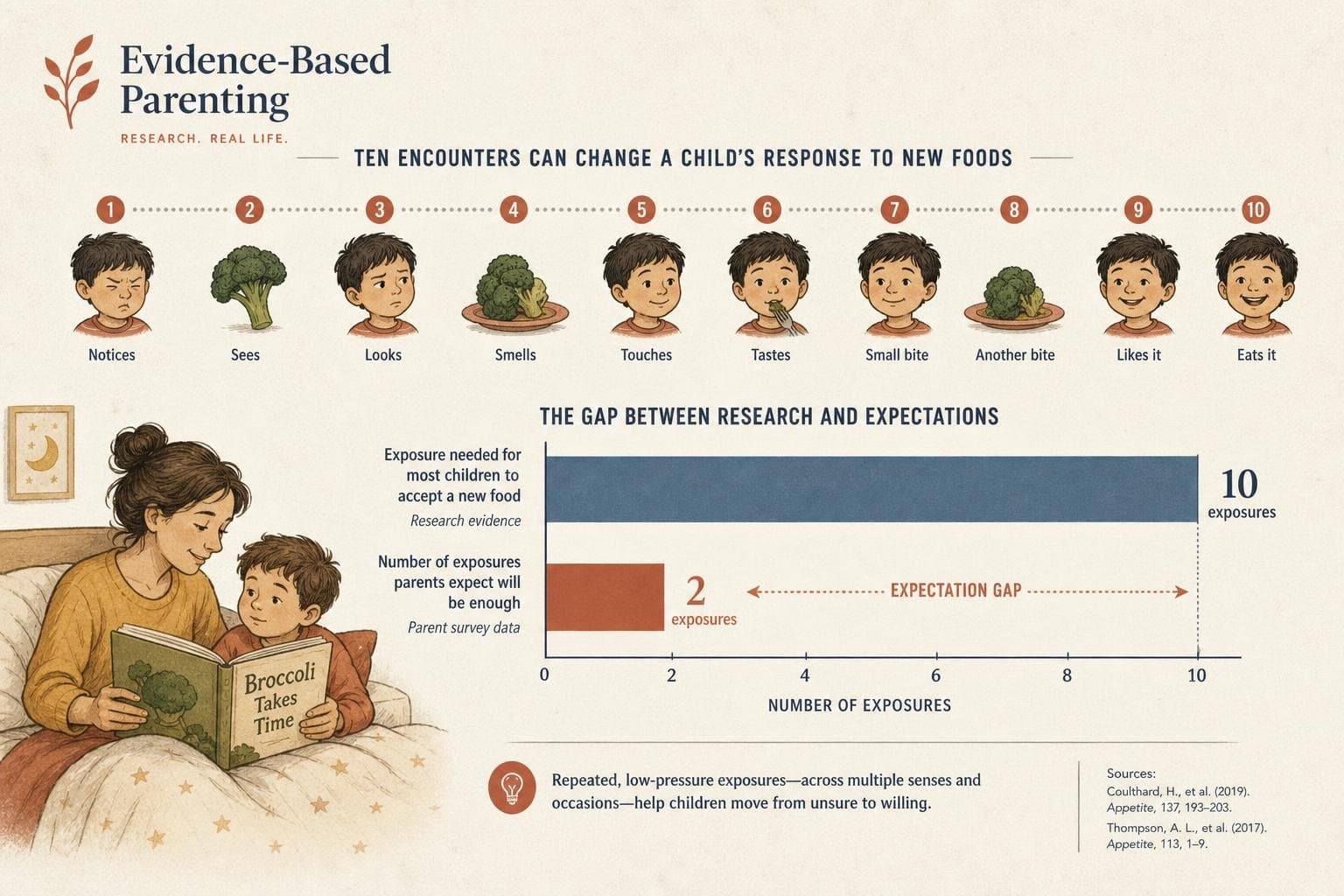
The foundational problem with picky eating advice is that parents underestimate how many exposures it actually takes. The research consensus, reflected in a systematic review published in Obesity Reviews in August 2026, puts the effective threshold at more than ten exposures to a new food before preschool-aged children reliably show increased acceptance. That's not ten meals — that's ten distinct encounters with the food, which can span weeks or months.
Most parents tap out well before that. The child rejects broccoli twice, the parent stops offering it, and the window closes. This isn't a failure of parenting resolve; it's a mismatch between what the research says works and what the advice parents actually receive communicates. "Keep offering it" is correct guidance, but it undersells the repetition required.
The same review also notes that some parents find it genuinely difficult to get children to taste a food the recommended number of times — which is the honest framing that most parenting content skips. The question worth asking, then, is whether there are lower-friction ways to accumulate those exposures.
What Picture Books Actually Do
The Obesity Reviews systematic review examined picture books specifically as an alternative or supplementary strategy for increasing preschool children's vegetable intake, liking, and willingness to taste. The mechanism is indirect: story-based exposure to a food — seeing a character eat and enjoy it, encountering it as a familiar object in a narrative — appears to lower the novelty threshold before the food ever appears on a plate.
This matters because food neophobia (refusal of unfamiliar foods) is partly a familiarity problem. A child who has "met" a parsnip in a picture book is encountering something less foreign when it shows up at dinner. The review follows PRISMA guidelines and draws on intervention studies, which is a stronger design than the observational work that dominates a lot of feeding research.
I want to be careful about what the evidence does and doesn't say here. The review establishes that picture book exposure shows promise as a strategy — it doesn't establish effect sizes I can quote with confidence from the abstract alone, and the full text is behind a publisher paywall. What I can say is that the mechanism is plausible, the study design is appropriate, and the intervention is low-cost enough that the bar for "worth trying" is low even if the effect is modest.
The Feeding Practice That Reliably Makes Things Worse
While picture books represent a potentially useful addition, the research on what not to do is considerably more settled. A cross-sectional study published in Frontiers in Nutrition in September 2026, drawing on 1,535 children aged 3 to 11 recruited from schools in Catalonia, found that both restrictive and pressure-to-eat feeding practices were associated with lower health-related quality of life in children. Monitoring — the more neutral practice of tracking what children eat without actively pressuring — showed no significant association.
The pressure-to-eat finding is particularly worth sitting with. "Just take one bite" feels like a reasonable compromise, but the evidence consistently shows that pressure at the table is associated with worse outcomes, not better ones. (I covered the mechanism in more depth in the July post on table pressure.) The Frontiers study adds a quality-of-life dimension to that picture: it's not just that pressure doesn't work for expanding food acceptance — it's associated with children reporting lower wellbeing more broadly.
The study is cross-sectional, which means it can't establish causation. Children who are already more anxious or have more feeding difficulties may elicit more pressure from parents, rather than the pressure creating the problem. But the direction of the association is consistent with the longitudinal literature, and the sample size is large enough to take seriously.
What This Adds Up To
The practical picture from the current evidence looks like this: the mechanism that works is repeated, low-pressure exposure, and the threshold for "enough" exposures is higher than most parents expect. Anything that adds exposures without adding pressure — including, apparently, vegetable-forward picture books at bedtime — is worth the marginal effort. Anything that adds pressure, even well-intentioned pressure, is working against the mechanism.
The clinical worry threshold is a separate question from everyday picky eating. If a child's food refusal is severe enough to affect growth, involves extreme sensory distress, or fits the profile of avoidant/restrictive food intake disorder, that's a different clinical picture requiring professional assessment — not a problem that more picture books will solve. For the vast majority of preschoolers who simply refuse vegetables with theatrical conviction: the research says keep offering, reduce the stakes, and consider adding a few more routes to familiarity before the food hits the plate.


