
There's a version of this story every preschool parent knows. A neighbor's kid is reading chapter books at four. The kindergarten teacher mentions that some children already know their letter sounds. The parenting forums fill up with phonics app recommendations for toddlers. And somewhere in the background, a low-grade anxiety hums: are we behind?
The research on early reading has a more complicated answer than either "start early" or "let them play." The question isn't really about timing — it's about sequence. And the sequence the evidence points to is not the one most academic-push programs are designed around.
The Brain Builds a Reading Network, But Not From Letters
The Cincinnati Children's research published in JAMA Pediatrics offers a useful frame here. Researcher John Hutton and colleagues describe emergent literacy as a developmental process that begins in infancy, long before a child sees a letter. Their "eco-bio-developmental" model identifies three categories of influence: ecological (home environment, shared reading, conversation), biological (genetics, family history of reading difficulties), and developmental (cognitive and language capacities as they mature). The key finding from their neuroimaging work: more stimulating reading activities in the home environment prior to kindergarten are associated with better-developed brain structure and function supporting literacy.
Notice what that says — and what it doesn't. It's not flashcards. It's not letter drills. It's reading activities: shared books, conversation, stories. The brain is building the network that will eventually support decoding, but it builds that network through language and attention, not through early exposure to the alphabet.
What Actually Predicts Reading Success
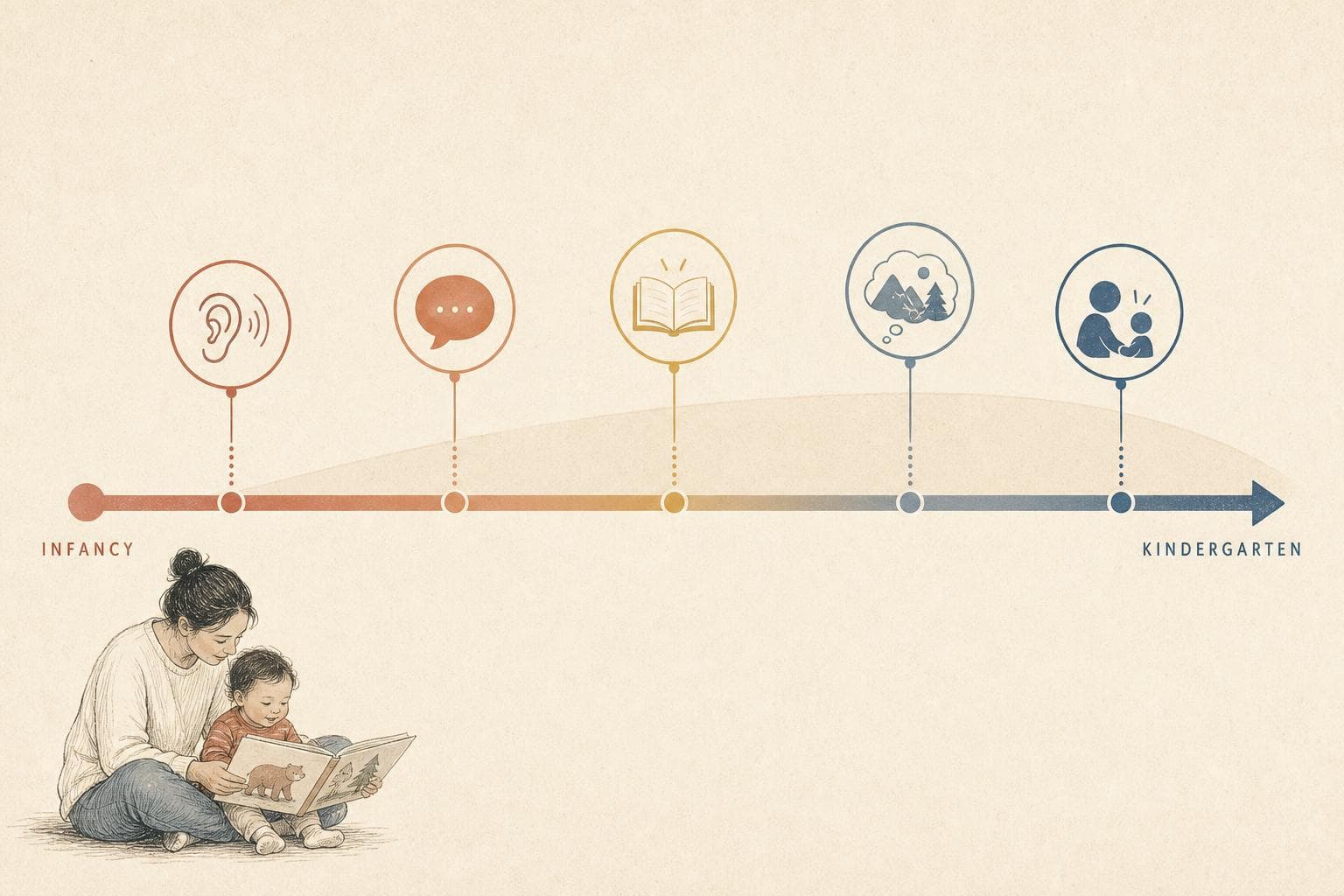
A recent analysis of the pre-reading research literature identifies five capacities that consistently predict later reading outcomes: phonological awareness, oral vocabulary, print awareness, narrative comprehension, and sustained joint attention. The argument, grounded in longitudinal evidence, is that these years from infancy through roughly age five are not a neutral waiting period before formal literacy instruction but a formative window in which the conditions for future reading are actively established.
Phonological awareness — the ability to hear that cat and bat rhyme, to clap syllables, to notice that sun and sit start the same way — is the most robustly predictive of these. And here's what matters for the "push early" debate: phonological awareness develops primarily through spoken language, not written. Rhyming games, songs, read-alouds, and conversation build it. Letter-sound drills can reinforce it once it's developing, but they can't substitute for it.
Oral vocabulary is similarly foundational. A child who arrives at formal reading instruction with a large spoken vocabulary has a massive advantage — not because they know more words, but because decoding a word they've never heard is much harder than decoding a word they already know. The research on shared book reading, including a systematic review of parent-child reading behaviors across Chinese and English research from 2005 to 2024, consistently finds that the quality of reading interactions — dialogue, questions, pointing, elaboration — matters more than the quantity of books or the formality of the instruction.
Where "Pushing" Goes Wrong
The pattern that shows up in the research isn't that early academic exposure is harmful in itself. It's that it tends to crowd out the things that actually build the foundation. Time spent on letter worksheets is time not spent on conversation. An app that drills phonics sounds doesn't build narrative comprehension. A curriculum focused on letter recognition doesn't develop the sustained joint attention that makes shared reading so powerful.
There's also a mismatch problem. Formal reading instruction — systematic phonics, decoding practice — is well-matched to children who have already developed the underlying capacities. For children who haven't, early instruction often produces frustration without progress, and sometimes produces apparent progress (letter-naming, rote decoding) that doesn't transfer to actual reading comprehension. The child who can recite letter sounds but has a thin vocabulary and weak phonological awareness hasn't been accelerated; they've been given a tool they're not yet equipped to use.
I'd argue this is where the "push early" culture most consistently goes wrong. It mistakes the visible outputs of reading (letters, sounds, words) for the invisible prerequisites (language, attention, phonological sensitivity). You can teach a four-year-old to name letters. You cannot shortcut the two years of conversation and shared reading that make those letters meaningful.
What This Means in Practice
The practical takeaway is less about what to stop doing and more about what to protect. Shared reading — with dialogue, not just recitation — builds vocabulary and narrative comprehension simultaneously. Songs and rhymes build phonological awareness without any formal instruction. Conversation, especially the kind that extends a child's own sentences and introduces new words in context, does more for reading readiness than most structured programs.
Formal phonics instruction has strong evidence behind it — but that evidence is strongest when it arrives after the foundation is in place, typically around kindergarten age for most children. Starting earlier doesn't compound the benefit; it often just shifts where the gaps show up.
The neighbor's four-year-old reading chapter books is a real phenomenon. It's also not the goal. The goal is a child who arrives at formal instruction with a brain that's ready to use it.


