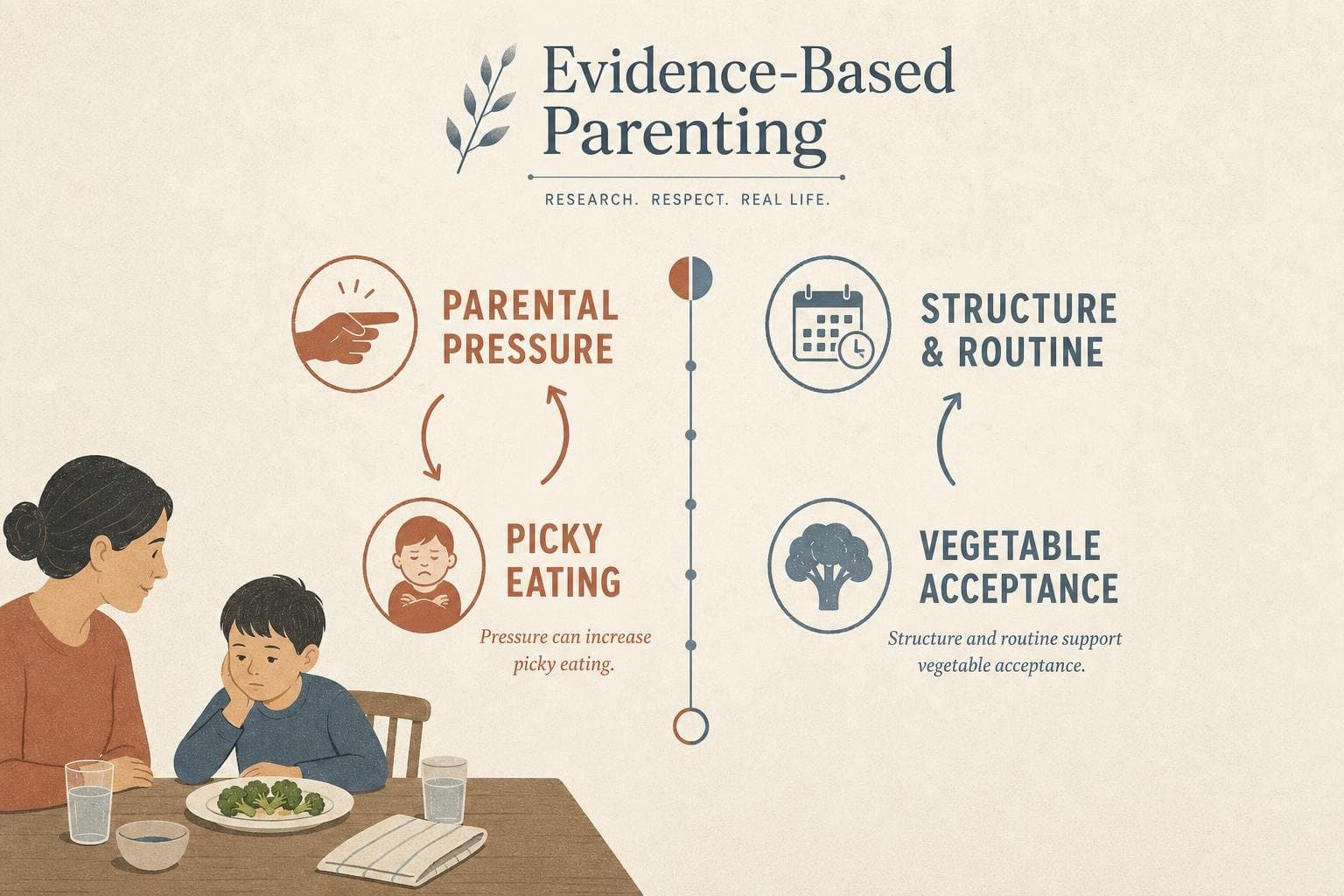

When a toddler refuses broccoli for the fourteenth consecutive meal, the parental instinct to push — "just one bite," "you won't get dessert," "how do you know you don't like it?" — feels almost irresistible. It seems logical: if they never try it, they'll never accept it. But a substantial body of research now suggests this logic runs backward. Pressure to eat tends to worsen food acceptance over time, not improve it. The mechanism matters more than the outcome data, and understanding it changes what "helping" actually looks like at the dinner table.
I wrote about picky eating back in June, focusing on Helen Zoe Veit's historical argument that childhood food selectivity is largely a modern cultural construction rather than a biological given. That framing holds up. What I want to examine now is the parenting behavior side: specifically, what the research says about pressure as an intervention, and what the evidence-supported alternative actually requires of parents.
Pressure Predicts Worse Outcomes — and the Causality Runs Both Ways
The most useful recent data here comes from a longitudinal study published in Appetite this year, drawing on the Fathers & Families Study — 802 fathers of children aged 2–6, tracked across two time points. The study examined what researchers call "coercive control" in feeding — the pressure-based end of the parenting spectrum — alongside "structure," which involves consistent routines and food availability without force.
The findings were instructive in both directions. Higher paternal coercive control at Time 1 predicted a lower likelihood of children consuming sugar-sweetened beverages less than once per week at Time 2 (β = −0.12). But the reverse association also held: children who already consumed fewer SSBs predicted lower coercive control from fathers over time. In other words, pressure and poor dietary patterns appear to reinforce each other bidirectionally — a child's difficult eating behavior can elicit more parental pressure, which then makes the eating behavior worse, which elicits more pressure. Researchers flagged that further work is needed to clarify the mechanisms, but the bidirectional design is more honest than the usual one-directional assumption that parenting simply acts on children.
Structure, by contrast, showed a different pattern. Higher paternal structure at Time 1 predicted greater vegetable consumption at Time 2 (β = 0.09), and children who ate more vegetables predicted higher paternal structure at Time 2 (β = 0.15). Positive cycles, not just negative ones, are possible — but they appear to run through consistency and routine rather than enforcement.
What "Not Pressuring" Actually Requires
The evidence-supported alternative to pressure has a name: the Division of Responsibility in Feeding, developed by dietitian Ellyn Satter. The framework assigns parents responsibility for what food is offered, when, and where — and assigns children responsibility for whether they eat and how much. HealthLink BC's summary of the framework is direct about why pressure fails even when it produces a bite in the moment: "While these strategies may get a child to take a bite at that moment, in the long run pressure can make it harder for them to enjoy a variety of foods on their own. It can also teach them to ignore their body's cues."
That last point deserves more attention than it usually gets. The concern with pressure isn't just that it doesn't work — it's that it actively disrupts the internal hunger and satiety signaling that children need to develop. A child who learns to eat past fullness because a parent is watching, or who learns to associate vegetables with conflict rather than appetite, carries those associations forward.
The practical language shift the framework recommends is small but meaningful. "Would you like to try some?" (respecting a no) versus "Take at least one bite for me" — the difference is whether the child's autonomy over their own body is treated as real.
The Historical Context Sharpens the Point
Veit's research, covered in Newsweek earlier this summer, adds a useful frame: the conditions that produced modern picky eating — constant snack availability, reduced pre-meal hunger, fewer alternatives at the table — are also conditions that make pressure more tempting and less effective simultaneously. When a child arrives at dinner already half-full from an afternoon snack, parental pressure to eat vegetables is fighting both the child's satiety signals and their food preferences at once. The structural fix (managing snack timing, reducing alternatives) addresses the root; pressure addresses the symptom.
What to Watch For
The Fathers & Families Study is notable for centering paternal feeding practices, a population that's been understudied relative to mothers. Whether the bidirectional pressure-diet cycle looks different across family structures, income levels, or cultural contexts remains an open question — the researchers flagged it explicitly. Watch for follow-up work that examines whether interventions targeting paternal feeding practices specifically can break the negative cycle, rather than assuming that findings from maternal-focused research translate directly.
The short version, for the parent staring down a plate of rejected broccoli: the research is fairly consistent that pushing harder makes the problem worse. The harder work is building the conditions — routine, variety, low-pressure exposure — where acceptance can develop on the child's own timeline.


