
Nearly one in five school-age kids used melatonin in the past month, according to survey data cited by The Well at Northwell. That's not a niche bedtime hack anymore — it's closer to a household staple, sitting next to the toothpaste in a lot of medicine cabinets. And yet a new study is the first real evidence that melatonin might be doing something to a stage of sleep parents rarely think about: REM, the dream stage tied to memory and learning (Contemporary Pediatrics).
The headline finding sounds alarming if you don't sit with the study design for a minute. So let's sit with it.
What the Study Actually Measured
Researchers pulled overnight sleep studies — polysomnograms, the gold-standard test that tracks sleep stages, breathing, and nighttime awakenings — from children evaluated at Nationwide Children's Hospital between 2017 and 2019, published in JAMA Network Open and reported by The Well. Polysomnography is the same kind of measurement tool researchers use elsewhere in pediatric sleep medicine to connect physiological severity to functional outcomes, as a separate cross-sectional study of children with sleep-disordered breathing illustrates (JAMA Otolaryngology–Head & Neck Surgery) — a reminder that sleep architecture, not just total hours, is something researchers take seriously when they're trying to explain a kid's daytime functioning.
Researchers compared 342 children whose medical records listed melatonin against 342 children without a melatonin record, matching the two groups on factors like age and health conditions that could independently affect sleep (The Well).
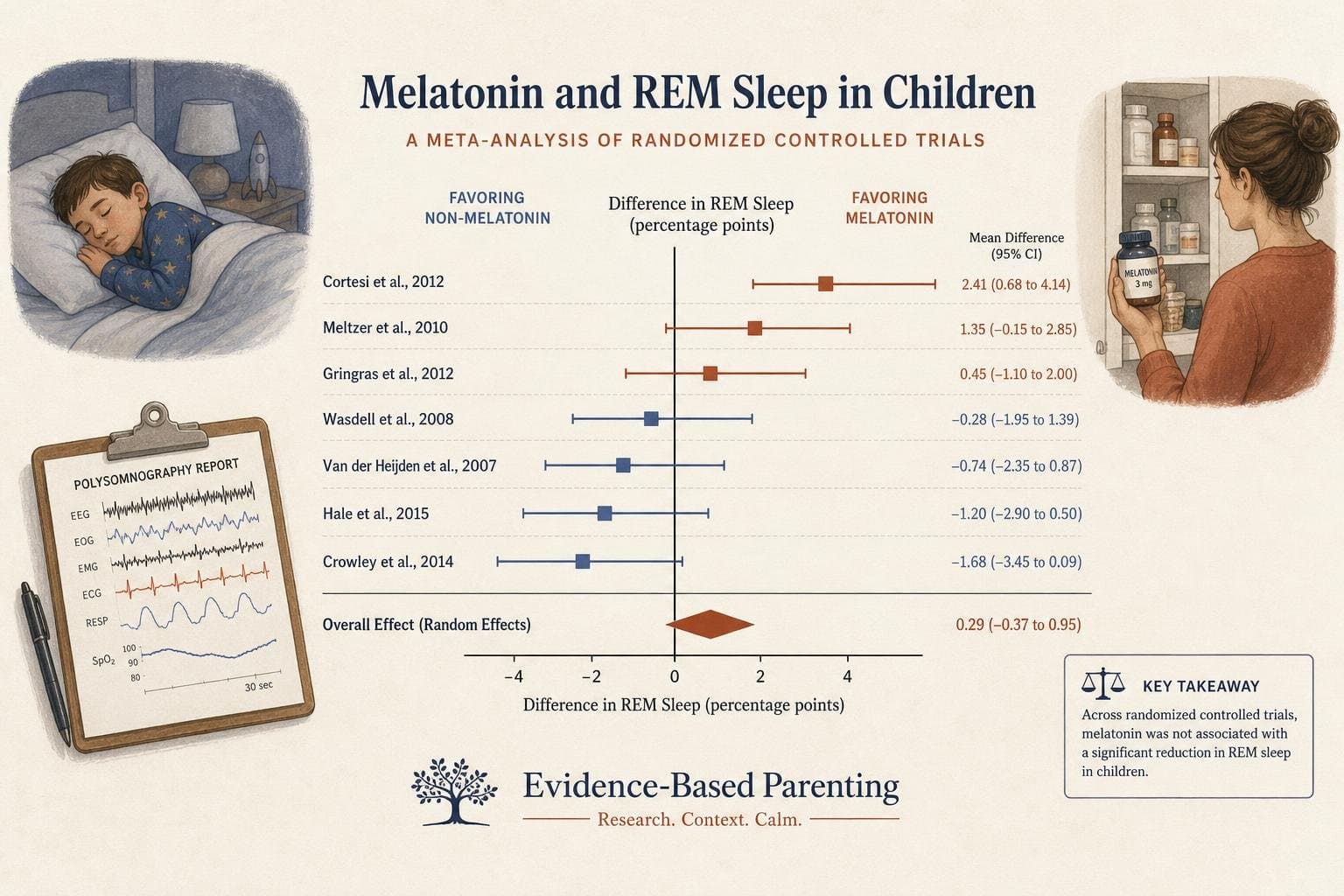
Out of 15 different sleep measures they tracked, only one held up as statistically meaningful after accounting for multiple comparisons: REM sleep. The melatonin group spent a median 16.7% of the night in REM, compared with 19% in the group without melatonin — a 2.3 percentage point gap. Everything else — total sleep time, sleep efficiency, non-REM stages, breathing measures, arousals, periodic limb movements — showed no meaningful difference between groups (The Well).
That's a narrow, specific finding, and the narrowness is the point. This wasn't a study that found melatonin wrecks kids' sleep architecture across the board. It found one measure, out of fifteen, moving in one direction.
Correlation Isn't a Verdict, and the Researchers Know It
Here's the honesty built into the study itself: researchers don't know whether melatonin caused the lower REM percentage, or whether the association reflects something else entirely — the reasons a child was prescribed melatonin in the first place, rather than the drug itself. Dr. Daniel Bigman, a child psychiatrist at Northwell's Zucker Hillside Hospital, frames the uncertainty itself as the reason the finding deserves attention rather than panic (The Well).
This is a retrospective, matched-cohort design pulled from records at a single hospital system over a three-year window. It's a reasonable first step for generating a hypothesis. It is not a randomized trial that can tell you melatonin caused anything. The children on melatonin may have had different underlying sleep problems, different neurodevelopmental profiles, or different reasons for ending up in a sleep lab in the first place — any of which could independently affect REM percentage. Until someone runs a prospective, randomized study tracking REM before and after melatonin initiation, this stays an association worth watching, not a mechanism worth fearing.
Where Melatonin Actually Fits in Clinical Practice
Zoom out, and the REM finding lands inside a broader clinical picture that's been consistent for a while: insomnia symptoms affect roughly 20-25% of children and 25-35% of adolescents, climbing above 80% in kids with chronic medical, psychiatric, or neurodevelopmental conditions, according to a clinical overview in Contemporary Pediatrics. Insufficient nighttime sleep has been linked to effects on attention, memory, academic performance, and risk for behavioral symptoms, which is part of why clinicians treat insomnia as something worth addressing rather than waiting out (Contemporary Pediatrics). The same source is unambiguous about sequencing: sleep hygiene and behavioral treatment are first-line, particularly for typically developing kids, with medication — melatonin included — positioned as an adjunct that clinicians reach for off-label when behavioral approaches aren't enough.
That sequencing matters for how you read the REM study. Melatonin in practice is rarely the first tool parents or pediatricians try. It tends to show up after sleep hygiene fixes have already been attempted, often in kids whose sleep difficulties are more entrenched or layered onto another diagnosis. If the REM study's melatonin group was disproportionately made up of harder sleep cases to begin with, that alone could explain part of the gap — no drug effect required. Population-level tracking of children's health patterns, the kind compiled by agencies like the National Center for Health Statistics, is exactly the sort of infrastructure that would eventually help sort out whether melatonin use correlates with other sleep or developmental factors at scale (CDC/NCHS) — but that broader dataset doesn't exist yet for this specific question.
The Honest Bottom Line
I don't think this study is a reason to panic about melatonin bottles already on your shelf. I do think it's a reason to want better studies — specifically ones that track REM sleep before and after a child starts melatonin, rather than comparing two different groups of kids at a single point in time. Until that exists, the REM finding is a flag, not a verdict. Watch for whether this JAMA Network Open result gets picked up as the basis for a prospective trial — that's the study that would actually settle whether the association is causal, and it's the one worth waiting for before changing how you use melatonin at home.


