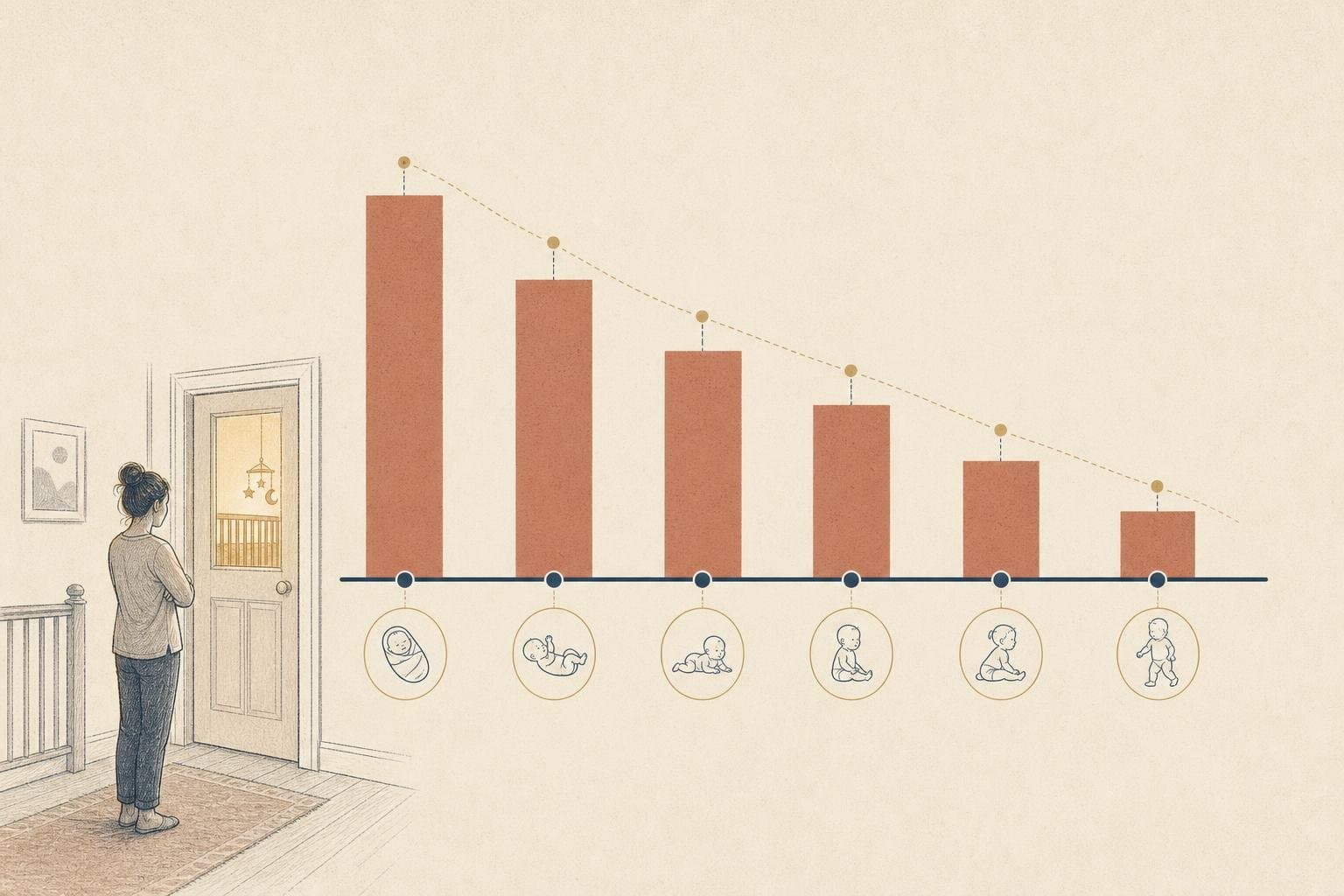

There's a particular kind of 3 a.m. guilt that belongs exclusively to sleep-training parents. You've put the baby down, walked out, and now you're standing in the hallway listening to crying, wondering if you're doing something that will show up in a therapy session twenty years from now. The fear isn't irrational — it's been actively cultivated by a parenting culture that treats extinction sleep training as a form of emotional abandonment. So what does the research actually say?
The short answer: the attachment damage claim doesn't hold up well under scrutiny. The longer answer involves some important design limitations you should know before you either relax completely or dismiss the concern entirely.
What the Evidence Actually Shows
The most direct study on this question followed 178 infants and their mothers over 18 months, repeatedly assessing whether parents intervened immediately when babies cried or allowed them to cry it out. Attachment was measured at 18 months using the Strange Situation Procedure — the gold-standard experimental setup that observes how infants respond to separation and reunion with their caregiver. Behavioral development was assessed through direct observation, psychologist evaluation, and parent-report questionnaires.
The finding: whether parents responded immediately or let babies cry made no measurable difference to attachment security or behavioral development at 18 months. The study, published in the Journal of Child Psychology and Psychiatry, also found something counterintuitive — infants left to cry it out at 3 months actually cried less and for shorter durations by 18 months, suggesting some capacity for self-regulation was developing.
That's a meaningful result. But 178 participants, followed to 18 months, measured primarily through maternal report — that's not the kind of longitudinal depth that settles a question permanently. It's a solid data point, not a verdict.
The Age Question Is Not Optional
Here's where the evidence gets more specific, and where a lot of popular sleep training discourse goes wrong: the research on sleep training outcomes applies to babies old enough for sleep training to be developmentally appropriate. That's not newborns.
Pediatricians don't recommend cry-it-out or Ferber methods before about 4 months of age — and the studies showing sleep training works were conducted on babies 6 months and older, not newborns. Before 4 months, infant sleep runs on biology: sleep cycles of 40–60 minutes, circadian rhythms still developing, genuine nutritional need for nighttime feeds every 2–4 hours. There's nothing to train because the neurological infrastructure for self-regulation isn't there yet.
This matters for interpreting the attachment research. When studies find no adverse effects from cry-it-out, they're studying parents who are, in practice, mostly using it with older infants whose brains have matured enough to begin learning self-soothing. Applying that finding to a 6-week-old is a misread of what the evidence covers.
The Measurement Problem Worth Taking Seriously
There's a subtler issue that doesn't get enough attention: the Strange Situation Procedure, the standard tool for assessing infant attachment, may not be culturally neutral. A study published in the International Journal of Behavioral Development found that Korean and Japanese infants cried significantly more during the Strange Situation than U.S. and Czech infants — not because they were more insecurely attached, but because separation from mothers is far less common in their daily lives, making the procedure itself more frightening. Past research had disproportionately classified East-Asian infants as "insecure-resistant" based on this reaction.
This doesn't undermine the cry-it-out attachment findings directly, but it's a useful reminder that the tools we use to measure attachment carry assumptions. "No adverse effects on attachment" means no adverse effects as measured by this procedure, in these populations. That's still meaningful — but it's a narrower claim than the headline version.
What This Actually Means for Your Decision
The honest synthesis: the fear that cry-it-out causes lasting attachment damage is not well-supported by the available evidence. Parents who use extinction methods with developmentally appropriate-aged infants — generally 4–6 months and older, per pediatric guidance — are not, as best we can measure, harming their children's relationship with them.
What the research doesn't tell you is whether the method is right for your family, your baby's temperament, or your own capacity to tolerate the process. The Sydney Children's Hospitals Network notes that experts including the Australian Association of Infant Mental Health recommend approaches that consider a baby's emotional and developmental needs — and that there's no single right method. That's not a hedge; it's an accurate description of where the evidence sits.
The guilt you feel in the hallway isn't evidence that you're causing harm. But it's also not something the research can fully dissolve. What it can do is tell you that the catastrophic version of the story — that letting a baby cry will break the bond between you — isn't what the data shows. That's worth knowing at 3 a.m.


