
Every few months, a new wave of social media posts revives the same claim: letting your baby cry it out causes lasting emotional damage, disrupts attachment, floods infants with cortisol, and sets them up for anxiety. The posts are vivid and emotionally compelling. They are also, based on the available research, not well-supported.
I've covered sleep training methodology twice before — first examining measurement problems in the research and then looking at how housing instability reshapes the entire debate. What I haven't done is address the attachment question head-on, because it keeps coming back. So let's do that.
What "Cry-It-Out" Actually Means (and Why the Terminology Keeps Confusing Everyone)
Before the evidence, a definitional problem that genuinely matters. "Cry-it-out" is used colloquially to describe a wide range of approaches, and the conflation creates real confusion. The Ferber method — probably the most widely practiced structured approach — involves timed parental check-ins that can begin as short as two minutes. Traditional extinction, the actual "close the door and don't return" approach, is a distinct method. Parents and researchers often use the same term for both, which means studies measuring one get cited as evidence about the other.
This matters because the emotional stakes of the two approaches are different, the parental experience is different, and the research populations may not be comparable. When you read a headline claiming cry-it-out "works" or "harms," the first question is always: which version did they study, and on whom?
What the Evidence Actually Shows on Attachment
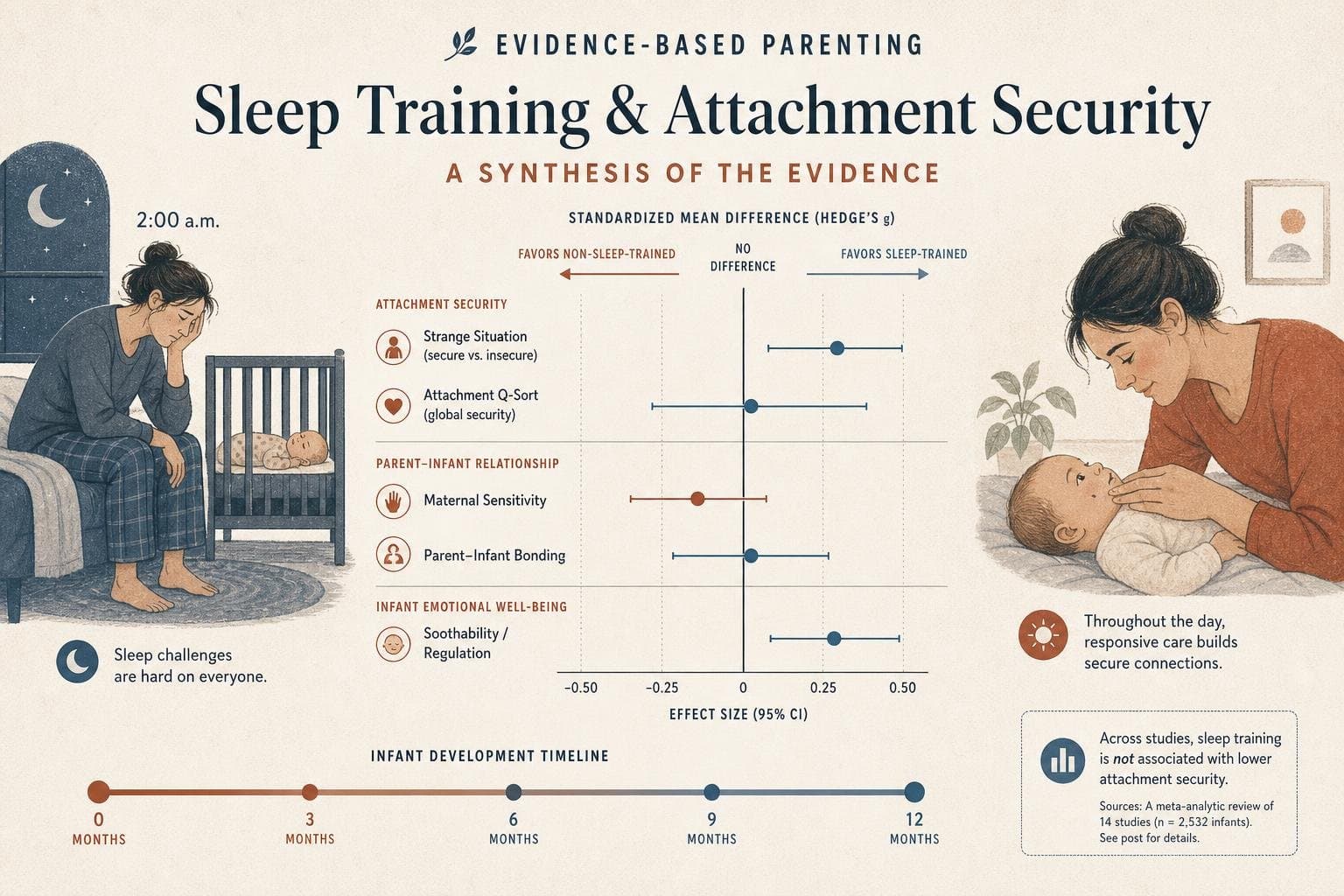
A BBC Future review of the research — drawing on decades of studies — found that sleep training, broadly defined, does not appear to cause lasting harm to parent-child attachment, emotional development, or stress regulation in healthy infants. A 2015 study by Wendy Hall, a pediatric sleep researcher in Canada, followed 235 families of six- to eight-month-old babies and found that sleep training improved infant sleep without detectable negative effects on the parent-child relationship.
That finding has been replicated enough times that the scientific consensus is fairly stable: developmentally appropriate sleep training in healthy infants does not damage attachment. The research has not found meaningful differences in attachment security, emotional outcomes, or later stress levels between sleep-trained and non-sleep-trained children.
What the research has found — and this is the part that gets less attention — is that parental wellbeing matters enormously. Poor infant sleep is associated with maternal depression and compromised maternal health, according to the same BBC Future review. A parent who is severely sleep-deprived and depressed is not better positioned to provide sensitive, responsive caregiving. The attachment calculus isn't just about what happens at 2 a.m. when the baby cries.
The Variable That Keeps Showing Up: Maternal Sensitivity
A 2026 longitudinal study published in European Child & Adolescent Psychiatry adds useful texture here. Researchers followed 101 German and 117 U.S. mother-infant dyads, tracking infant night sleep duration at multiple points from 3 to 24 months. Their finding: maternal sensitivity — observed at 6 months — predicted longer infant sleep duration in the U.S. cohort, and buffered the effects of maternal stress history on infant sleep in the German cohort.
The study wasn't about cry-it-out specifically. But its implications are worth sitting with. Responsive, sensitive caregiving during waking hours appears to support infant sleep independently of nighttime method. This is consistent with attachment theory's actual predictions: secure attachment is built across thousands of daytime interactions, not determined by a single nighttime approach. The idea that one method of nighttime settling overrides the entire relational context of an infant's life is not what the attachment literature says.
A narrative review of pediatric sleep disorders published on PubMed notes that behavioral interventions — the category that includes sleep training — remain the primary recommended approach for childhood insomnia, with parental education as a core component. The clinical consensus hasn't moved toward warning parents away from behavioral methods.
What This Means for Anxious Parents
The honest summary: the research on cry-it-out and attachment has been fairly consistent for years. No well-designed longitudinal study has found that developmentally appropriate sleep training causes lasting harm to healthy infants in stable caregiving environments. The caveats in that sentence — developmentally appropriate, healthy infants, stable caregiving environments — are real and worth taking seriously. Sleep training is not a universal prescription, and the research populations in most studies skew toward families with resources and stability.
But the viral claim that letting a baby cry causes permanent emotional damage is not supported by the evidence we have. What is supported: parental sensitivity and responsiveness during waking hours matter a great deal. Parental mental health matters. The specific method matters less than the relational context surrounding it.
If you're choosing a nighttime approach out of genuine reflection on your family's needs, the research gives you room to make that choice without catastrophizing either direction. What it doesn't support is the confident social media certainty — in either direction — that one nighttime method determines your child's emotional future.


