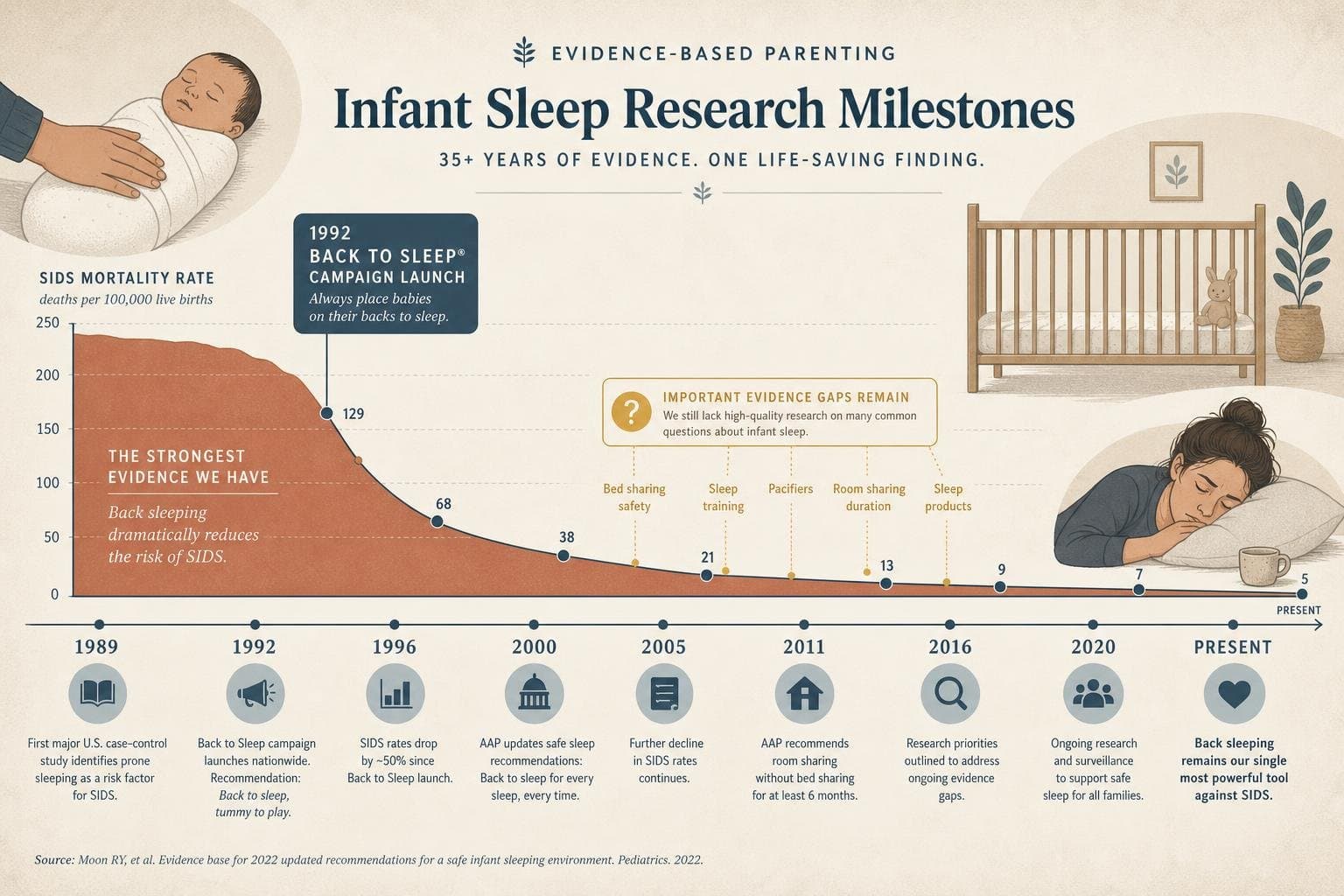

Ask ten parents where their newborn slept last night and you'll get ten different answers, plus some defensiveness. Bed-sharing is one of those topics where the official guidance is blunt — don't do it — and the lived reality in a lot of households is messier. What's striking when you actually trace the evidence trail is how much of the foundational research predates the current conversation entirely, and how little has moved since.
The Back-Sleeping Story Is the Strongest Evidence We Have — And It's Not Really About Bed-Sharing
The single most robust finding in infant sleep safety has nothing to do with co-sleeping arrangements. It's sleep position. When the American Academy of Pediatrics began advocating against prone (stomach) sleeping in 1992, following research out of Australia, New Zealand, and Europe in the late 1980s, SIDS deaths in the US fell by roughly 40 percent — from about 1.2 to 0.7 deaths per 1,000 live births, translating to roughly 3,000 fewer deaths a year (Contemporary Pediatrics). That's a genuinely dramatic population-level shift, and it's the reason "back to sleep" became the single most repeated phrase in newborn care.
But that same 2001 review flagged something adjacent that's still relevant: physicians were, even then, inconsistent about discussing co-sleeping risk with families, despite data showing parents follow safe-sleep recommendations most reliably when their pediatrician raises the subject directly (Contemporary Pediatrics). That gap between "guidance exists" and "guidance gets delivered" is worth sitting with, because it hasn't obviously closed.
Current Guidance Separates Room-Sharing From Bed-Sharing — On Purpose
The CDC's current safe sleep recommendations, aligned with the American Academy of Pediatrics' 2022 policy statement, draw a sharp line between sharing a room with your infant and sharing a bed (CDC). Room-sharing — baby in a separate, firm sleep surface in the parents' room — is the recommended setup. Bed-sharing, where the infant sleeps on the same surface as a parent, sits outside that recommendation.
This is worth being precise about, because the two get conflated constantly in casual conversation. "Co-sleeping" is often used loosely to mean both, and the risk calculus for each is not the same. The CDC's framing treats room-sharing as protective and bed-sharing as something to avoid, without collapsing them into a single category (CDC).
What I can't do, honestly, is hand you a recent large-sample longitudinal study from this source pool that quantifies bed-sharing risk with the kind of precision I'd want — a dose-response curve by infant age, breastfeeding status, parental smoking, surface type, the variables that actually determine whether bed-sharing is catastrophic or merely discouraged. That research exists in the broader literature, but it isn't in front of me today, and I'd rather tell you that plainly than manufacture a number.
The Sleep Quality Half of the Question Is Even Thinner Than the Safety Half
Here's where I want to flag a genuine evidence gap rather than paper over it. Parents who bed-share often report it as the thing that got everyone more sleep — fewer full wake-ups, easier nursing in the night, a baby who settles faster against a warm body. That's a plausible mechanism. But none of the sources available to me today actually measure infant or parental sleep quality under bed-sharing versus separate-surface arrangements with objective tools.
For context on how that kind of measurement even works: a newer JAMA Pediatrics analysis of the Adolescent Brain Cognitive Development study used consumer wearables to estimate sleep duration across large samples, while also noting that wearable-derived sleep estimates come from proprietary algorithms researchers can't always independently verify (JAMA Pediatrics). That's a caution worth importing into any infant sleep claim you see floating around — self-report and device data both have real limits, and infant sleep research faces the added problem that you can't put a monitor on a newborn and get the same signal quality you'd get from an adult.
Separately, a 2026 AAP systematic review on supporting parents of excessively crying infants is a reminder that the broader infant-settling literature is still actively being built, with researchers explicitly cataloging where evidence is thin and where it's solid (Pediatrics/AAP) — a pattern that shows up again and again in infant sleep research generally.
What to Actually Watch
The safety guidance here is settled and unambiguous: back to sleep, separate firm surface, room-sharing without bed-sharing, per CDC and AAP (CDC). The sleep-quality question — whether bed-sharing genuinely improves rest for parents or infants, and for whom — remains underbuilt as a research base, at least in what's been published and indexed recently. If you're making this decision in your own house, that distinction matters: one half of the question has decades of consensus behind it, the other is still mostly anecdote dressed up as evidence.


