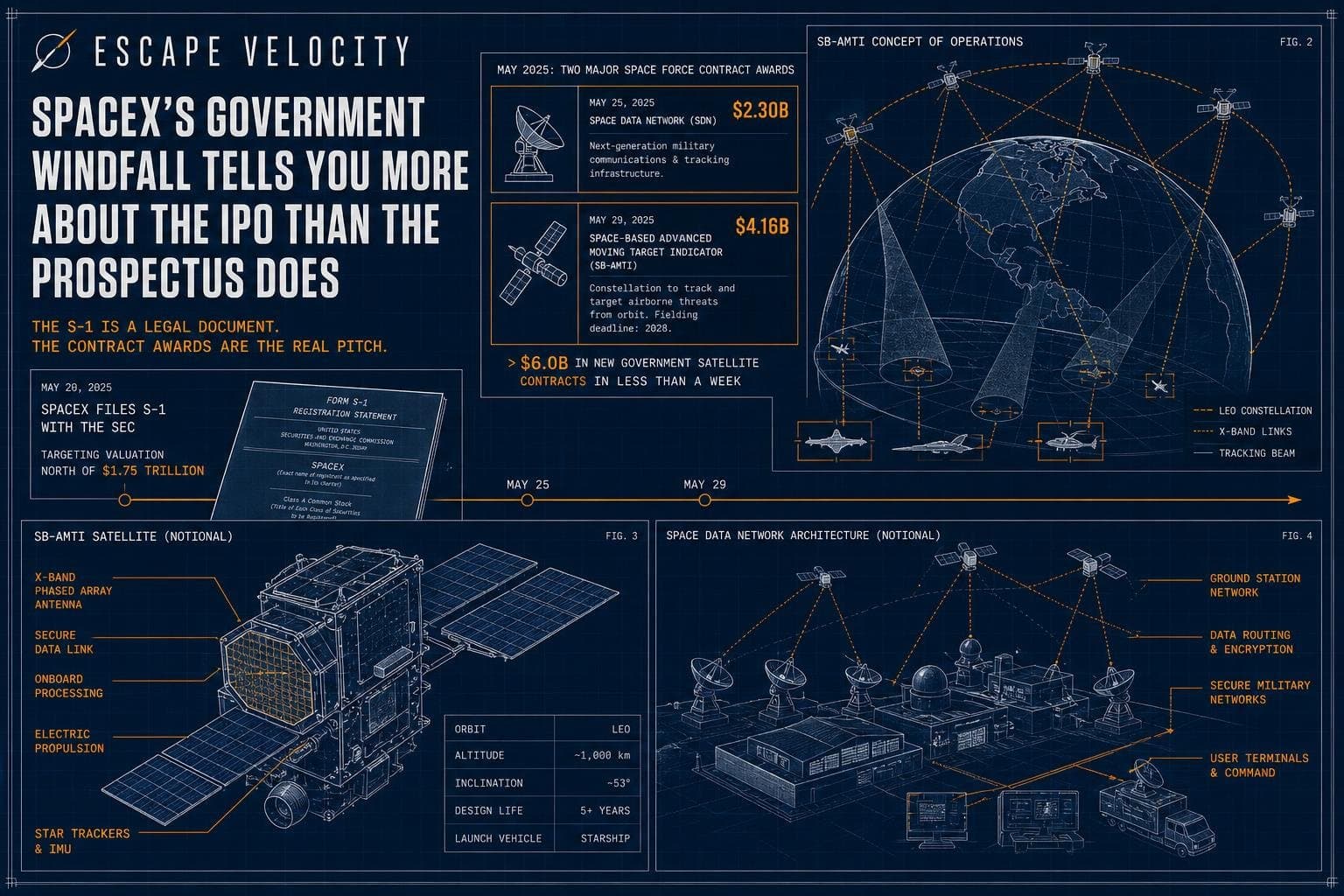

The S-1 is a legal document. The contract awards are the real pitch.
In the three weeks before its planned IPO, SpaceX collected two major Space Force contracts in four days. On May 26, the Space Force awarded the company a roughly $2.3 billion deal for the Space Data Network. Three days later, on May 29, it added a $4.16 billion contract for the Space-Based Advanced Moving Target Indicator program — a constellation designed to track and target airborne threats from orbit, with a fielding deadline of 2028. That's over $6 billion in new government satellite contracts in less than a week, from a company that filed its S-1 with the SEC on May 20 and was targeting a valuation north of $1.75 trillion.
Coincidence of timing is possible. But the sequencing is worth examining, because it tells you something about what SpaceX actually is as a business — and what the IPO is actually selling.
The SB-AMTI Contract Is Not a Blank Check
The $4.16 billion SB-AMTI award is real and confirmed. What it isn't is a completed program. Air & Space Forces Magazine reported that the Space Force did not specify how many satellites SpaceX would deliver under the contract, and that the service plans to announce "multiple awards in the coming year" from a vendor pool that includes other undisclosed companies. The stated goal is "vendor-diverse expansion" of the industrial base.
That framing matters. SpaceX has an initial award and a 2028 fielding target. It does not have an exclusive program of record. The Space Force's fiscal 2027 budget request includes $7 billion for SB-AMTI procurement broadly — SpaceX's $4.16 billion is a piece of a larger, multi-vendor architecture, not a sole-source franchise.
The S-1/A amendment filed June 3 would presumably reflect the company's government contract posture at the time of filing. Investors reading the prospectus should be asking which of these awards appear as backlog versus pipeline, and what the revenue recognition schedule looks like against a 2028 delivery milestone. A $4 billion contract with a two-year build schedule is not $4 billion in near-term revenue.
What Amazon's Launch Dependency Actually Reveals
While SpaceX was collecting defense contracts, a different constellation story was playing out at Kourou. On June 17, an Ariane 6 with upgraded P160C solid rocket boosters launched 36 Amazon Leo satellites — the most on a single mission to date for that program, and the heaviest payload Ariane 6 has ever carried. The upgraded boosters added more than two metric tons of LEO capacity compared to the previous P120C configuration.
The reason Amazon is leaning on Arianespace is instructive. New Glenn suffered an anomaly on the BlueBird 7 mission in April that deployed the satellite into the wrong orbit, losing the spacecraft. Vulcan Centaur has its own schedule challenges. Amazon has one Atlas V launch remaining for Leo, scheduled for July 3, after which Arianespace becomes the primary workhorse for a 3,636-satellite constellation that has so far placed 367 satellites on orbit across multiple vehicles.
The VA269 mission was the third of 18 Ariane 6 launches Amazon contracted from Arianespace in 2022. Eighteen confirmed launches over a multi-year manifest is exactly the kind of contracted, denominated revenue that deserves the word "contract." It's also a reminder that constellation deployment at scale requires launch reliability, not just launch availability — and that single-vehicle dependencies are a program risk, not a feature.
The Servicing Market Is Still Proving Its Economics
One more data point from the same week: Katalyst Space announced $12 million in funding to develop NEXUS, its first GEO-capable robotic servicing spacecraft, scheduled to launch on Ariane 6 in 2027. The round was led by Geodesic Capital. Before NEXUS flies, Katalyst will use its LINK spacecraft — integrated on Northrop Grumman's Pegasus XL — to rendezvous with NASA's Neil Gehrels Swift Observatory under a $30 million NASA contract awarded last September, with launch scheduled for June 27.
The Katalyst story is worth watching not because $12 million is a large number — it isn't, by the standards of this industry — but because the mission architecture is specific and verifiable. Named spacecraft, named launch vehicles, named government customer, named orbital target. That's the kind of specificity that separates a real program from a market-size slide.
CEO Ghonhee Lee's framing is also worth noting: the goal is to move beyond life extension as the default servicing use case, toward robotics that can support broader in-orbit infrastructure. Whether the economics support that vision at NEXUS scale is a question the 2027 mission will actually answer.
The through-line across all three stories: government contracts are the load-bearing structure of the current commercial space business, not the commercial market that pitch decks describe. SpaceX's IPO valuation rests substantially on defense and civil space revenue. Amazon Leo's deployment schedule depends on which government-backed launch vehicles are actually flying. Katalyst's first revenue comes from NASA. Watch the contract awards, the flight rates, and the anomaly histories. The narrative will take care of itself.


