


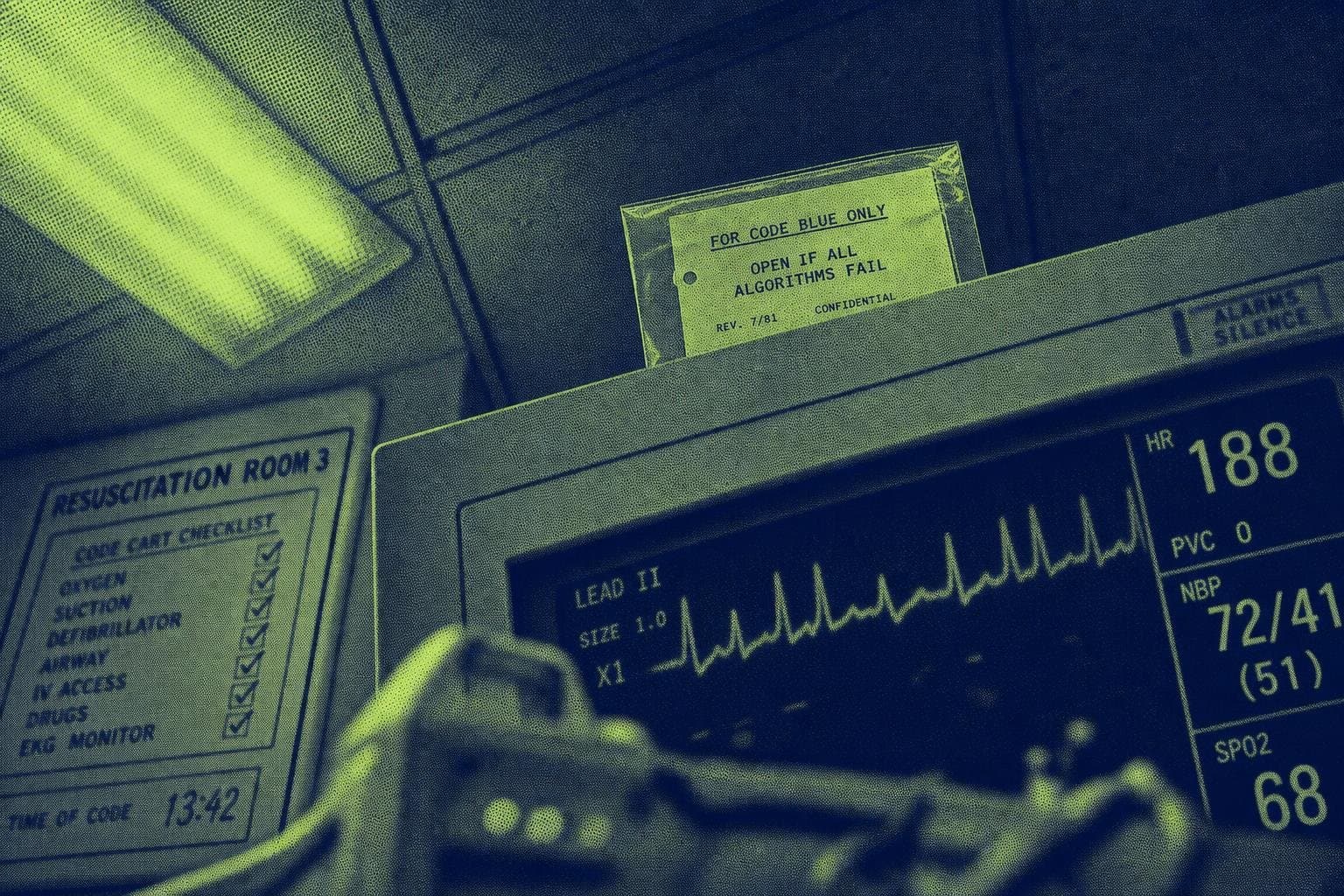

Here's the design problem that has haunted near-death experience research for two decades: if patients in cardiac arrest sometimes report accurate perception of events happening around their unconscious bodies, you should be able to test it. Put a hidden image on top of a shelf or monitor in the resuscitation room, somewhere only a floating consciousness could see it, and ask survivors what they saw. It's an elegant idea. It is also, in practice, brutally hard to execute, because cardiac arrest is rare, survival is rarer, and clear memory of the arrest itself is rarer still.
This week's search for fresh data on that specific question — the AWARE-II line of research and its claims about veridical perception during clinical death — came up short. I don't have a peer-reviewed paper or institutional report in front of me confirming new findings, positive or null, from that program. Rather than manufacture a result that isn't there, it's worth sitting with why this particular corner of consciousness research keeps producing more methodology than data.
The Sample Size Problem Is the Whole Story
Any honest account of hidden-target NDE research has to start with attrition. You need a hospital with enough cardiac arrests, enough survivors, enough of those survivors reporting a "resuscitation experience" at all, and then enough overlap between that group and people who happened to look toward the hidden image. Multiply those filters together and you get a denominator that shrinks fast. The general summary of NDE research history notes that clinical investigations in cardiac arrest settings have been a recurring but methodologically constrained thread since the field's mid-20th-century development — which is a polite way of saying that these studies have never had the statistical power to settle much of anything on their own.
This is where a broader piece of science news from this month is worth borrowing, even though it has nothing to do with NDEs directly. A large replication project published in Nature this year re-ran 274 claims of positive results across 164 social and behavioral science papers and found that only about 55% replicated in the original direction with statistical significance, with effect sizes shrinking by roughly 82% on average from original to replication (Nature). That's not a psi or NDE study. But it's a useful baseline for how skeptical to be of any small-sample, high-stakes claim before independent replication — and veridical-perception NDE research sits squarely in the category of small samples and extraordinary claims that this kind of project exists to stress-test. Regular readers know this is a drum I've beaten before with Bem's psi data — the pattern of "statistically real, interpretively contested" shows up again and again in edge science, and NDE research is no exception.
The Cultural Hunger Runs Ahead of the Evidence
What's easier to document than the neuroscience is the appetite for meaning that surrounds these experiences. A recent Atlantic conversation between David Brooks and novelist Ayad Akhtar, built around Akhtar's new novel about a man whose spiritual state is transformed by an inner illumination, isn't about NDEs at all — but it's circling the same territory: the difficulty of putting ineffable, self-transforming experience into language that a skeptical audience can evaluate (The Atlantic). That gap — between an experience that feels totally certain to the person who had it and a description that can survive scrutiny from someone who didn't — is exactly what makes veridical perception claims so tantalizing and so hard to nail down. The subjective certainty of the near-death experiencer and the epistemic caution required of the researcher are pulling in opposite directions, and no amount of narrative power resolves that tension.
None of this means the hidden-target approach is a dead end. It means the honest status of the research, as far as current sourcing shows, is still "promising design, insufficient data" rather than "confirmed phenomenon." The next time a large multi-site cardiac arrest study reports its enrollment numbers and hit rate on hidden targets, that's the number worth watching — not the anecdotes that circulate long before the data does.