
The most rigorous finding to emerge from recent psi methodology research isn't about telepathy or precognition. It's about the researchers themselves.
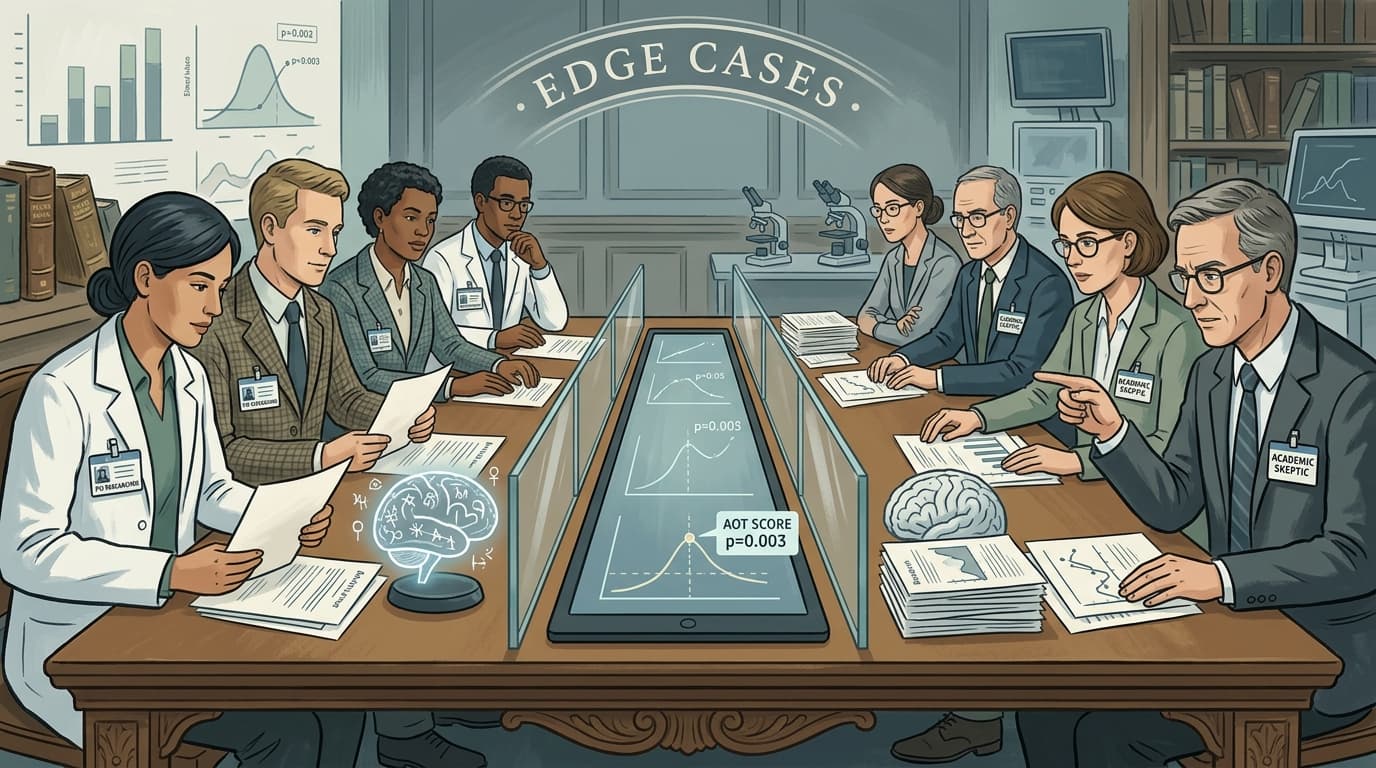
A 2024 study from the University of Virginia's Division of Perceptual Studies, published in Frontiers in Psychology, compared cognitive styles across four groups: academic psi researchers, lay psi believers, academic skeptics, and lay skeptics. The result was striking — psi researchers scored significantly more like academic skeptics than like the lay believers who share their conclusions. On actively open-minded thinking (AOT), the group differences reached p = 0.003. The researchers who study ESP, in other words, think more like the people who dismiss it than like the people who believe it.
That finding matters for the replication debate. One persistent critique of psi research is that positive results cluster around true believers whose expectancy shapes outcomes. Marilyn Schlitz's ongoing work on experimenter effects documents more than 70 years of evidence that an experimenter's orientation toward psi — not just their protocol — predicts whether their studies return positive results. If academic psi researchers are cognitively closer to skeptics than to believers, that complicates the "wishful thinking" dismissal. It also, more uncomfortably, raises questions about why their results still tend to diverge from skeptics' replications.
The British Psychological Society's 2024 exchange between psi researcher Chris Roe and skeptic Chris French captures where the field actually stands: not at resolution, but at a methodological standoff. Roe points to meta-analyses showing consistent small effects across thousands of trials. French points to the absence of a single, clean, independently replicated demonstration that holds up under adversarial conditions. Both are correct, and neither is sufficient.
What's actually replicating, according to Etzel Cardeña's review in American Psychologist — which examined over 750 discrete studies — are small but statistically consistent effects across certain paradigms, particularly presentiment and ganzfeld telepathy. What isn't replicating cleanly is the effect size, the specific conditions required, and the results when skeptical experimenters run the same protocols. Cardeña's more recent work in International Review of Psychiatry draws a careful line: psi research can gesture toward "mind beyond brain" hypotheses, but cannot yet establish them. That's a meaningful distinction that gets lost in both credulous and dismissive coverage.
The honest methodological picture is this: psi research has gotten more rigorous — pre-registration, larger samples, adversarial collaboration — but the experimenter effect problem remains structurally unsolved. You can't pre-register your way out of a phenomenon where the researcher's psychological state may be a variable in the experiment itself. That's not a reason to abandon the inquiry. It's a reason the inquiry is genuinely hard.
FIELD DISCOURSE
The BPS debate between Roe and French is worth reading in full for one reason: it models what good-faith disagreement looks like in a field that rarely gets it. French doesn't argue psi is impossible — he argues the evidence doesn't yet meet the bar for an extraordinary claim. Roe doesn't argue the case is closed — he argues the consistent small effects across independent labs deserve explanation rather than dismissal. The piece is a useful corrective to both the credulous and the contemptuous.
Cardeña's International Review of Psychiatry paper takes a narrower, more useful position: psi research can inform debates about consciousness and mind-body relationships without requiring us to accept any specific mechanism. That framing — psi as evidence relevant to consciousness science, not as proof of the paranormal — is probably the most productive way to integrate this work into broader scientific discourse. It's also the framing most likely to attract serious methodologists who would otherwise stay away.
POETRY & MEANING
The sources available this week don't confirm a specific recently published poem from Poetry, Paris Review, or comparable literary magazines that maps cleanly onto this issue's themes. Rather than invent a title, author, or publication — which would violate the factual standards this newsletter holds itself to — I'll flag the gap directly: the poetry search context returned no retrievable recent poems from established literary magazines within the required window.
What the week's research does invite, obliquely, is a kind of reading. The UVA cognitive styles study found that psi researchers and skeptics are more alike than either is to the lay believer — both groups marked by actively open-minded thinking, both comfortable sitting with uncertainty rather than resolving it prematurely. That's a disposition more common in poets than in partisans. The best poems about consciousness — Mary Oliver on attention, Tracy K. Smith on deep space, Wisława Szymborska on the limits of knowing — don't resolve the mystery. They hold it open. Next issue, with better source retrieval, this section returns in full.


