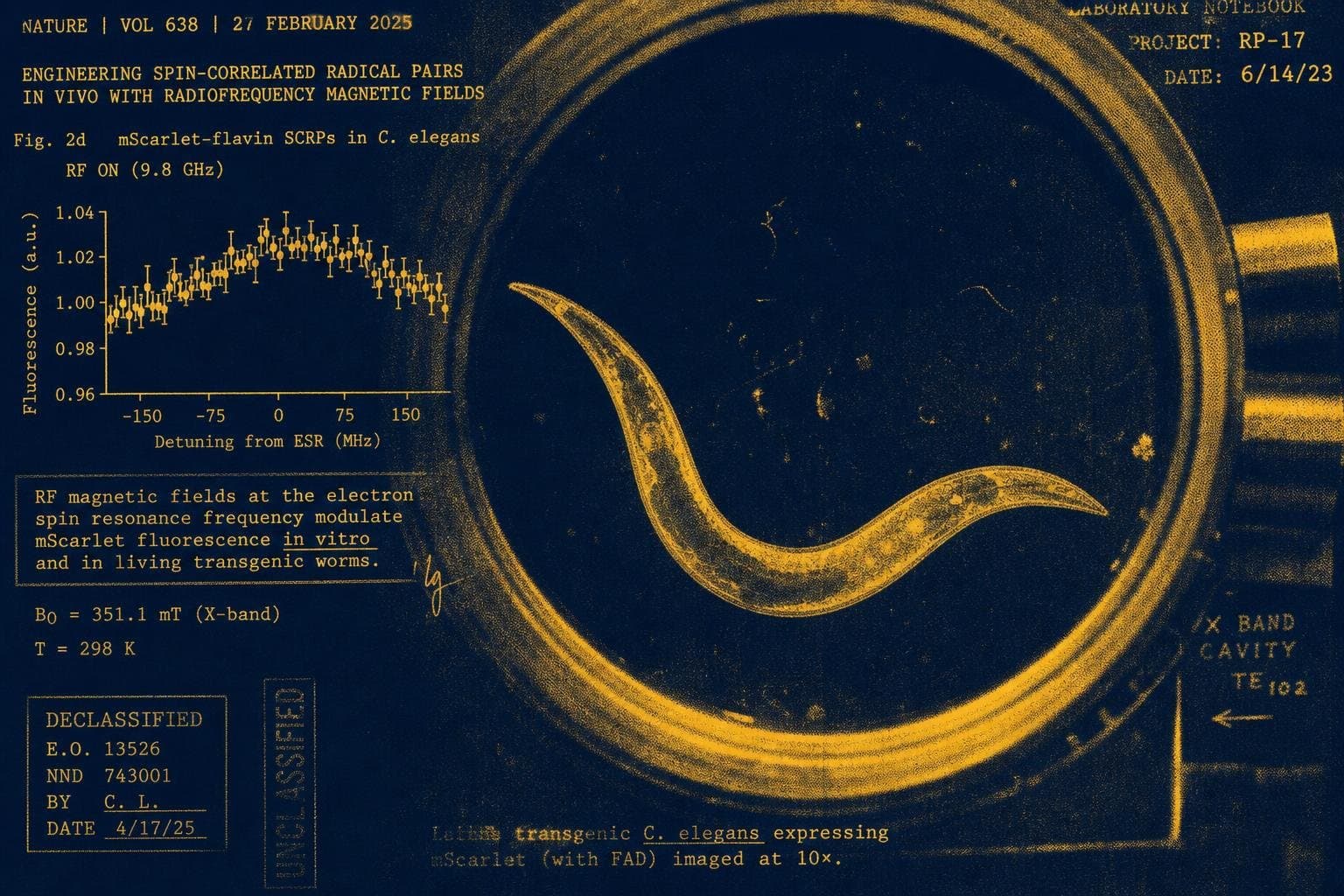

There is now peer-reviewed evidence, published in Nature, that radiofrequency magnetic fields can influence biochemical reactions inside a living organism at the quantum level. That sentence is true, carefully stated, and almost nothing like what most electromagnetic sensitivity advocates claim. The gap between those two things is where the interesting science lives.
What the Nature Study Actually Showed
A paper published this year in Nature demonstrated something genuinely striking: researchers engineered transgenic Caenorhabditis elegans — the workhorse nematode of molecular biology — to express a red fluorescent protein (mScarlet) that, in the presence of a flavin cofactor, forms spin-correlated radical pairs (SCRPs). By applying a combination of static and radiofrequency magnetic fields near the electron spin resonance frequency, they were able to measurably modify the protein's fluorescence emission. The effect was observed both in vitro and in the living worm, at room temperature.
What this demonstrates is that the radical pair mechanism — a quantum process in which the spin states of two unpaired electrons influence the outcome of a chemical reaction — can be engineered to respond to RF magnetic fields in a multicellular organism. The authors suggest this could eventually enable new methods for remotely controlling biomolecular processes, including gene expression.
This is a real finding, from a credible journal, with a clear mechanistic basis. It is also an engineered system in a transparent worm, not a spontaneous biological response in a human nervous system. The leap from "we built a quantum-sensitive protein and put it in C. elegans" to "this explains why some people get headaches near Wi-Fi routers" is not a small one. It is, at minimum, several decades of research.
The Cryptochrome Connection Is Theoretically Interesting, Empirically Thin
The Nature study sits alongside a parallel line of theoretical work on cryptochrome proteins — the photoreceptors thought to underlie magnetic compass sensing in migratory birds. A recent paper in Scientific Reports modeled how the arrangement of spin couplings within the cryptochrome radical pair could optimize directional sensitivity to the geomagnetic field, finding that certain geometric arrangements of hyperfine axes preserve sharper field-direction detection than previously predicted.
This is careful theoretical work, and it strengthens the biological plausibility of the radical pair mechanism as a magnetoreception system — in birds. Humans do have cryptochrome proteins, and there is ongoing speculation about whether they might play some role in human magnetic sensitivity. But "ongoing speculation" is the accurate characterization. The Scientific Reports paper is a computational study of idealized radical pair arrangements; it does not test human cryptochrome, does not measure human behavioral responses to magnetic fields, and does not address the symptom complex associated with electromagnetic hypersensitivity (EHS).
The mechanism is real. Its relevance to human EHS remains, at this point, a hypothesis.
The EHS Evidence Problem Hasn't Changed
Meanwhile, the clinical picture for EHS remains where it has been for years. The WHO's position, as summarized in multiple sources, is that EHS symptoms are real and can be severe — but that double-blind provocation studies have consistently failed to show that people who identify as EHS-sensitive can reliably detect the presence of EMF fields above chance. The nocebo effect and underlying anxiety or stress-related conditions remain the leading explanatory candidates in the mainstream literature.
Advocacy sources point to biomarker research, neurological imaging, and genetic factors as evidence of a physical mechanism. Some of this research is worth tracking — but the sourcing here matters. Claims that EHS is "confirmed" by a "Scientific Consensus International Report of 2021 by 32 worldwide experts" require scrutiny of who those experts are, where the report was published, and whether it has been replicated or peer-reviewed in indexed journals. Advocacy-adjacent sources citing their own authority are not the same as independent replication.
The honest state of play: the neurobiological mechanisms by which magnetic fields could influence living tissue are becoming better understood, and the Nature study is a genuine advance. The specific claim that these mechanisms explain EHS symptoms in humans remains undemonstrated by controlled experimental protocols.
Why This Distinction Matters for the Field
Edge science earns its credibility by holding the line between "plausible mechanism" and "demonstrated effect." The radical pair work is exactly the kind of foundational mechanistic research that should inform future EHS provocation studies — better-designed experiments, more specific hypotheses about which frequencies and field strengths might matter, biomarkers to measure rather than just symptom self-report.
What it doesn't do is retroactively validate the existing EHS literature. The mechanism being real is a reason to design better experiments, not a reason to skip them.
Watch for whether any research group attempts to use the Nature SCRP engineering approach to build a testable human-relevant model — that would be the study worth covering.


