
There's a pattern worth naming: the United States government has now created offices, held hearings, issued directives, and missed deadlines — all in the name of UAP transparency — while the actual evidentiary record has barely moved.
The latest data point arrived quietly. Rep. Anna Paulina Luna, chair of the House Oversight UAP Task Force, set an April 14 deadline for the Pentagon to release 46 UAP videos. The Pentagon missed it. Luna has since said she'll work directly with Defense Secretary Pete Hegseth to obtain the footage and is prepared to subpoena if necessary. That's a remarkable sentence to write in 2026 — a congressional chair threatening to subpoena her own executive branch over videos that, per whistleblower testimony at a September 2025 hearing, the All-Domain Anomaly Resolution Office (AARO) already possesses.
This is the accountability gap. Not a conspiracy. Not a cover-up (necessarily). Just the widening distance between institutional motion and actual disclosure.
The Infrastructure Keeps Expanding While the Evidence Stays Thin
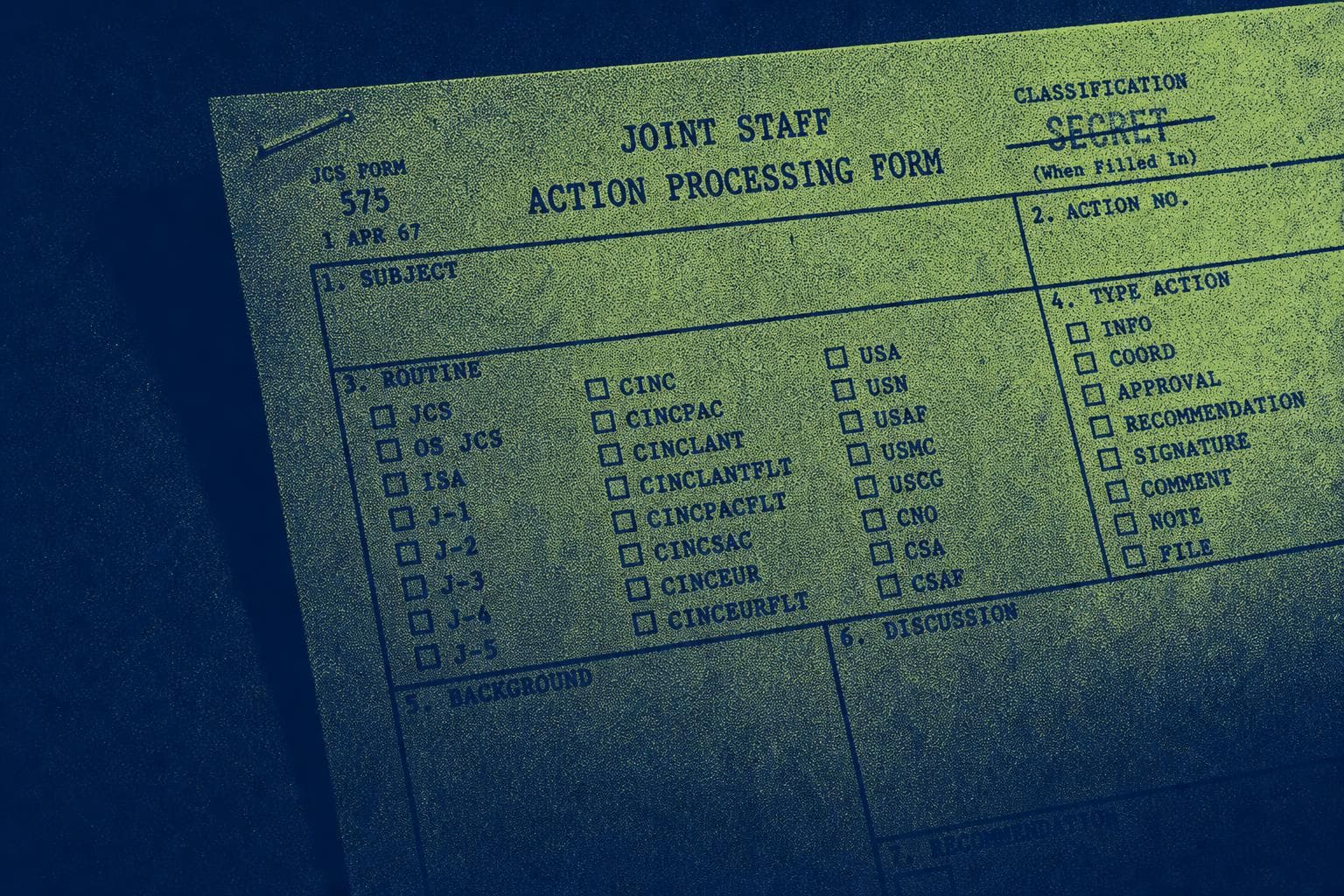
I wrote in April about how the infrastructure of UAP legitimacy is being built before the evidence arrives. The FOIA documents keep coming, and they're genuinely interesting as organizational artifacts. A newly released Department of War document obtained through a FOIA request describes the 2023 formation of a "UAP Space Tiger Team" — a coordinated AARO-led effort focused specifically on space-domain and transmedium cases. The document is a Joint Staff Action Processing Form dated November 20, 2023. It tells us that people were organized, meetings were held, a working group was named. What it doesn't tell us: what they found.
That's the epistemological problem in miniature. Process documents are not findings. Org charts are not evidence. The existence of a "Space Tiger Team" is interesting precisely because it suggests someone in the institutional chain took these cases seriously enough to formalize a response — but seriousness of process and quality of outcome are different things, and we have documentation of the former without visibility into the latter.
Meanwhile, PBS News reports that President Trump has been building anticipation around a forthcoming UAP document release, calling the files "very interesting" at a NASA astronaut event and promising that "the first releases will begin very, very soon" — a phrase he used in April. Experts cited in that reporting caution against elevated expectations. Worth noting: AARO's 2024 debut report, which covered hundreds of new UAP incidents, found no evidence that the U.S. government had ever confirmed a sighting of alien technology. A second report covering more recent sightings is expected, but hadn't been released at the time of that reporting.
What "Secondhand" Actually Means Here
The whistleblower testimony that prompted Luna's video request deserves a careful read. Witnesses testified that sources told them AARO holds additional video records. That's secondhand testimony — not confirmation that the videos exist, not confirmation of what they show, and not confirmation that any of it constitutes anomalous evidence. It may well be accurate. But the epistemic chain runs: source → whistleblower → congressional hearing → headline. Each link in that chain is real; none of them is the thing itself.
This distinction matters because the entire disclosure conversation keeps collapsing these layers. Congressional pressure is treated as evidence of cover-up. Missed deadlines are treated as confirmation of secrets. Organizational documents are treated as proof of findings. The pattern suggests something more mundane and more frustrating: a bureaucracy that is genuinely slow, genuinely compartmentalized, and genuinely uncertain about what it has — being asked to produce certainty it may not possess.
What to Actually Watch
The next concrete milestones are specific: whether Luna follows through on subpoena threats (and whether Hegseth responds before that becomes necessary), and whether AARO's second report surfaces before summer. Those two events will tell us more than any number of presidential hints. If the second report lands with the same "no confirmed alien technology" conclusion as the first, the disclosure narrative will need to reckon seriously with what the evidence actually supports. If the 46 videos are released and show something genuinely anomalous — something that survives methodological scrutiny — that changes the conversation in a different direction entirely.
Until then, the gap between institutional activity and evidentiary output remains the story. The Tiger Team met. The deadline passed. The videos are still classified. Watch for what actually arrives.
RESEARCH ROUNDUP
Three studies worth your attention this week.
Consciousness may be rooted in perception, not reasoning. A landmark adversarial collaboration published in Nature — seven years in the making, involving 256 human subjects — pitted Integrated Information Theory (IIT) against Global Neuronal Workspace Theory (GNWT) in a direct experimental test. Neither theory won cleanly. Instead, the findings pointed toward early visual processing areas, rather than the prefrontal cortex, as more central to conscious experience. Christof Koch of the Allen Institute, one of the researchers involved, framed it as progress on "the Mind-Body Problem" — which is either inspiring or a reminder of how far we have to go, depending on your mood. The finding that "intelligence is about doing while consciousness is about being" is a clean formulation worth sitting with. Implications for detecting covert consciousness in patients with disorders of consciousness are noted by the researchers as a near-term clinical application.
Methodology note: This was a pre-registered adversarial collaboration with a large sample — a design that earns more credence than typical single-lab psi or consciousness studies. The null result on both theories is the finding, not a failure.
FIELD DISCOURSE
Commentary and analysis worth reading.
The most substantive ongoing argument in UAP discourse right now isn't about whether UAPs are real — it's about what "real" means in this context. The gap between "something anomalous was observed" and "that anomaly is non-human technology" is enormous, and much of the public conversation skips it entirely. The institutional signals — offices, hearings, FOIA releases, Tiger Teams — are being read as confirmation of the larger claim. They aren't. They're confirmation that the government takes the observational record seriously enough to investigate. That's meaningful, but it's a different thing.


