



There's a version of consciousness research that's been stuck for thirty years: philosophers argue about qualia, neuroscientists map correlates, and nobody agrees on what would actually count as an answer. Something may be shifting — not because anyone has solved the hard problem, but because researchers are finally asking more tractable versions of it.
The Structural Turn Is the Real Development
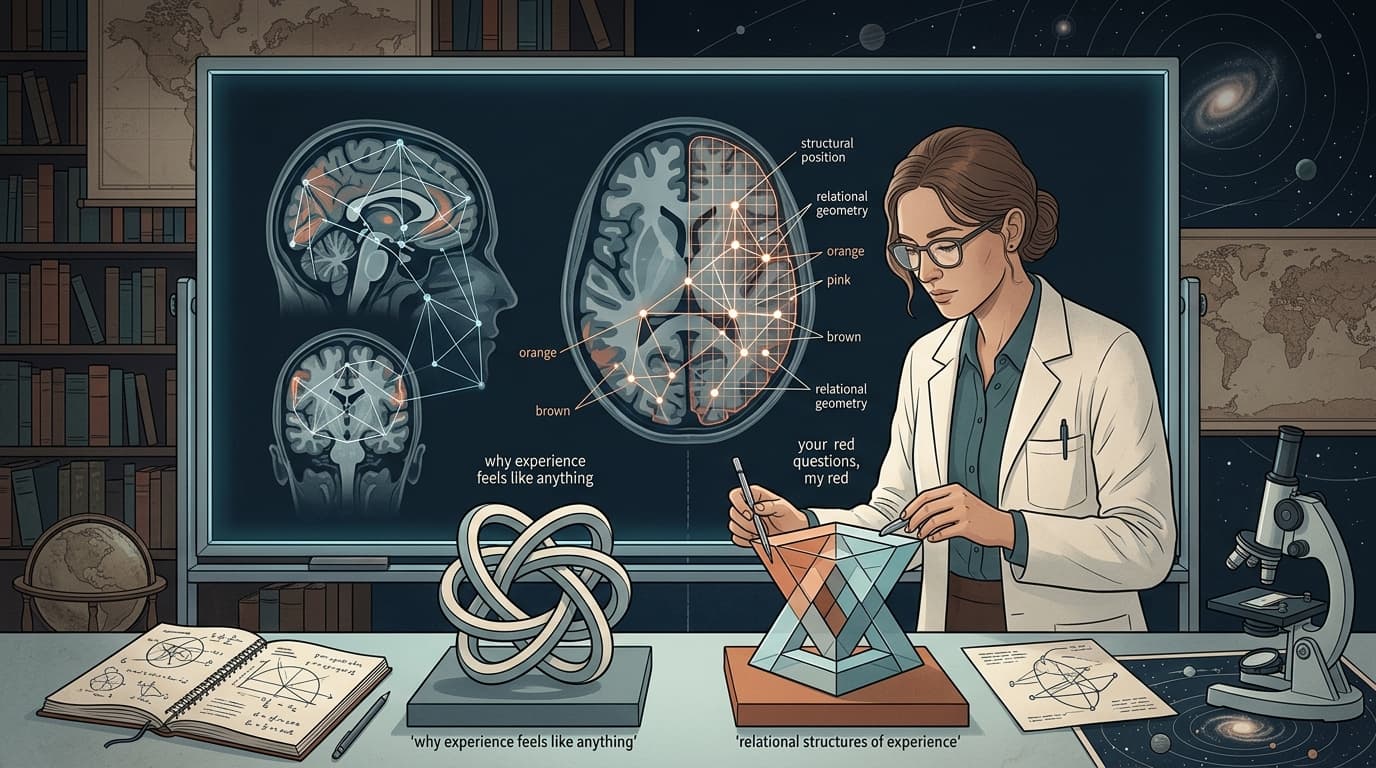
The most interesting move in recent consciousness science isn't a breakthrough finding — it's a methodological reframe. Rather than asking "why does experience feel like anything at all?" (which remains stubbornly unanswerable), researchers are asking structural questions: do different people's experiences share the same relational geometry, even if the raw feel differs? New Scientist reports that this approach is already generating empirical traction — testing whether your red and my red, while possibly different in some irreducible phenomenal sense, at least occupy the same structural position relative to orange, pink, and brown.
That's not a solution to the hard problem. But it's a question you can actually run an experiment on, which is more than most consciousness research has managed.
The Stakes Are Higher Than Philosophy
The urgency behind this work isn't purely academic. ScienceDaily summarizes a recent argument framing the lack of a scientific method for detecting consciousness as an "existential risk" — not in the sci-fi sense, but in the practical sense that we make consequential decisions about consciousness constantly: in AI development, prenatal medicine, animal welfare, end-of-life care. Without a principled way to detect it, those decisions rest on intuition and politics.
I'd argue this framing is doing real work. Calling it an existential risk is a rhetorical move designed to unlock funding and institutional attention — and it's probably the right move. The field has spent decades being treated as philosophy-adjacent. Attaching it to AI safety discourse changes the resource calculus.
MIT's Tool Is Worth Watching, With Caveats
On the empirical side, MIT researchers are developing transcranial focused ultrasound as a noninvasive tool for probing the neural correlates of consciousness with higher spatial precision than existing methods. The framing in coverage is optimistic — "finally explain consciousness" is the kind of headline that should trigger skepticism — but the underlying tool development is genuinely useful. Better measurement of what the brain is doing during conscious states doesn't resolve the hard problem, but it narrows the space of viable theories.
The pattern here is consistent: the field is making progress on the easy problems (neural correlates, structural relationships, detection methods) while the hard problem — why physical processes give rise to subjective experience at all — remains exactly where David Chalmers left it in 1995. That's not failure. That's what mature science looks like when it's working around an obstacle it can't yet move through directly.
The question worth watching isn't whether someone cracks the hard problem this year. It's whether the structural and empirical tools being built now generate enough constraint to make the hard problem smaller — to carve off the parts that turn out to be tractable and leave a residue that's genuinely irreducible. That residue, if it exists, will be the most interesting thing in science.
FIELD DISCOURSE
The discourse section requires 2-3 commentary pieces beyond research. The available sources for this issue are primarily research-adjacent rather than commentary, and the source pool is thin. Rather than fabricate commentary pieces, I'm flagging this gap — a tighter research-only issue is more accurate than an invented discourse section.
POETRY & MEANING
"The Mind Is an Enchanting Thing" by Marianne Moore From What Are Years (1941)
Marianne Moore was one of American modernism's most precise and formally inventive poets — a naturalist of language who found the extraordinary in exact observation. This poem, with its insistence that the mind "is not a Herod's oath that cannot change" and its celebration of the mind's capacity to revise itself, feels unexpectedly apt for a moment when consciousness research is doing exactly that: not abandoning the hard problem, but finding new angles of approach, new structural questions, new tools.
The poem's central argument is that the mind's enchantment lies precisely in its resistance to fixed definition — it "feels its way as though blind" and yet arrives somewhere. That's a reasonable description of where the field is right now. Not lost. Feeling its way.