


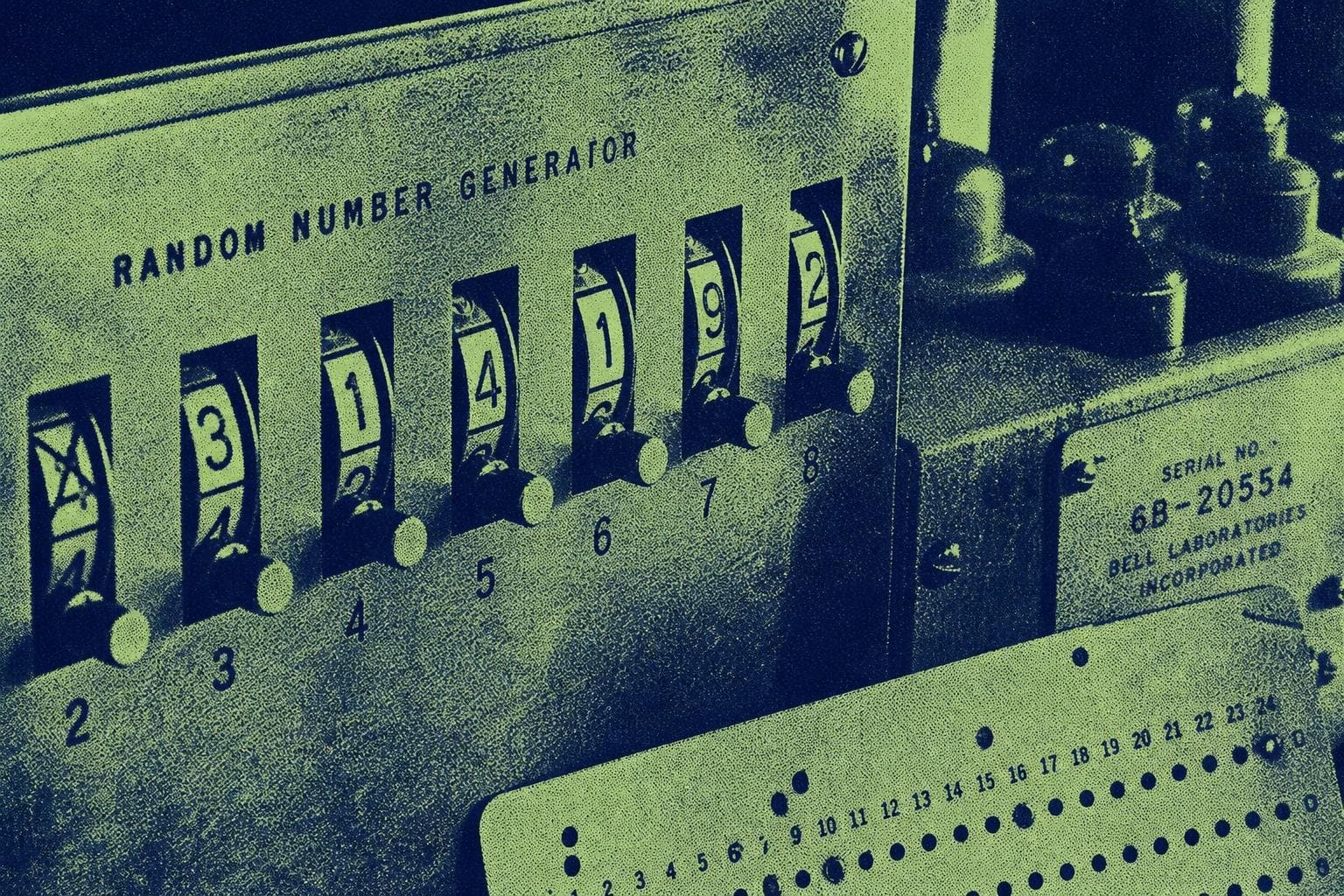

If you came to this issue expecting fresh word on the Global Consciousness Project — the long-running effort to see whether networked random number generators drift during moments of mass human attention — I don't have it for you. Nothing in the current research pool touches Roger Nelson's RNG network or offers a new statistical read on its archive. What I found instead is stranger in its own way: a paper called "Conceptualizing and measuring global consciousness" that has nothing to do with random number generators at all.
Published in Political Psychology, the paper is a secondary analysis — not pre-registered, per its own disclosure — that treats "global consciousness" as a psychological construct, something closer to cosmopolitan identity or felt connection to humanity as a whole, measured through survey instruments rather than physical hardware. It's a reminder that terminology in this space is a minefield. Two research communities can use the identical phrase to mean entirely different things: one a measurable attitude scale, the other a decades-old hypothesis about whether collective emotional events nudge the output of hardware-based randomness generators. Readers chasing RNG anomalies on the strength of a headline alone would land in the wrong journal entirely. That gap is worth sitting with for a second, because it's exactly the kind of category error that makes fringe science easy to dismiss and easy to oversell in the same breath.
What Actually Moved the Consciousness Research Needle This Cycle
Two genuine developments did show up, and both are more immediately interesting than anything RNG-shaped.
The first is a preprint from Doris Tsao's lab at UC Berkeley, posted to bioRxiv and covered by Nature, which has not been peer reviewed. The team recorded neural activity in macaques during a binocular rivalry task — the classic paradigm where each eye receives a different image and the brain resolves them into a single conscious percept. Using only neural signals, the researchers reconstructed not just the images the animals consciously perceived but also images that were physically present and processed by the brain yet never entered awareness. The unexpected part: that unconscious signal was strong, not the faint residue earlier studies had found, and it flickered — switching between conscious-like and unconscious-like patterns multiple times per second.
This is firsthand neural recording with a clear experimental design, and the methodology earned real respect from outside researchers, including John Sakon at UCLA, who called it "an interesting little firestorm of a paper" while cautioning that some findings weren't entirely unexpected, per Nature's reporting. That caveat matters. A preprint with two million social-media views is not the same epistemic object as a peer-reviewed finding, no matter how clean the methodology looks on first pass. File this one as promising and unreplicated, and watch for what happens when it goes through formal review.
The second development is a bioRxiv study examining how psychedelics reshape what's called the brain's "global workspace" — the network of regions theorized to integrate and broadcast information, a leading candidate substrate for consciousness itself. This is a secondary analysis of existing resting-state fMRI data covering LSD, psilocybin, mescaline, MDMA, and D-amphetamine. The researchers found that classic psychedelics were associated with an increase in "gateway" regions — areas showing synergistic interaction with the rest of the brain — concentrated in frontoparietal and dorsal attention networks, while MDMA and amphetamine reduced gateway activity in visual and motor regions. The paper is explicit that these are associative findings from an observational reanalysis, not a controlled causal test, and it's worth noting two of the authors disclosed consulting relationships with a psychedelic therapeutics company, per the study's own competing-interest statement. The theoretical payoff, if it holds up under independent replication, is a mechanistic account of how different drug classes reorganize rather than simply suppress integrative brain activity — distinct from the older, simpler story that psychedelics just quiet the brain down.
The Honest Inventory
Neither of these studies says anything about random number generators, synchronized human attention, or the kind of field-consciousness hypothesis the Global Consciousness Project was built to test. That project's actual claims remain exactly where this newsletter has left other open questions before — unconfirmed by anything new this cycle, which is itself information. Fields don't owe you a headline every three weeks, and pretending otherwise is how edge science earns its bad reputation.
What's worth tracking instead: whether Tsao's preprint survives peer review with its flicker-rate finding intact, and whether anyone runs an independent replication of the psychedelic global-workspace analysis using a different dataset. Those are the two threads with an actual verdict coming. The RNG question, for now, stays exactly as unresolved as it was the last time someone looked closely at it.