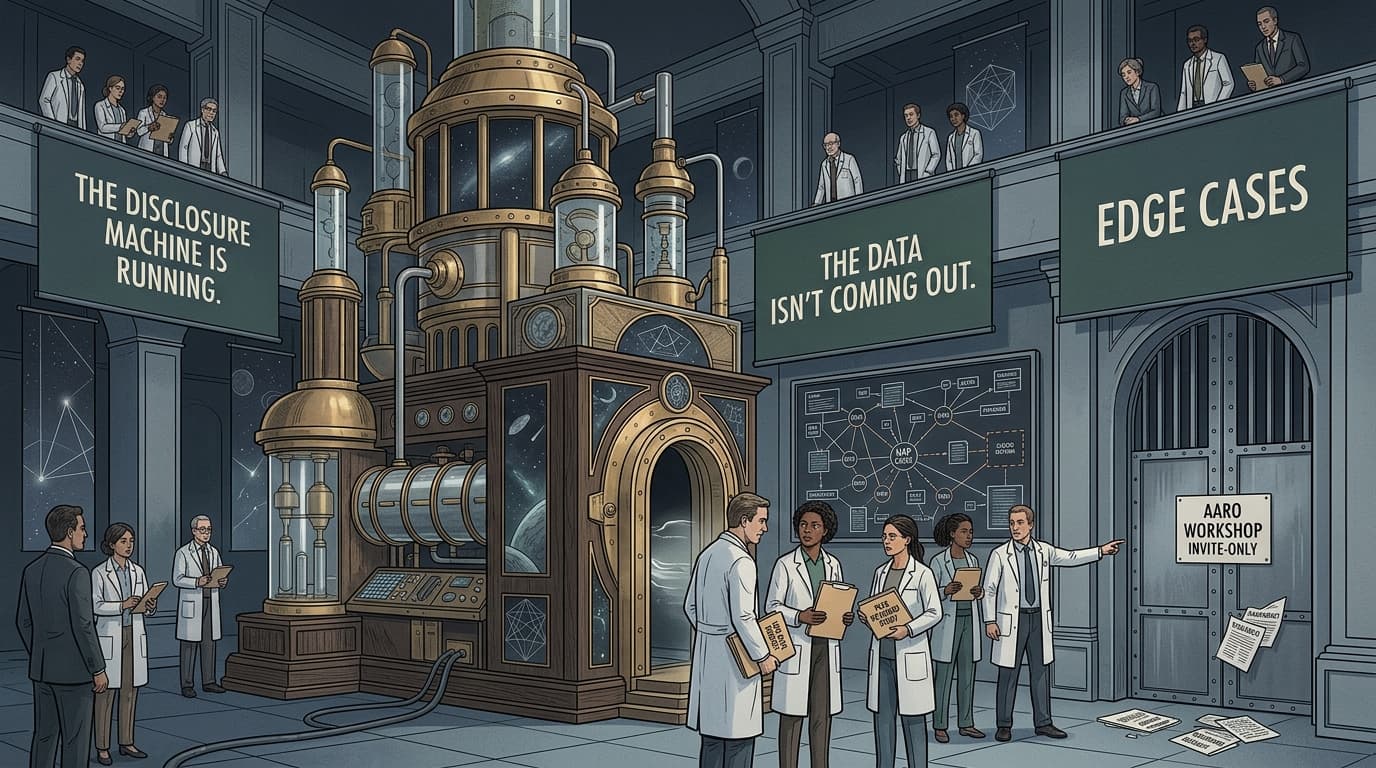

The Pentagon's All-domain Anomaly Resolution Office now has more than 2,000 cases in its active caseload. Defense Secretary Hegseth has publicly reaffirmed the Trump administration's commitment to UAP transparency. AARO recently held an invite-only workshop with roughly 40 government and academic participants to help shape the future of UAP research methodology. By every institutional signal, disclosure is accelerating.
And yet the researchers who most need access to that data are still being turned away.
That's the tension worth sitting with. The machinery of disclosure — the offices, the hearings, the press statements — is visibly expanding. What isn't expanding at the same rate is actual data access. Live Science reported that independent scientists attempting to conduct peer-reviewed UAP research are routinely stymied, even as Congress passes legislation and the Pentagon holds workshops. Stockholm University and the Nordic Institute for Theoretical Physics have been publishing peer-reviewed UAP work since 2017 — from Sweden, because the U.S. institutional environment makes that kind of work difficult to sustain domestically.
This is the gap that matters: between the performance of disclosure and the substance of it. AARO's invite-only workshop is a reasonable step toward building research frameworks. But "invite-only" is doing a lot of work in that sentence. Forty participants, selected by the government, shaping methodology for a government office — that's not independent scientific oversight. That's a controlled consultation.
The historical record doesn't help build confidence. A 2024 AARO historical review of U.S. government UAP documentation found no verifiable evidence of extraterrestrial craft or recovered materials — a finding that landed with a thud among researchers who'd expected more, and was immediately contested by figures like David Grusch, who told Congress he couldn't publicly discuss whether the government had made contact but testified that people with direct knowledge told him non-human biologics were recovered during some crash retrievals. That's a remarkable claim sitting in congressional testimony with no corroborating documentation in the public record.
The pattern suggests an institution that has learned to speak the language of transparency without fully committing to its logic. More cases logged, more workshops convened, more press statements issued — and the underlying data still classified, still inaccessible, still filtered through the same channels that produced the 2024 review that satisfied almost no one.
What would actually move the needle: open data-sharing agreements with independent academic institutions, published methodology from AARO's case evaluation process, and some mechanism for external replication. Watch whether any of those emerge from the workshop's outputs. If the deliverable is another internal framework document, that's your answer about where this is actually headed.
FIELD DISCOURSE
The skeptic's case, restated carefully. Skeptic magazine's recent overview of the UAP phenomenon makes the methodological argument that most scientists and journalists reject UAP evidence not from incuriosity but because the evidentiary base consists almost entirely of grainy videos, blurry photographs, and anecdotes — a fair characterization of the public record, whatever may exist in classified files. The piece is worth reading as a corrective to the assumption that skepticism is just institutional cowardice. Sometimes it's just epistemology.
What the skeptic framing underweights is the institutional shift itself. The question isn't whether grainy videos constitute proof — they don't — but why the U.S. government has spent the last several years building bureaucratic infrastructure around a phenomenon it officially can't confirm exists. That's the anomaly worth explaining, and "mass credulity" doesn't quite cover it.
POETRY & MEANING
My search context didn't surface a specific recently published poem I can verify by title, author, and publication within the last 21 days — and fabricating one would be exactly the kind of sourcing failure this newsletter is built to avoid.
What I can say: the UAP disclosure story is, at its core, a story about the limits of institutional knowledge — about what gets classified, what gets acknowledged, and what remains genuinely unknown. That's the territory poetry handles better than policy memos. If you're looking for a place to start, the Poetry Foundation's archive of work on uncertainty and perception is worth an afternoon. Louise Glück on the unknowable. Tracy K. Smith's Life on Mars, which won the Pulitzer in 2012 and still reads like the most honest thing written about humanity's relationship to the cosmos. Not new, but not wrong either.
I'll have a sourced recent poem in the next issue. This week, the honest answer is: I don't have one I can verify.


