
A preprint landed this month that should recalibrate how anyone reads the Pentagon's UAP releases — and it came from two researchers who sit on the UAP Science Advisory Council to the U.S. government.
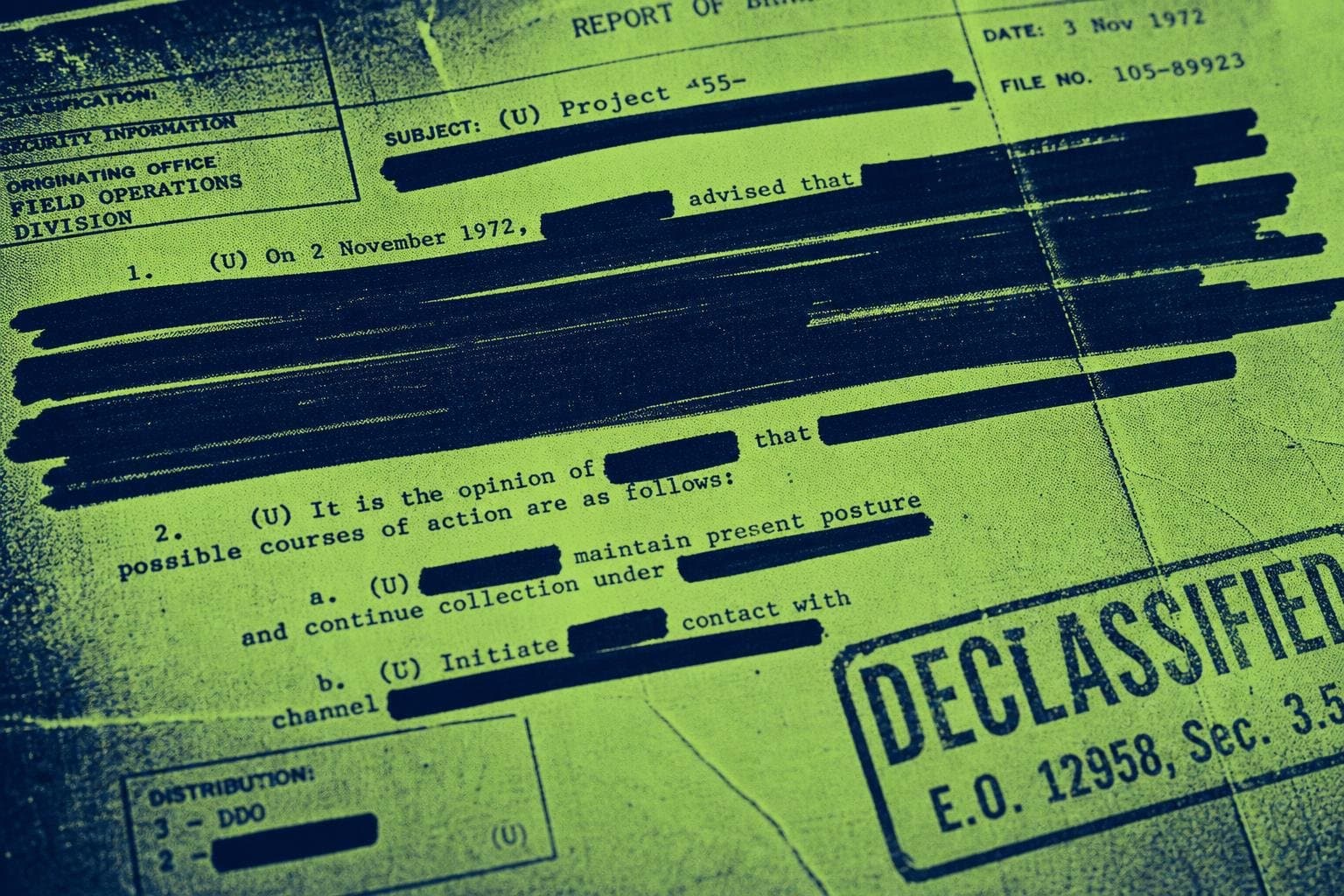
Jacob Haqq-Misra of Blue Marble Space and Ravi Kopparapu of NASA's Goddard Space Flight Center examined 112 videos released under PURSUE — the Pentagon's Presidential Unsealing and Reporting System for UAP Encounters — and arrived at a conclusion that is both obvious to specialists and apparently underappreciated everywhere else: you cannot determine whether an object is moving anomalously fast from video alone, without the sensor metadata that would let you calculate actual physical velocity. Most of that metadata, in the released files, is redacted.
"Most of the useful quantities are redacted," Haqq-Misra told The Debrief. "It is also not immediately obvious that what appears to be a fast-moving object in an infrared sensor video might be a mundane object (like a bird) much closer to the camera." The study has not yet undergone peer review, which matters — but the underlying problem it describes is not new, and the researchers' institutional positions give the critique some weight.
Five Releases, One Consistent Finding
Since May 8, 2026, the Department of War has released five tranches of UAP materials through PURSUE, catalogued across dates in May, June, July, and August. The archive includes written records, historical files, imagery, video, and — this label matters — digital renderings. A reconstruction is not a photograph. Footage without range, telemetry, or camera calibration data tells you considerably less than it appears to.
The fifth release, flagged by Nation Press, includes a case designated DOW-UAP-PR134: an unresolved UAP report from the Middle East in 2025. The "unresolved" classification is being read in some quarters as significant — and the Middle East is, as Nation Press notes, one of the most densely monitored airspaces on the planet. An unresolved case there does carry a higher evidentiary bar than one from a poorly instrumented location.
But "unresolved" has a specific meaning in AARO's framework, and it is worth holding onto. AARO's own figures, per its fiscal 2024 report, show that 444 cases were placed in an Active Archive because records lacked sufficient information for analysis — not because the objects defied explanation. Cases that were resolved were attributed to balloons, birds, drones, satellites, and aircraft. The office has found no verifiable evidence that any investigated case involved extraterrestrial beings or technology. Hundreds remain unresolved. Unresolved means the evidence is insufficient, not that the explanation is extraordinary.
The Gap Between Institutional Action and Analytical Capacity
This newsletter has covered the infrastructure-before-evidence problem before — the pattern where offices get created, hearings get held, and releases get scheduled before the analytical tools to evaluate the data are in place. The PURSUE releases are a version of this, but with a specific twist: the data being released is structurally incomplete for the purposes it's being used to serve.
Haqq-Misra put it plainly: "A lot of people haven't even looked at the data and may assume that there is more available than we really are getting." That's the core problem. The releases are real. The archive is growing. The institutional machinery — AARO, PURSUE, the congressional mandate tracing back to the 2021 ODNI preliminary assessment — is functioning as designed. What's missing is the sensor data that would allow independent researchers to do the physics.
There's also a new piece of the institutional picture worth noting: a July 31 memo from Aaron Lukas, principal deputy director of national intelligence, outlining a formal process for current and former government employees and contractors to share UAP-relevant information without violating nondisclosure agreements. The memo was shared publicly by Rep. Eric Burlison. What this process will produce — whether it surfaces firsthand accounts, documentary evidence, or secondhand claims — remains to be seen. A whistleblower system is an input mechanism, not a finding.
What Rigorous Analysis Actually Requires
The Haqq-Misra and Kopparapu preprint is useful precisely because it comes from inside the advisory structure rather than from critics on the outside. Their argument is methodological: apparent motion in an infrared sensor video is not physical velocity, and without range and telemetry data, you cannot distinguish a fast-moving distant object from a slow-moving nearby one. That's not a philosophical objection to UAP research — it's a basic requirement of the physics.
The honest read of the current moment is that the U.S. government is releasing more UAP material than at any prior point, and independent researchers still lack the tools to analyze most of it rigorously. The releases are a necessary condition for serious investigation. They are not sufficient for it.
Watch for whether future PURSUE tranches include less-redacted sensor metadata — that's the actual disclosure that would change the analytical picture. Until then, the archive is growing, and the gap between what's been released and what can be concluded from it remains the story.
The Haqq-Misra and Kopparapu preprint has not yet undergone peer review.


