
A volunteer research coalition just published what may be the most methodologically serious attempt yet to find a pattern in historical UAP data — and the pattern they found is striking enough that the harder question isn't whether it exists, but what to do with it once you've found it.
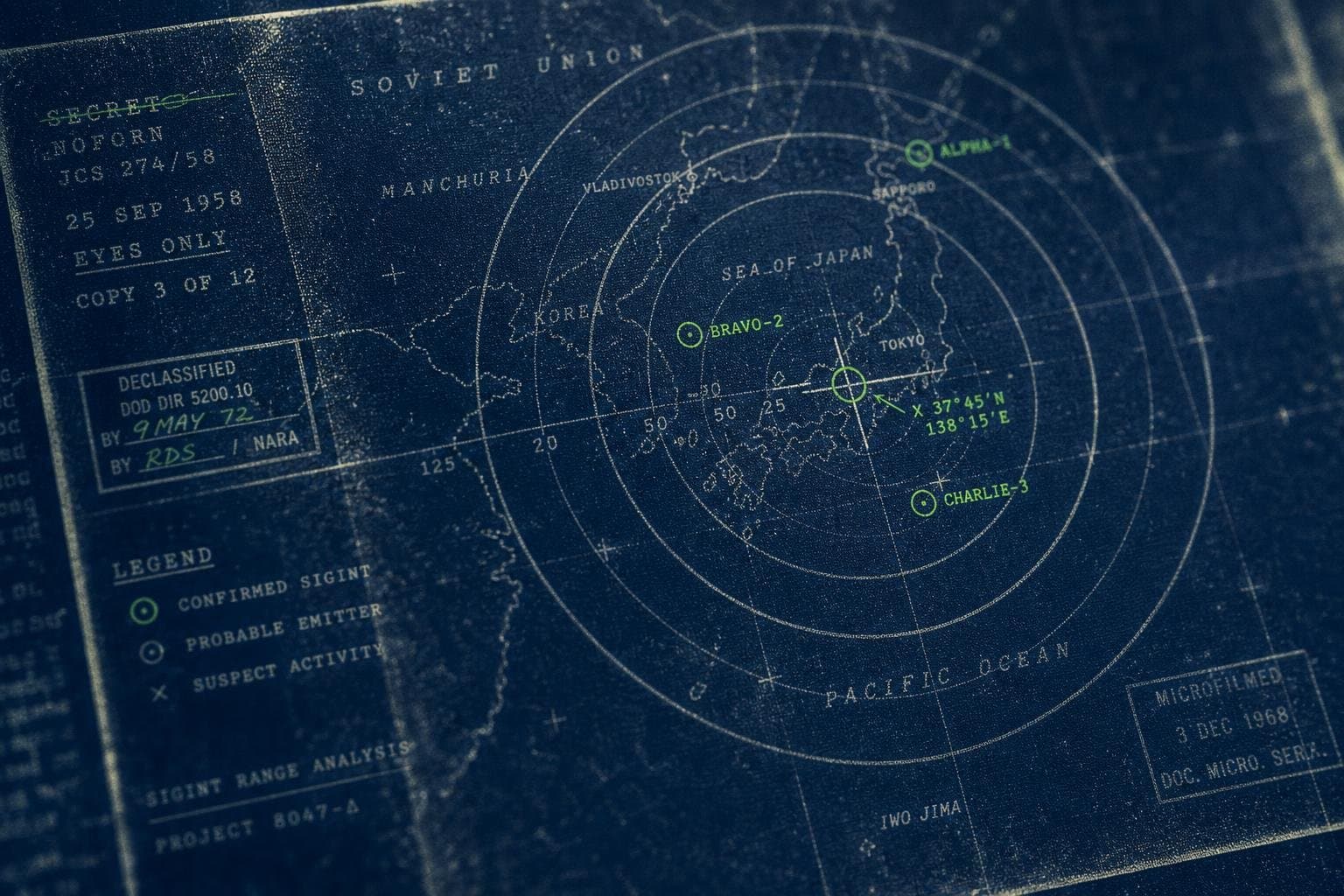
On April 20, 2026, the Scientific Coalition for UAP Studies (SCU) released "UAP Operational Presence, 1945–1975," its fifth and largest multi-decade study. The paper integrates findings from four prior SCU analyses into a single thirty-year assessment. The headline finding: a sustained, disproportionate pattern of UAP reports clustering around the U.S. atomic warfare complex, with activity surges in 1949–51, 1952, and October–November 1975. That pattern, according to the study, survives three complementary analytic approaches.
That's the correlation. Here's where it gets interesting — and where epistemic discipline becomes essential.
What the Data Actually Shows
The SCU is a volunteer coalition of scientists, engineers, and former military and law-enforcement personnel. Their primary dataset draws from Project Blue Book's "unknown" cases — reports that Air Force investigators could not explain — mapped against the geography of the U.S. atomic warfare complex. The three-methodology approach is a meaningful design choice: if a correlation appears in only one analytic framework, it might be an artifact of that framework. Surviving three is a stronger result.
But the study's abstract goes considerably further than a correlation claim. It treats non-human intelligence (NHI) as "a working analytic hypothesis" and states that the cumulative evidence "supports, but does not definitively establish, the interpretation of a persistent, intelligence-driven actor." The abstract also describes observed behavior as consistent with "a small, mobile 'reconnaissance force' operating under tight resource constraints," notes that UAP behavior appears to transition from daylight to nocturnal profiles over time, and characterizes repeated reports of UAP avoiding interceptors as "consistent with adaptive tactics responsive to human aggressive tactics."
Those formulations are new. The SCU's 2023 and 2025 predecessor papers did not use this language in their abstracts. The 2026 synthesis is making a stronger interpretive claim than the earlier work, and that distinction matters enormously for how the paper should be read.
A correlation between UAP reports and nuclear sites, even a robust one, does not establish the cause of that correlation. Reporting bias is a live alternative hypothesis: nuclear sites were heavily surveilled, staffed with trained observers, and embedded in a security culture that encouraged anomaly reporting. More eyes, more reports. The SCU study may account for this — the paper's methodology section would need to be examined closely to evaluate how well it controls for observation density — but the abstract's interpretive leap from "pattern survives three methodologies" to "reconnaissance force" is a significant one, and readers should hold those two claims at different epistemic levels.
The Institutional Context That Surrounds This
The SCU paper lands in an environment where institutional UAP infrastructure is expanding faster than the evidence base. AARO — the Pentagon's All-domain Anomaly Resolution Office — has been actively digitizing historical records in partnership with the National Archives, and in 2024 contracted Oak Ridge National Laboratory to evaluate a metallic specimen allegedly recovered from private property in Ohio in the mid-1990s. AARO's public records page notes the specimen "reportedly possessed anomalous" characteristics — the word "reportedly" doing significant work in that sentence.
Meanwhile, Avi Loeb has announced the formation of a UAP Science Advisory Council, tasked by the White House, AARO, ODNI, and the FBI to provide independent scientific analysis of publicly available UAP data. The council includes specialists in physics, statistics, molecular biology, oceanography, and quantitative psychology, with an explicit skeptic included to "mitigate biases and tribal thinking." Loeb frames the council's mandate as reviewing only unclassified information — which is both a genuine constraint and, as I've written before, a reminder that the gap between institutional signals and actual evidence remains the central story in UAP disclosure.
The Methodological Lesson Worth Keeping
What the SCU study demonstrates — whatever its interpretive overreach — is that historical UAP data can be subjected to rigorous quantitative analysis. That's not nothing. The field has spent decades drowning in anecdote; a study that applies three independent methodologies to a structured dataset and finds a consistent pattern is doing something different in kind from witness testimony compilation.
The separate critical evaluation of Villarroel et al.'s technosignature claims in POSS1 photographic plates — published in the Publications of the Astronomical Society of Australia — offers an instructive contrast. That paper found that the claimed correlations between unidentified photographic features and nuclear tests became statistically insignificant after properly normalizing for observation days, and that the apparent pattern was "almost completely determined by the observation schedule of the Palomar telescope." The lesson: a correlation that survives methodological scrutiny is genuinely different from one that doesn't, and the scrutiny is the work.
The SCU's nuclear-site correlation may be real. The question of what produced it remains open — and the paper's own abstract, to its credit, says as much, even as it reaches further than the data strictly requires. Watch for independent replication attempts and methodological critiques in the coming months; that's where the actual epistemic weight will accumulate.


