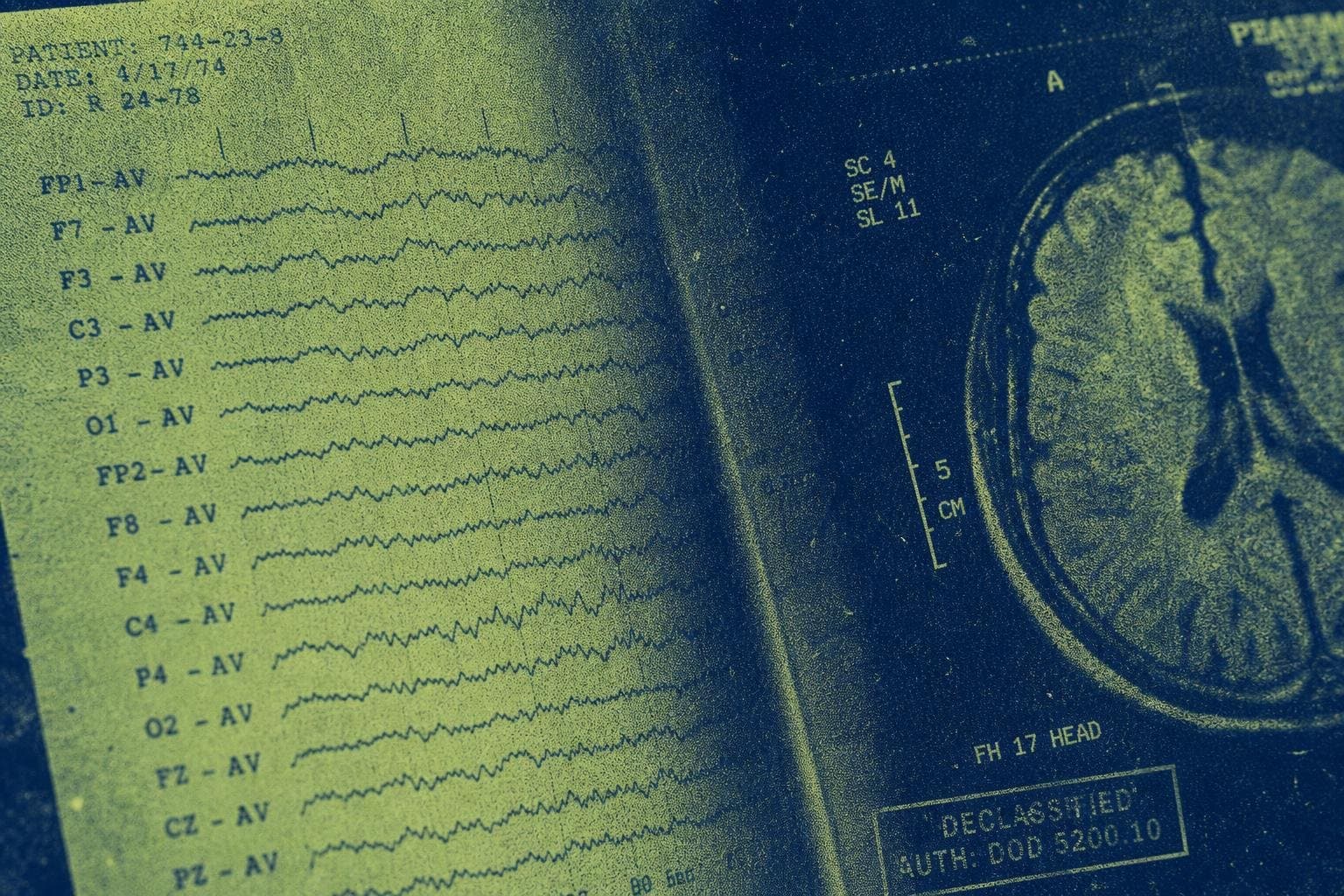

Two systematic reviews of ESP neuroimaging research landed within weeks of each other this summer, and together they tell a story that's more interesting than either a debunking or a vindication.
The first, published in NeuroImage, is the larger of the two: a systematic review by Acunzo, Denton, Weiler, and Kelly that consolidated 143 reports and qualitatively evaluated 129 individual studies spanning more than seventy years of functional neuroimaging research into putative extrasensory perception. The second, available as a preprint in Journal of Psychiatric Research, is a PRISMA-informed descriptive synthesis by Batouli, Parsa, Safdari, and Radin covering 92 ESP neuroimaging and neurophysiology reports. Both teams looked at the same basic question — does anomalous information transfer leave a measurable trace in the brain? — and both arrived at the same frustrating, honest answer: we genuinely don't know yet, and the methodology hasn't been good enough to find out.
Seventy Years of Scanning, and the Field Still Lacks a Coherent Map
The Acunzo et al. review is, by their own description, the first systematic review of neuroimaging studies of ESP spanning more than 70 years. That's a remarkable statement. The field has been producing studies since the early days of functional imaging, yet no one had previously attempted a comprehensive, critical synthesis of the methodological approaches and reported effects. What they found when they did: recurring problems in sample size, data preprocessing, and statistical control, with quality scores ranging from studies with major methodological limitations to a smaller subset that were methodologically robust with high reporting clarity.
The review classifies studies by experimental paradigm — forced-choice task-driven activity, forced-choice event-related activity, free-response paradigms, distant stimulation with receiver's activity only, and sender-receiver correlation designs. Remote viewing falls under the free-response category. The key finding isn't that the results are uniformly null; it's that the methodological heterogeneity is severe enough that the authors can only determine, per paradigm category, when neural candidates could be identified and when data precluded inference. That's a meaningful distinction. Some paradigms produced data too compromised to say anything. Others produced candidate findings that remain unresolved.
The Batouli-Radin Synthesis Arrives at the Same Wall, From a Different Direction
The second review covers similar territory but was explicitly reframed as a descriptive synthesis rather than evidence for a unified neural signature of ESP — a notable editorial choice that signals how seriously the authors are taking the replication problem. Their synthesis of 92 reports found that most studies used EEG or ERP rather than fMRI, with findings distributed across posterior scalp and occipital regions, frontal, parietal, temporal, medial temporal, and limbic areas, plus inter-brain and receiver-response measures. The anatomical spread alone tells you something: there's no convergent "psi region" emerging from this literature.
Null, weak, and non-specific findings were retained and explicitly summarized — which is the right call, and rarer than it should be in a field where publication bias toward positive results remains a documented problem. The overall verdict from the Batouli-Radin team: the literature is heterogeneous in design, modality, statistical approach, behavioral reporting, anatomical specificity, and methodological quality. The findings are descriptive patterns, not evidence for a unified neural ESP signature.
What This Actually Means for Remote Viewing Research
Here's where I'd push back slightly on the implicit framing that "heterogeneous and methodologically limited" equals "nothing to see." The Acunzo et al. team identifies paradigm categories where neural candidates emerged — the question is whether those candidates survive better-designed follow-up work. Their recommendations for future research are aimed at exactly that: tightening sample sizes, standardizing preprocessing pipelines, improving statistical controls.
The parallel to early consciousness neuroscience is worth sitting with. Thirty years ago, the neural correlates of consciousness were similarly contested, similarly plagued by small samples and inconsistent paradigms, and similarly dismissed by a significant portion of the scientific community. What changed wasn't a single landmark study — it was the gradual accumulation of methodological standards that made replication possible. The kind of infrastructure that enabled that shift is now more accessible: openly available, BIDS-formatted fMRI datasets released through platforms like OpenNeuro have become a standard tool for consciousness research, providing the shared data architecture that allows independent teams to test the same questions against the same recordings. Psi neuroimaging research has largely lacked that foundation.
The honest read of these two reviews is that the field has been generating data for seven decades without the methodological scaffolding to know what that data means. That's not a reason to dismiss the question. It's a reason to build better experiments.
Watch for whether either review's methodological recommendations get operationalized in pre-registered follow-up studies — that's the actual test of whether this literature is capable of growing up.


