
The hardest thing about quantum consciousness theories has always been the same problem: they're unfalsifiable in practice. You can gesture at microtubules, invoke coherence times, cite the mystery of anesthesia — and none of it produces an experiment that could actually settle anything. A new synthesis paper, posted to Zenodo in June, tries to fix that. Whether it succeeds is a different question.
The paper, "Can the Brain Function as a Quantum Information Transducer?", doesn't propose new physics. What it does — and this is the move worth paying attention to — is draw a clean conceptual line between two interpretations that have been routinely conflated in this literature. In the quantum production model, the brain generates and processes quantum information internally. In the quantum transduction model, the brain receives and converts quantum information from an external source through a coherence-supported biological substrate. These are meaningfully different claims, and until now, most discussions of quantum consciousness have treated them as interchangeable.
The Distinction That Actually Matters
The production/transduction split matters because it changes what you'd look for experimentally. If the brain produces quantum information internally, electromagnetic shielding shouldn't affect consciousness-linked signals. If the brain is transducing from an external source, shielding should alter those signals. The paper proposes exactly this as a first discriminating experiment — which is more than most quantum consciousness frameworks have ever offered.
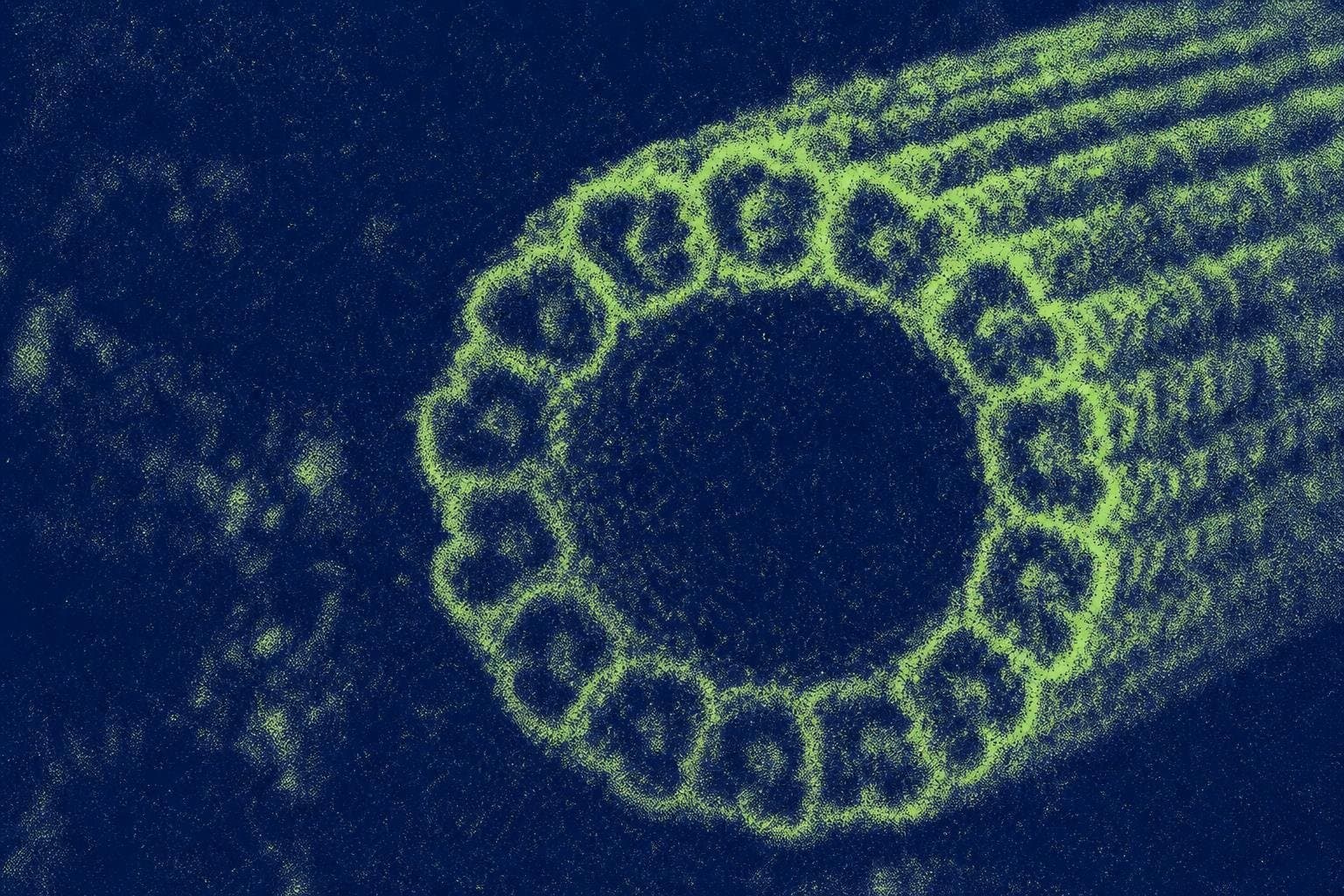
The synthesis builds its case through eight integrative principles, moving from established biological precedents (photosynthesis, the avian quantum compass) through microtubule QED-cavity models and Frohlich condensation, toward what the authors call the weakest empirical link in the chain: Kerskens and Perez's reported consciousness-state-linked non-classical MRI signals in human subjects. The paper is explicit that this finding is correlational and requires independent replication. That kind of epistemic honesty is rarer than it should be in this corner of the literature.
The quantitative anchors are worth noting carefully. Microtubule QED-cavity models and Frohlich-protection arguments point toward coherence times roughly seven orders of magnitude longer than the Tegmark estimate — the calculation that has been used for decades to argue quantum coherence in the warm, wet brain is simply impossible. And Khan et al. 2024 reportedly found that microtubule stabilization significantly delayed anesthetic-induced unconsciousness in rats, with a large reported effect size. I'd want to see that replicated before leaning on it heavily, but it's the kind of result that keeps this line of inquiry alive.
What the Quantum Foundations Work Actually Shows
Here's where I want to pump the brakes slightly, because the broader quantum foundations literature published this month is doing something quite different from what quantum consciousness enthusiasts often hope it's doing.
A Physical Review A paper from researchers at Hebei Normal University and the Chinese Academy of Sciences demonstrates rigorous connections between quantum contextuality, entanglement, and Bell nonlocality — specifically, that there are quantitative trade-off relations between local preparation contextuality and bipartite entanglement in shared quantum systems. This is genuinely interesting foundational work. But it's about qubit systems verified on a quantum cloud platform, not about brains. The temptation to recruit results like this into consciousness arguments is real and should be resisted until someone actually proposes a mechanism connecting the two.
Similarly, work from Delft University on entanglement-assisted coordination in distributed systems shows that quantum entanglement can achieve Pareto-superior performance compared to classical strategies in certain scheduling problems — because entanglement correlations manifest instantaneously upon measurement regardless of physical distance. Again, fascinating. Again, not about consciousness. The gap between "quantum effects do interesting things in engineered systems" and "quantum effects explain consciousness" remains enormous, and the transducer paper is one of the few recent contributions that tries to bridge it with something testable rather than just analogical.
Where This Leaves the Field
The Journal of Cognitive Neuroscience's recent convergence paper on perception, memory, simulation, and consciousness — from researchers at the VA Boston Healthcare System, University of Toronto, and University of Auckland — approaches consciousness from a completely different direction: the relationship between perception, memory, and simulation in generating conscious experience. It doesn't invoke quantum mechanics at all. That's not a failure; it's a reminder that there are multiple serious research programs trying to explain consciousness, and quantum approaches are one thread among several.
What the transducer paper contributes, at its best, is methodological discipline. The electromagnetic shielding experiment it proposes is concrete, feasible in principle, and would actually distinguish between competing hypotheses. That's the bar this field needs to clear more often. Whether the underlying framework survives contact with that experiment is an open question — but at least it's finally a question that could be answered.
Watch for whether any lab picks up the shielding protocol. If the Kerskens and Perez MRI findings get an independent replication attempt, that's the more immediate milestone. Either result would move the needle.
A closing poem this week: from the archive, Wisława Szymborska's "Conversation with a Stone" — a consciousness that knocks on matter and is told, politely, there is no entrance here. Some weeks the research and the poetry are the same question.


