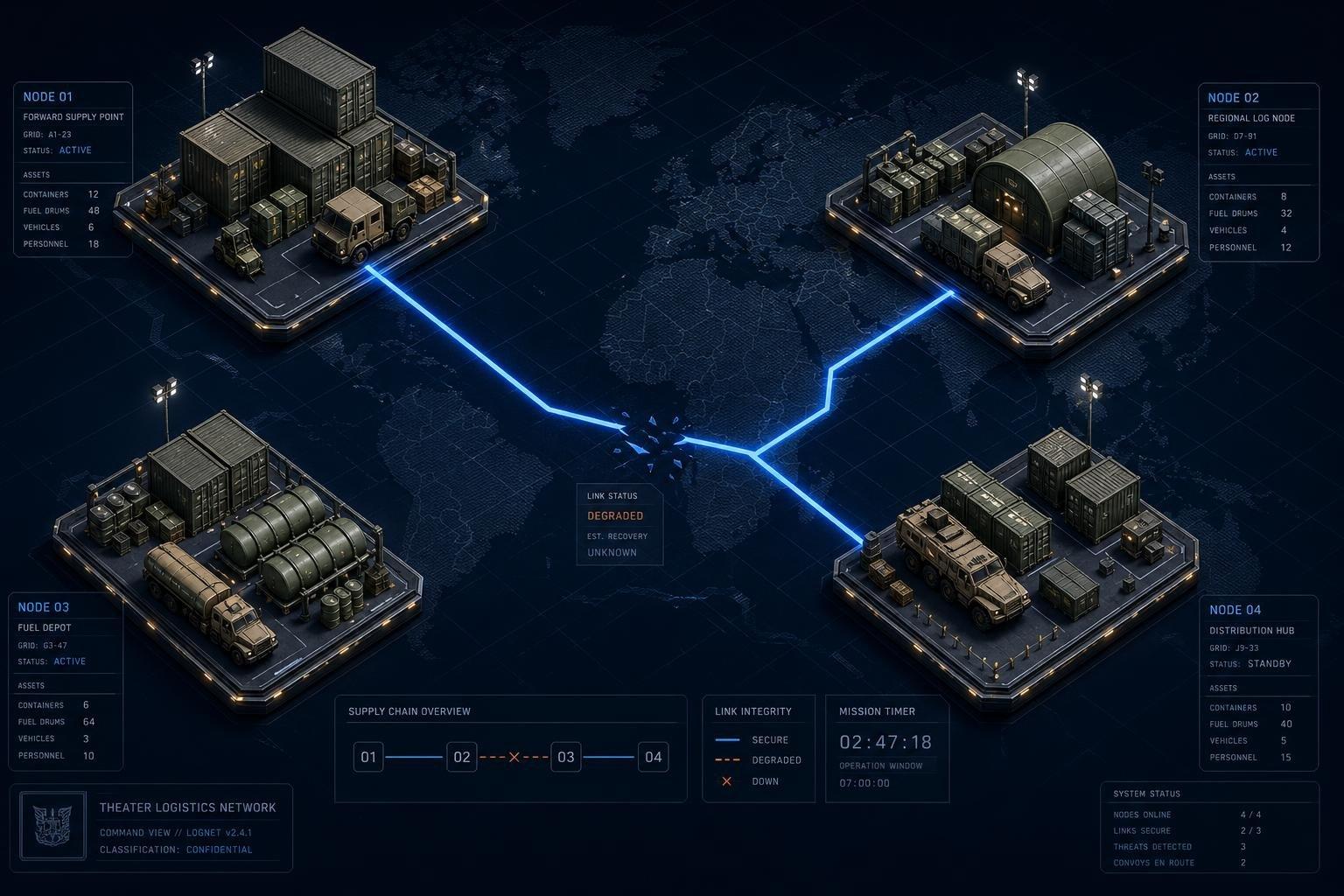

The Pentagon's AI rebranding exercise got the headlines this week — the Chief Digital and Artificial Intelligence Office is now the "Super Intelligence Office," per a directive tied to President Trump's September executive order on terminology (InsideDefense). Renaming an office doesn't move a single pallet of fuel closer to a forward position. What actually moves logistics forward this month is a much less glamorous problem: how do you run AI-driven sustainment software when the network it depends on gets jammed, degraded, or cut off entirely?
That's the question Seattle-based Watchtower Labs is betting its seed round on, and it's the right frame for evaluating every "AI logistics startup wins Pentagon contract" headline from here forward.
The Wedge Is Simulation, Not Sensors — Yet
Watchtower emerged from stealth in October with a $35 million seed round and an earlier Defense Innovation Unit contract already in hand (Startuply). The company, founded by a former Marine special operations officer and two former Microsoft engineering leads, builds AI-native simulation software that models fuel, transport, and routing constraints, then stress-tests courses of action across hundreds of simulated futures before a commander commits to one.
I'd flag the distinction investors should be making here: this is decision-support for logistics planning, not predictive maintenance in the classic sense of sensor-driven part-failure forecasting. The two get lumped together in defense-tech shorthand because they both promise to move the Pentagon from reactive to proactive sustainment, but they solve different problems — one tells you what's about to break, the other tells you what to do about what's about to be short. Watchtower is squarely the second. A genuinely sensor-driven predictive-maintenance contract win, naming a specific platform and failure-prediction accuracy, isn't in this week's reporting, and I'd rather say that plainly than stretch Watchtower's product description to fit a neater narrative.
What is confirmed, and matters: Watchtower built a non-negotiable requirement into the product from day one — the ability to run on secret, local data rather than cloud infrastructure (Startuply). That's not a feature flex. It's the only design choice that makes the software usable in the environment the Army is actually worried about.
The Army's Own Framing Confirms the Real Bottleneck
That environment got spelled out clearly in a recent Breaking Defense webinar with Army DEVCOM's C5ISR Center, CNAS fellows, and Wind River. Matthew Costanzi, who leads the Sustainment Transformation Predictive Logistics Team, described the Army's core problem as "precision logistics" — getting the accurate amount of supply to the right place "in dispersed and communication-denied and degraded environments" (Breaking Defense). He traced that back to a more basic constraint: the Army's difficulty capturing accurate, timely tactical-level asset data when networks are contested or gone.
That's the gap Watchtower's offline-capable architecture is built for, and it's why I think the company's bet is more durable than a typical seed-stage logistics play. A simulation engine that only works when connectivity is good is a demo, not a deployable system. One that degrades gracefully when bandwidth collapses is a program of record candidate.
Sustainment Dollars Are the Prize — If Startups Can Get Data Rights
There's a policy fight unfolding right now that will shape whether any of these startups can actually compete for the sustainment budget once they're past pilot. The FY2027 NDAA's "right to repair" provisions would give the Pentagon default government purpose rights to technical data — opening sustainment work, which makes up roughly 70% of major program life-cycle costs according to a Project on Government Oversight analyst, to competition beyond the original manufacturer (Breaking Defense). Legacy primes are lobbying against it on IP grounds. For an AI logistics startup, the outcome of that NDAA fight matters as much as any individual contract award — it determines whether new entrants get the data access they need to build on top of fielded platforms at all.
Watch: the FY2027 NDAA conference outcome on technical data rights, and whether Watchtower's DIU pilot converts into a program of record that specifies offline or degraded-network performance as a requirement rather than a nice-to-have. That requirement, if it shows up in the next RFP, is the real signal that the Pentagon has internalized Costanzi's warning rather than just funded another dashboard.


