


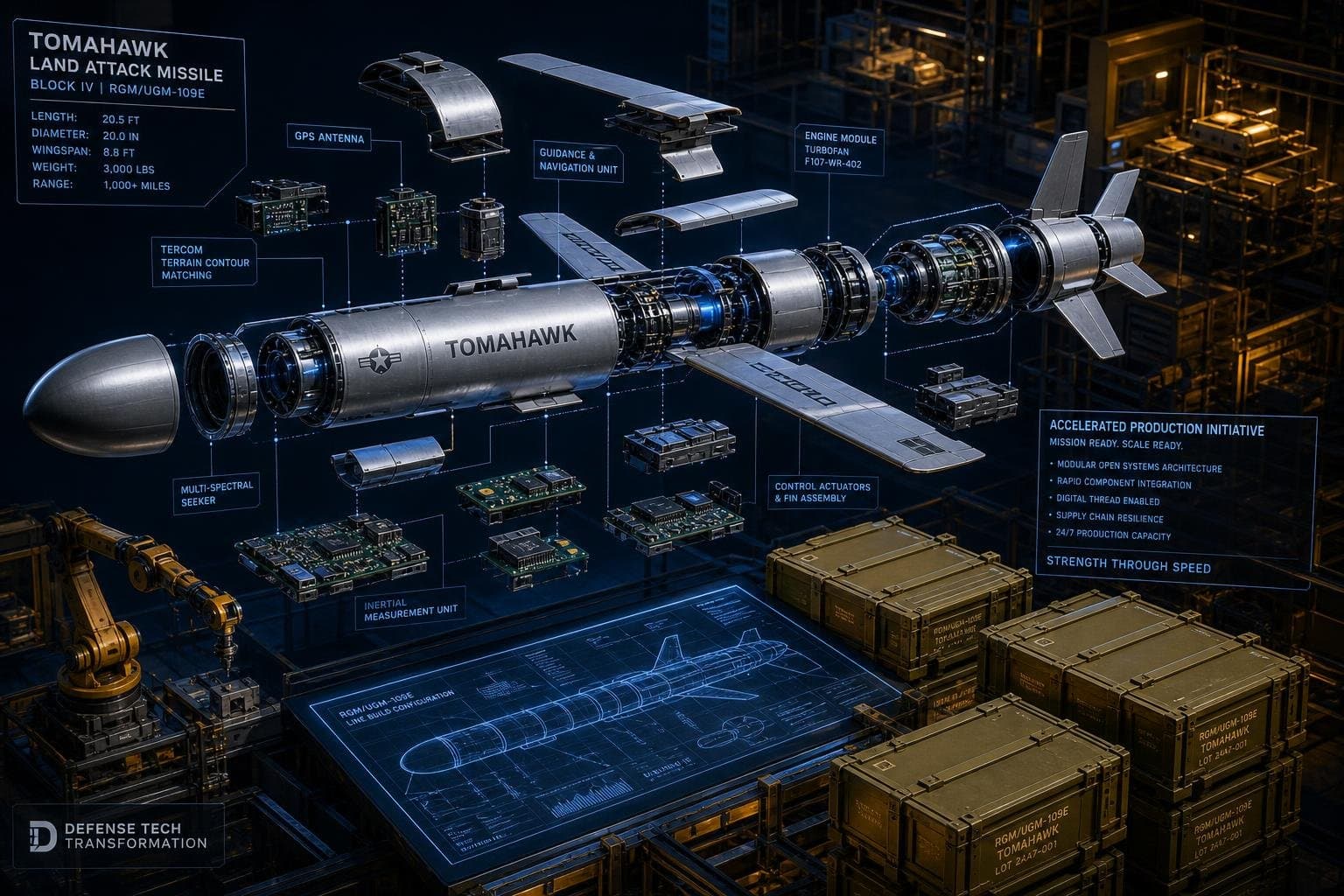

Sixty missiles a year. That's what Raytheon was producing before this week. The Navy just handed them a $22.9 billion, seven-year contract to get that number above 1,000 annually — a roughly 16-fold production increase.
That's not a procurement story. That's an industrial mobilization signal.
The Iran conflict has done something that years of Pentagon reform rhetoric couldn't: it's created genuine urgency around munitions stockpiles. The Tomahawk contract follows deals earlier this month to ramp Patriot and THAAD interceptor parts, per Reuters. The pattern is clear — the administration is locking in multi-year production commitments specifically to give contractors the confidence to build new facilities and buy new equipment. The framework agreement was signed in February; the formal contract just made it real.
For defense tech investors, the interesting question is what this does to the startup tier. Legacy primes like Raytheon are absorbing enormous capital to scale existing platforms. That's not inherently bad for startups — but it does mean the next few years of Pentagon budget attention will be heavily weighted toward replenishment of proven systems rather than experimentation with new ones. The DIU and OTA pathways remain open, as the Space Force's $12 million per company awards to five firms for its Space Data Network demonstrate. But the gravitational pull of a shooting war favors what's already in the inventory.
The Army's selection of Hanwha Defense USA for a $262 million mobile artillery prototype contract fits the same logic — proven hardware, accelerated fielding, allied industrial base. The M777 replacement program isn