


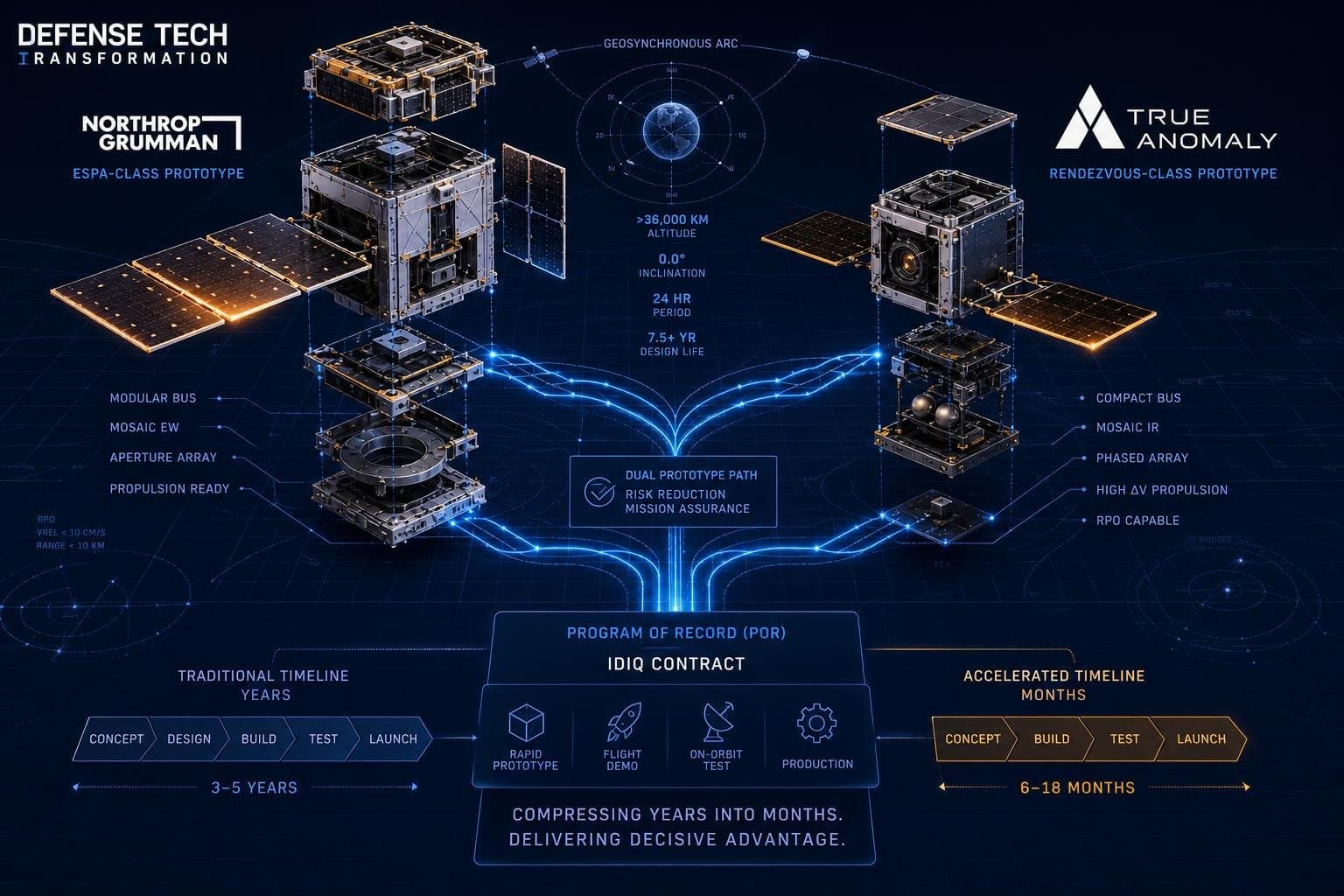

Two companies just got picked to fly satellite prototypes by 2028 under a program that started as a DIU experiment eight months ago. That timeline is the story.
GHOST-R Becoming RG-XX Is the Reform Pattern Working as Designed
The Defense Innovation Unit's GHOST-R effort — a commercial satellite program aimed at monitoring geosynchronous orbit — launched in February. By April, the Space Force had already folded it into RG-XX, the program meant to replace the aging GSSAP "neighborhood watch" satellites. Now Northrop Grumman and True Anomaly are building prototypes due to fly by 2028, with Col. Bryon McClain framing the arrangement explicitly as risk-reduction: successful prototypes get "a direct path to transition into the program of record," per the same Breaking Defense report.
That's the DIU model doing exactly what it was built to do — using a rapid, commercially-driven demonstration to de-risk a service acquisition before money and years get sunk into a traditional program. And the dollar figures behind it are real: the broader GEO-monitoring effort, Andromeda, now carries a $6.2 billion ceiling after the Space Force added $4.4 billion to the contract vehicle in May, up from an original $1.8 billion pool spread across 14 vendors. True Anomaly landing a seat at that table — alongside an incumbent as large as Northrop Grumman — is the more interesting signal than the dollar figure itself. It means a company founded to build orbital rendezvous and inspection tech is now competing for a program of record slot on a multi-year track, not just picking up a one-off study contract.
Compare that cadence to what legacy defense-industrial timelines still look like elsewhere this month. OCCAR's $4.2 billion DDX destroyer contract for Fincantieri and Leonardo, announced this week, traces back to a 2020 program announcement that originally targeted 2028 delivery. The ships won't arrive until 2033 and 2035. And the Pentagon's $20.7 billion AMRAAM deal with RTX's Raytheon, meant to replenish missile stockpiles drawn down by Middle East and Ukraine operations, is a scale play on an existing production line, not a capability leap.
None of that makes the incumbent contracts wrong — stockpiles need refilling and destroyers need building. But the GHOST-R-to-RG-XX pipeline is the only one of the three where a startup's prototype timeline is setting the pace of a Pentagon program, rather than the other way around. Watch whether True Anomaly's 2028 prototype flight actually holds — that's the test of whether "feeder" programs can keep their promises once real money is on the line.