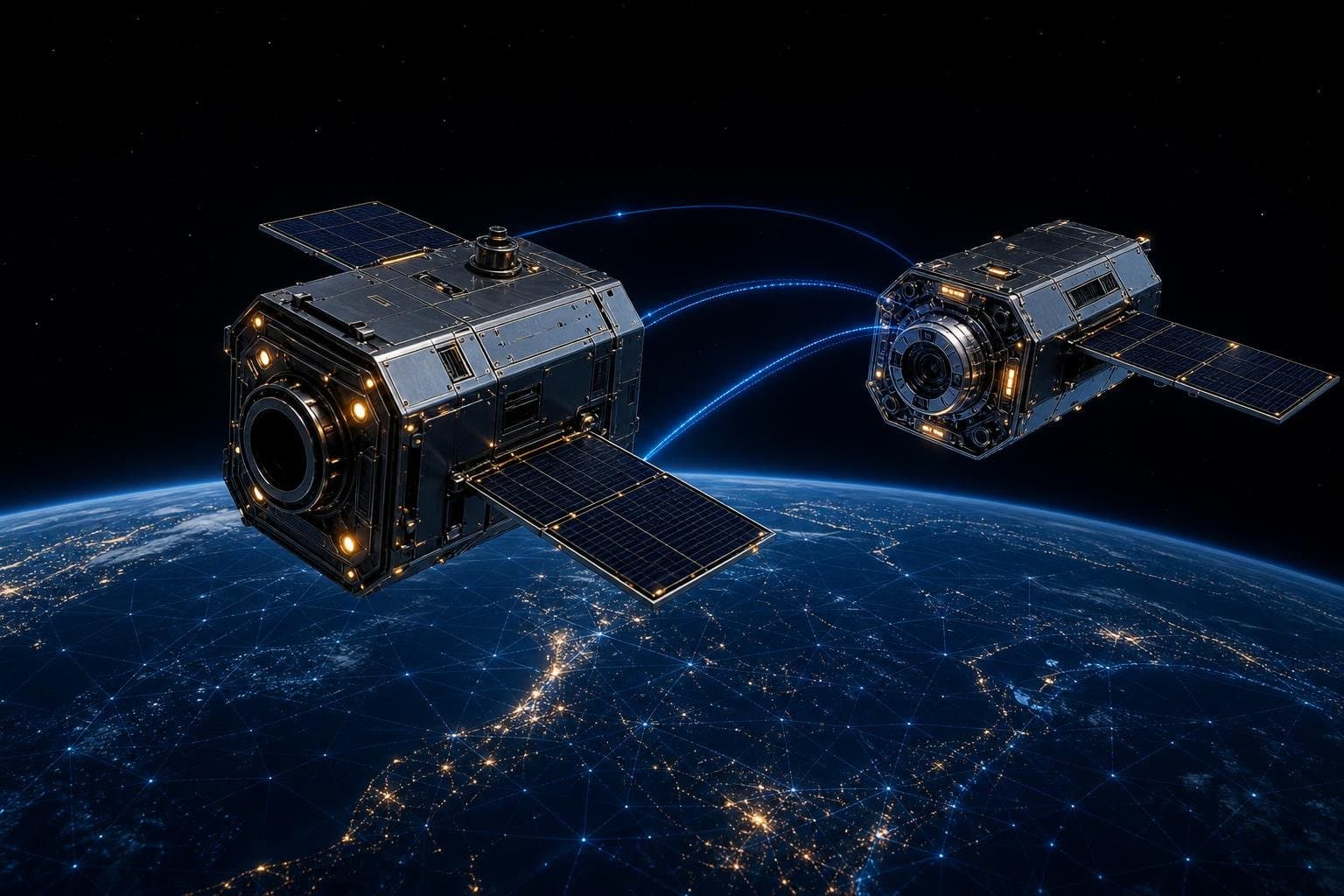

There's a moment in any technology transition when the proof of concept stops being theoretical. For space domain awareness, that moment arrived quietly in orbit sometime in the last few weeks, when two venture-backed startups began flying what the Space Force describes as proximity operations around military satellites — the kind of close-quarters maneuvering that, until recently, the Pentagon would never have trusted to a company that didn't exist a decade ago.
The shift is bigger than any single contract. It reflects a fundamental rethinking of who builds and operates America's eyes in space — and what it means when the answer is increasingly: startups.
The Proximity Operations Bet: True Anomaly and Rocket Lab Are Already Flying
The clearest signal of where this is heading came from reporting on True Anomaly and Rocket Lab, which are now executing what sources describe as Top Gun-style proximity operations for the Space Force — autonomous spacecraft flying close to military satellites, mirroring the close-quarters maneuvering that fighter pilots practice in the atmosphere, except at roughly 17,000 miles per hour in low Earth orbit.
True Anomaly, founded just three years ago, built its entire company around what the industry calls rendezvous and proximity operations, or RPO. The pitch was always that autonomous spacecraft with onboard AI could make real-time decisions — tracking a potentially hostile satellite that changes course without waiting for ground controllers to plan a response days in advance. The Space Force contracts validate that thesis in the most direct way possible: they're not paying for a demo, they're paying for operational missions.
Rocket Lab's involvement adds a different dimension. The company went public via SPAC in 2021 as primarily a launch provider, but has been methodically expanding into satellite manufacturing and space systems. Adding military proximity operations to that portfolio puts it in direct competition with Northrop Grumman and Lockheed Martin on missions those primes have historically owned. That's the competitive disruption the defense tech thesis has always promised — and it's now happening in one of the most sensitive mission categories the Space Force operates.
True Anomaly raised $100 million in Series B funding earlier this year, led by Riot Ventures with participation from Eclipse and ACME Capital. The timing matters: that capital was raised before these operational contracts were confirmed, meaning investors were betting on the thesis before the Pentagon validated it. Now that validation has arrived, the next funding cycle will be priced accordingly.
What Vantor's International Expansion Reveals About the GEOINT Demand Shift
While True Anomaly and Rocket Lab are operating at the sharp end of space domain awareness — tracking and characterizing objects in orbit — a different company is reshaping the intelligence layer underneath: the geospatial imagery that tells you what's happening on the ground and, increasingly, what's happening in orbit.
Vantor, the Colorado-based company that emerged from Maxar Technologies, is repositioning itself as a spatial intelligence company with a national security focus. CEO Dan Smoot told Breaking Defense that the company has seen a dramatic geopolitical shift in the marketplace over the last 16 months — driven by the U.S. pulling back from intelligence sharing and pushing allies to invest in their own capabilities.
The numbers tell the story. Vantor's international revenue runs roughly 70 percent defense, 30 percent civil. That ratio reflects something important: when allies are building their own GEOINT capabilities from scratch, they're building them for military purposes first. The civil applications come later. This is the same pattern that played out in the U.S. market over the previous decade, compressed into a much shorter timeline because the geopolitical urgency is higher.
The hardware investment backs this up. On June 24, Vantor announced a deal with BAE Systems to build the first two of its next-generation Vantage electro-optical imaging satellites, with 20-centimeter resolution. That resolution matters operationally — it's the threshold where imagery becomes genuinely useful for tracking military equipment and infrastructure rather than just confirming that something is there. The deal covers two satellites but is structured to grow toward a larger constellation on the order of Vantor's existing WorldView Legion, which currently includes six birds in low Earth orbit.
The strategic logic here connects directly to space domain awareness. Better imagery resolution means better characterization of objects in orbit and on the ground. When you can see what a satellite is doing with 20-centimeter fidelity, you can distinguish between a communications satellite and one that's maneuvering toward your assets. That's not just commercial imagery — that's the intelligence layer that makes the rest of space domain awareness possible.
The Responsive Launch Piece: Why Rocket Lab's 16-Hour Record Matters
Space domain awareness is only as good as your ability to get new sensors into orbit when you need them. That's why Rocket Lab's record 16-hour-42-minute Victus Haze launch for the Space Force deserves more attention than it's gotten in the context of the broader SDA story.
Responsive launch — the ability to put a satellite into a specific orbit on very short notice — has been a stated Pentagon priority for years. The theory is straightforward: if an adversary destroys or degrades your space assets, you need to reconstitute quickly. But "quickly" in traditional procurement terms meant months or years. Rocket Lab just demonstrated it means hours.
Sixteen hours and forty-two minutes from call-up to orbit is a different category of capability. It means the Space Force can respond to a gap in its sensor coverage almost in real time. It means that a space domain awareness constellation isn't a fixed architecture that an adversary can map and exploit — it's a dynamic system that can be reconfigured faster than an adversary can plan around it. That's the operational advantage that makes the entire startup-driven SDA thesis coherent rather than just commercially interesting.
The fact that Rocket Lab is simultaneously executing proximity operations and demonstrating responsive launch puts it in a uniquely powerful position. It can characterize threats in orbit and rapidly deploy new sensors to track them. That's a vertically integrated space domain awareness capability that no legacy prime currently offers as a single package.
The Orbital Servicing Wildcard: What Katalyst's Swift Mission Proves
The fourth piece of this picture is the one that gets the least attention in defense circles, but may have the longest-term implications: autonomous orbital servicing.
NASA's Swift Boost Mission, a $30 million effort to save the Neil Gehrels Swift Observatory from orbital decay, launched early Friday from the Marshall Islands. The mission uses Link, an autonomous robot built by startup Katalyst Space Technologies, to find the telescope, attach to it, and boost its orbit before it burns up in the atmosphere.
This is nominally a NASA science mission. But the capability it demonstrates — autonomous rendezvous, attachment, and orbital adjustment of an uncooperative spacecraft — is directly relevant to military space domain awareness in ways that should make the Space Force pay close attention.
Consider what this means operationally: if you can autonomously rendezvous with and service a friendly satellite, you can also inspect, characterize, or — in a contested environment — interfere with an adversary's satellite. The same autonomy stack that saves Swift could, in a different configuration, be the most consequential counter-space capability the U.S. develops in this decade. The Pentagon has been funding rendezvous and proximity operations through True Anomaly for exactly this reason, but Katalyst's mission demonstrates the servicing end of that capability in a live operational environment for the first time.
The $30 million price tag is also worth noting. That's a rounding error in traditional defense procurement. If the mission succeeds, it will have demonstrated a capability that legacy primes have been promising for years at a fraction of the cost and timeline. That's the cost curve argument that the defense tech startup thesis has always rested on — and it's about to get a very public test.
The Competitive Architecture Taking Shape
Step back from the individual contracts and a coherent architecture emerges. The Space Force is building a space domain awareness capability that runs on commercial infrastructure at every layer: imagery from Vantor's high-resolution constellation, proximity operations from True Anomaly's autonomous spacecraft, responsive launch from Rocket Lab, and orbital servicing from Katalyst. Each company is venture-backed. Each is operating on timelines and cost structures that legacy primes can't match.
What's changed in the last 18 months — and this connects to what I wrote about the Space Force's three-tier communications architecture in June — is that the Pentagon has stopped treating commercial space as a supplement to military infrastructure and started treating it as the primary layer, with government-owned assets as the backup. That's a fundamental inversion of the previous model, and it's happening faster than most of the traditional defense industry has processed.
The international dimension adds urgency. Vantor's CEO is right that allies are now building their own GEOINT capabilities from scratch, and they're doing it with U.S. commercial providers rather than waiting for government-to-government intelligence sharing arrangements. That creates a network effect: the more allies buy into the commercial SDA architecture, the more data flows into it, the better the picture becomes for everyone in the network. China and Russia are building their own orbital maneuvering capabilities — the Space Force's proximity operations contracts with True Anomaly and Rocket Lab are a direct response to that threat — but they're doing it through state-owned enterprises on state timelines. The U.S. is doing it through startups that raised venture rounds and move at venture speed.
The question worth watching over the next 12 months: whether the Space Force's procurement infrastructure can keep pace with the operational tempo these companies are now demonstrating. True Anomaly and Rocket Lab are flying missions. Katalyst is launching. Vantor is building next-generation hardware with a European partner. The capability is real. The bottleneck, as it has been throughout the defense tech transformation, is whether the contracting and integration machinery can absorb it fast enough to matter.
Watch specifically for how the Space Force structures follow-on contracts for proximity operations — whether True Anomaly and Rocket Lab get expanded mandates or whether the program gets absorbed into a larger prime-led architecture. That decision will tell you more about the Pentagon's actual commitment to the startup model in space than any press release about innovation.


