


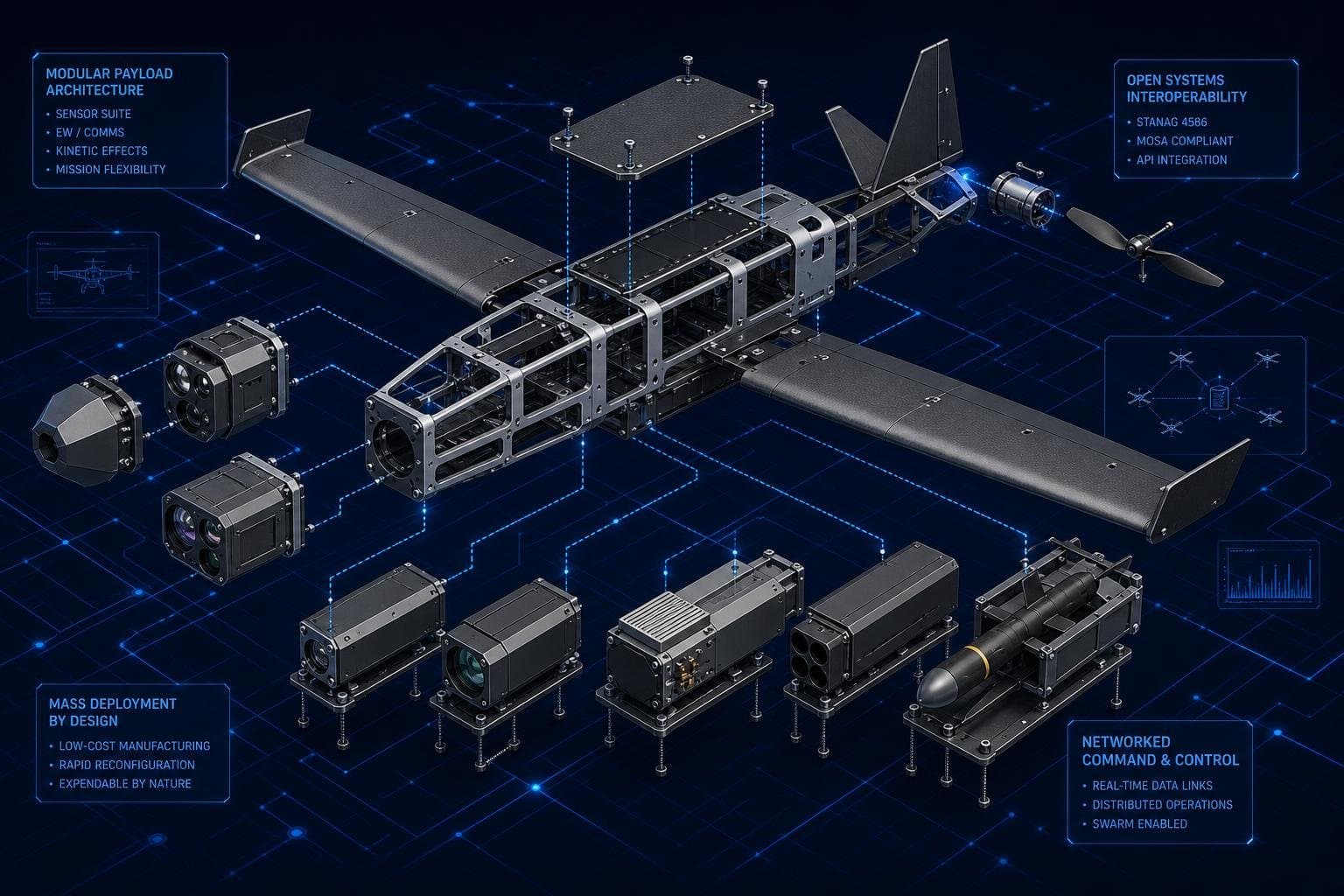

The MQ-9 Reaper wasn't supposed to be expendable. At $30 million per airframe, it was a precision asset to be protected, not risked. Then the Iran war happened, and dozens were shot down. The loss rate is "not sustainable" against a force like Iran — whose air defenses are less sophisticated than China's or Russia's — and that single operational reality is now rewriting how the Pentagon thinks about unmanned systems from the ground up.
The DIU's Massed Modular Aircraft solicitation is the clearest expression of that shift. The MMA isn't a better Reaper — it's a different theory of airpower entirely. The specs are striking: 2,800-pound payload, 2,300-nautical-mile combat range, and enough onboard power to host a variety of sensor and weapons packages, with one operator controlling several drones simultaneously. The underlying logic: if you can't make a drone survivable, make it numerous enough that losses become tactically irrelevant.
Expendability Is a Capability, Not a Compromise
This connects directly to where the broader autonomous systems conversation is heading. The CCA program is undergoing a similar conceptual expansion — the autonomous wingmen of 2030 will likely look less like missile trucks and more like multi-role platforms capable of electronic warfare, targeting relay, and persistent loiter in contested airspace. As Breaking Defense reported, autonomy unlocks mission profiles that are simply too risky for manned or high-value unmanned platforms — and the same units that fly manned fighters will task and control them.
That ambition is colliding with real fiscal pressure. The Pentagon is simultaneously seeking to reprogram $4.3 billion in FY2026 funds to cover surging personnel and operational costs from ongoing missions — strain that wasn't priced into the original budget. Venture capital is reading the same signals: [VC investment in defense tech has doubled](https://www.bloomberg.com/news/newsletters/2026-07-07/vc-money-pours-into-defense-tech-in