



Shield AI just put its own money where its mouth is. The Navy's $150 million modification to its X-BAT Other Transaction agreement came with a catch: Shield AI had to match it dollar-for-dollar, bringing the total program investment to $400 million when stacked against August's earlier round, according to Breaking Defense. That's not a company chasing a contract. That's a company betting its own balance sheet that the AI-piloted VTOL fighter jet concept works before the government fully commits.
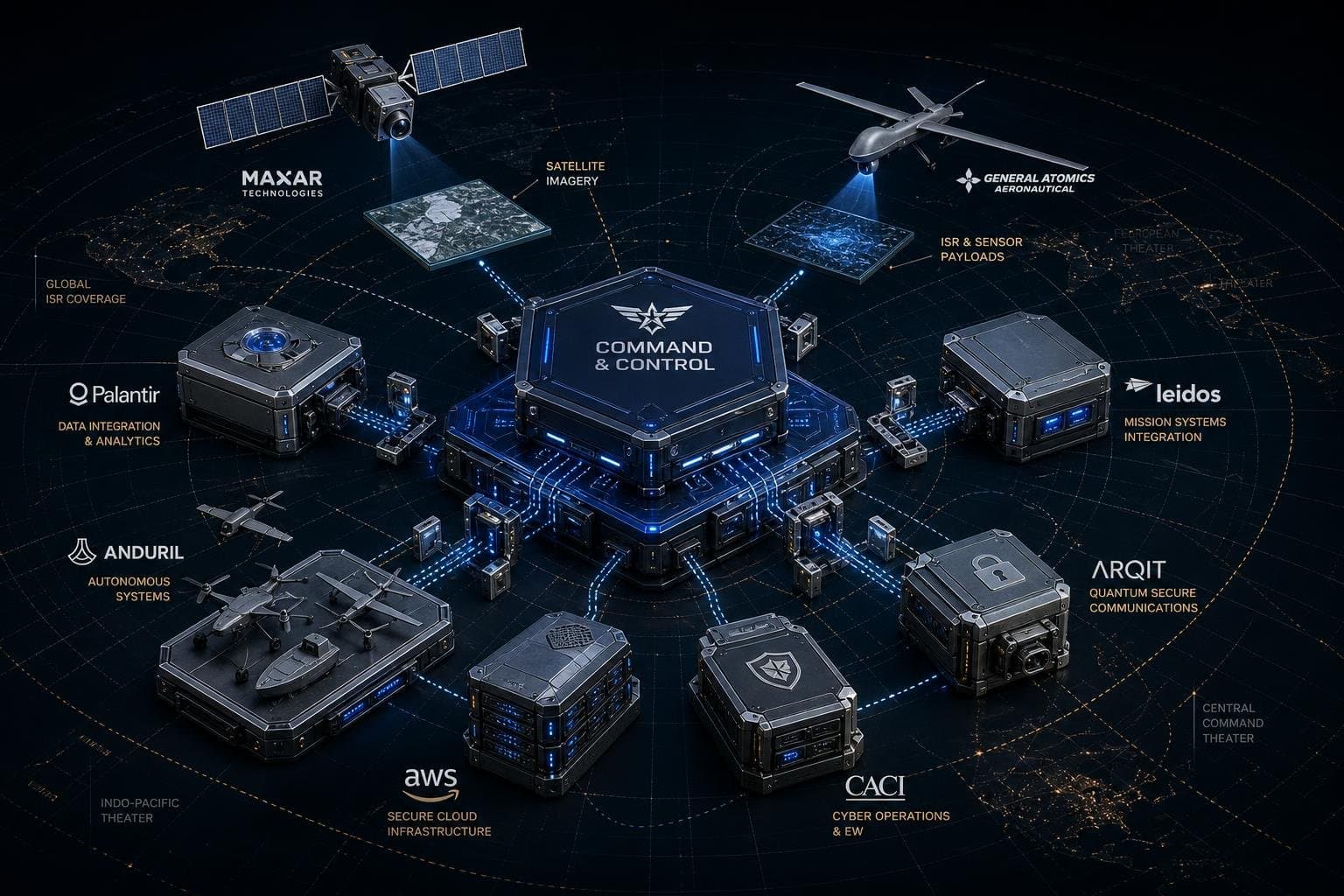
Compare that to how the Army is building its Next Generation Command and Control software. Nine companies — including Onebrief, Rune Technologies, and Mente Systems alongside General Dynamics — just split $93.6 million to build applications, but all of them sit on top of a common data baseline that Anduril, Palantir, Raft, and Striveworks already built, per Defense News. Anduril alone picked up $162.8 million in a contract worth up to $1.8 billion on Sept. 30 just to keep refining that foundation.
Two different procurement philosophies, same underlying logic: the Pentagon is no longer buying finished products, it's buying into platforms where smaller firms plug in modules and the government shares financial risk with whoever holds the biggest conviction. Anduril's reported talks to sell $1.3 billion in insider shares at a $90 billion valuation, per Bloomberg via Axios, make sense in that light — it's less a drone company now than infrastructure other drone companies build on.
PitchBook data cited by Axios shows Q3 defense tech funding concentrating even as early-stage investing overall slows. Watch whether that concentration keeps favoring platform owners over point-solution vendors — the X-BAT flight tests later this year will tell you if matched capital actually buys speed.