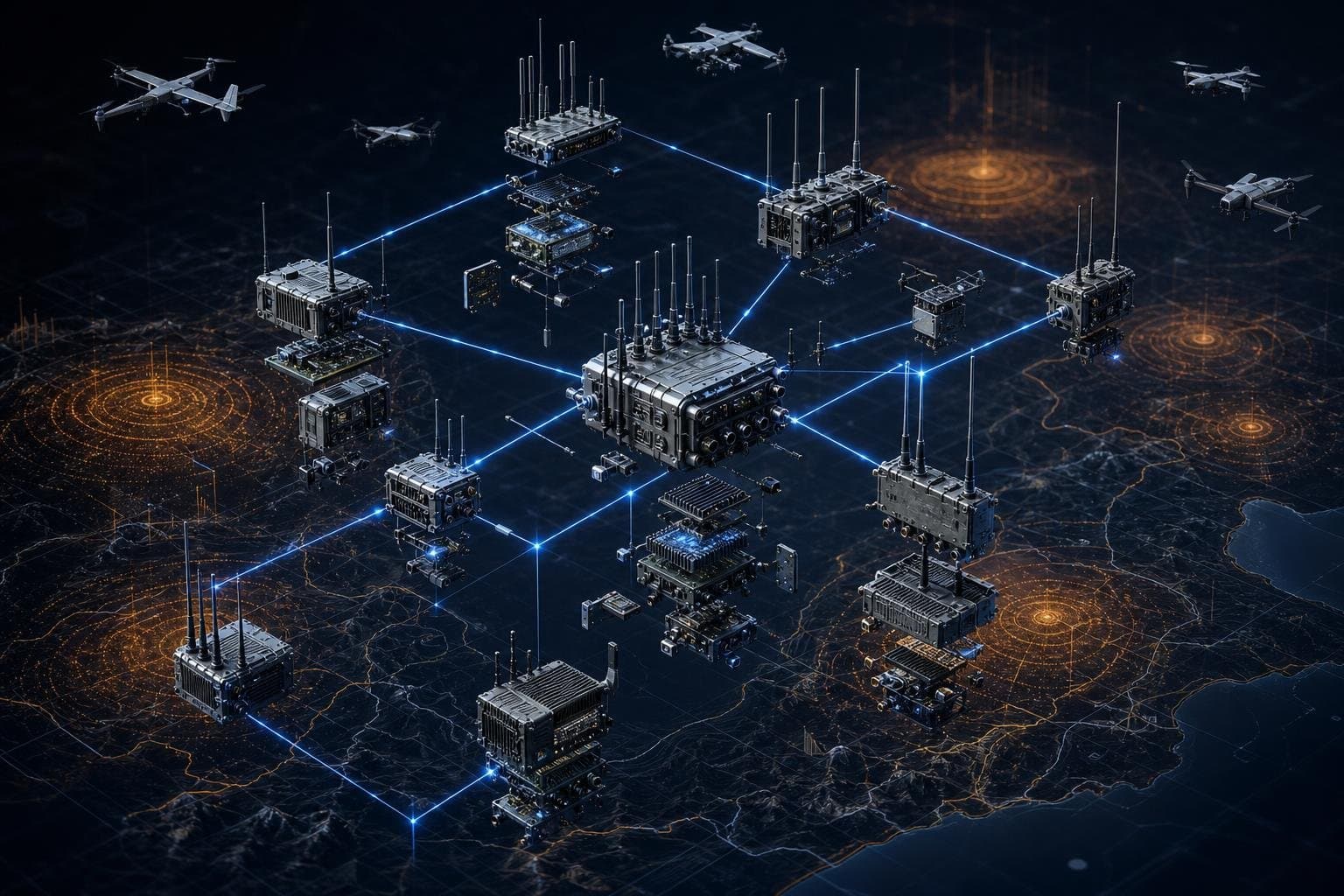

The assigned topic asks about software-defined networking startups modernizing Pentagon tactical communications. The source pool doesn't confirm that specific thesis — no sources this week cover SDN startups winning Pentagon comms contracts. What the sources do confirm is something more interesting: the actual modernization happening at the tactical edge runs through radio hardware, mesh networking, and the drone communications layer. That's where the real story is, and it's where I'm going.
The radio is the network. That's the lesson coming out of Ukraine, and it's reshaping how the Pentagon thinks about tactical communications infrastructure — not through software-defined networking abstractions, but through the unglamorous, physics-constrained problem of keeping drones connected when adversaries are actively trying to sever that link.
Doodle Labs, a Singapore-based radio specialist, has become one of the clearest examples of how this plays out in practice. The company builds long-range wireless mesh networking solutions specifically for unmanned systems operating in contested environments — and its Ukraine deployments are generating the kind of operational feedback that no lab test can replicate. When a Ukrainian operator needs to strike a vehicle equipped with a jammer, they reach for a Doodle Labs radio. When they need to hit a cheaper, lower-value target, they use a drone with a commodity radio. That triage decision — made under fire, repeatedly — is a procurement signal the Pentagon should be reading carefully.
The communications layer for autonomous systems is becoming a first-order capability question, not a procurement afterthought. And the companies solving it aren't primarily software firms. They're solving a physics problem with engineering.
The Jamming Problem Is Forcing a Hardware Reckoning
Electronic warfare has always been part of military operations, but the drone-saturated battlefield in Ukraine has compressed the feedback loop between adversary jamming tactics and the countermeasures needed to defeat them. What used to take years to cycle through requirements, development, and fielding is now happening in months — because the operational cost of getting it wrong is immediate and visible.
Doodle Labs' approach centers on two capabilities that matter most in a jamming environment: frequency agility and mesh architecture. As the company's senior director of sales explained to Defense News, their radios can "move from the channels that they're trying to jam to an unjammed channel" and maintain connectivity across a wide frequency range within a single radio. That's not a software feature — it's a hardware and firmware capability that requires significant RF engineering to execute reliably at the ranges and speeds drone operations demand.
The mesh networking piece matters equally. A point-to-point radio link has a single point of failure: jam the link, lose the drone. A mesh network routes around degraded nodes, maintaining connectivity even when individual links are disrupted. For a swarm of drones operating in a contested environment, that architectural difference is the gap between a capable system and an expensive debris field.
What's notable about Doodle Labs' trajectory is that demand is now outrunning supply chain capacity. The company is actively exploring manufacturing partnerships in both the U.S. and Europe, with an eye on NDAA compliance requirements and Made in America incentives. The scale ambition is real: the company claims the ability to produce tens of thousands of radios per month if demand requires it. That's a manufacturing posture, not a startup pitch — and it mirrors the broader pattern Reuters has tracked of Pentagon technology suppliers being pushed toward enterprise-scale commitments rather than boutique contracts.
The Drone Dominance Competition Reveals What "Tactical Comms" Actually Means
The Pentagon's Drone Dominance program — a $1.1 billion competition that just completed another round at Camp Grayling, Michigan — offers a useful lens for understanding how communications infrastructure fits into the broader autonomous systems picture. Of the 49 companies that competed, 19 advanced to the next round of testing scheduled for August. Most are young, privately held companies focused on small UAS rather than traditional weapons platforms.
What's revealing about the finalist pool, according to defense technology consultant J.R. Mullis, is that the companies aren't all building the same thing. They're developing different pieces of an integrated capability — airframes, sensors, autonomy software — and the communications layer threads through all of it. A drone with superior airframe performance and weak radio connectivity is a liability in a contested environment. The integration challenge is real, and it's why the Drone Dominance evaluation criteria include performance and ease of use: a system that requires specialized operators to manage its communications stack doesn't scale.
The program's structure also reflects a broader shift in Pentagon acquisition logic. The government has become more willing to identify specific operational gaps and let entrepreneurs with specialized expertise build directly against them. That's a meaningful change from the traditional requirements process, which historically produced specifications that were already outdated by the time a contract was awarded. It's the same institutional logic driving the Cathedral funding round — Andreessen Horowitz and Sequoia didn't bet $160 million on a general-purpose defense platform; they backed a team with specific operational domain knowledge targeting a specific Pentagon gap.
The companies that are winning in this environment share a common characteristic: they're solving a specific, well-defined problem rather than pitching a general-purpose platform. The communications layer is one of the clearest examples of this dynamic — the problem is specific (maintain connectivity in a jamming environment), the physics are unforgiving, and the operational feedback from Ukraine is immediate.
The Enterprise Software Consolidation Creates a Contrast Worth Noting
While the tactical edge is being modernized through hardware and specialized RF engineering, the Pentagon's enterprise software layer is moving in a different direction: consolidation. The nearly $7 billion Oracle agreement announced this week — negotiated by the Department of the Navy and covering the entire Pentagon along with the Coast Guard and intelligence community — is the second major enterprise software consolidation move in two months. A similar five-year, $9.69 billion Microsoft deal closed in May, part of what Pentagon CIO Kirsten Davies has described as a push to replace piecemeal, service-by-service contracts with enterprise-wide agreements.
Davies framed the Oracle deal explicitly as a cost-cutting measure, projecting at least $441 million in taxpayer savings. That's a legitimate procurement reform story, but it's a different kind of modernization than what's happening at the tactical edge.
The contrast is instructive. Enterprise software consolidation is about eliminating redundancy and driving down unit costs on commodity capabilities. Tactical communications modernization is about creating new capabilities that didn't exist before — or that existed only in theory, without the operational validation that comes from actual contested environments. These are different problems with different solution architectures, and conflating them produces confused procurement strategies.
The Oracle deal is also a reminder that not all Pentagon technology spending is defense tech transformation in the meaningful sense. A $7 billion software license consolidation is a procurement efficiency story. A company building jam-resistant mesh radios that Ukrainian operators are using to hit armored vehicles with jammers — that's a capability story. Both matter, but they matter differently.
The Autonomous Systems Layer Is Where Comms Infrastructure Gets Interesting
Anduril's unveiling of Thunder at Farnborough this week — a fully autonomous armed reconnaissance tiltrotor designed to fly in groups of three to six alongside Apache and Cheyenne helicopters — illustrates where the communications infrastructure challenge is heading. A loyal wingman concept doesn't work without reliable, low-latency communications between the manned aircraft and the autonomous wingmen. At the ranges and speeds Thunder is designed to operate, that's a hard RF engineering problem.
Anduril President Chris Brose described Thunder as drawing on lessons from Ukraine and from the company's experience with the Fury aircraft currently in production for the Air Force's Collaborative Combat Aircraft program. The payload configuration Anduril's Shane Arnott outlined — up to 10 Hellfires, 16 air-launched effects, 76 rockets, plus counter-UAS systems in the nose — represents significant autonomous decision-making authority operating over a communications link that adversaries will actively try to sever.
That's the real communications infrastructure challenge for the next generation of autonomous systems: not just keeping a drone connected to a ground operator, but maintaining the mesh of communications between multiple autonomous platforms operating in a coordinated fashion under electronic attack. The software-defined networking concepts that work well in data center environments face serious constraints when the "network" is a group of armed tiltrotors flying at altitude in a contested airspace. Bloomberg's tracking of Silicon Valley's defense bets captures the investor enthusiasm behind this thesis — Andreessen Horowitz has been particularly active, adding a defense investor and military veteran to its American Dynamism team as the firm deepens its commitment to national security technology.
The companies that figure out how to solve this problem — maintaining reliable, low-latency, jam-resistant communications across a heterogeneous swarm of autonomous platforms — will have a capability that no amount of enterprise software consolidation can replicate.
The Investment Signal Is Pointing at the Right Problem
The Cathedral funding round — $160 million at a $1.4 billion valuation, led by Andreessen Horowitz and Sequoia Capital — is primarily a cyber story, but it reflects the same underlying dynamic: sophisticated investors are betting that the Pentagon's most pressing technology gaps are in the operational layer, not the enterprise layer. Cathedral's focus on AI-driven offensive and defensive cyber capabilities, including plans to acquire dedicated compute infrastructure, suggests a recognition that the communications and cyber domains are converging in ways that traditional defense contractors haven't fully addressed.
The DOGE alumni founding team's deep ties to the current administration give Cathedral an unusual path to contracts, but the underlying thesis — that AI can meaningfully expand military cyber capabilities — is sound regardless of the founders' political connections. The more interesting question is whether Cathedral's approach to dedicated compute for cyber operations translates into an architectural advantage, or whether it's a feature that larger players can replicate once the capability is demonstrated.
For investors watching this space, the pattern is consistent: the companies attracting serious capital are solving specific, hard problems at the operational layer — communications, cyber, autonomy — rather than building general-purpose platforms and hoping the Pentagon finds a use for them. The Axios reporting on Empirical Security's $25 million Series A — an exposure management startup using AI to help organizations prepare for new security risks — reflects the same investor logic applied to the commercial side: the funding is chasing specific, well-scoped problems, not broad platform bets.
What to Watch Through the Rest of 2026
The Drone Dominance program's next testing round begins in August, and the 19 companies that advanced will face evaluation criteria that include production scalability — not just performance. That's the filter that separates companies with genuine manufacturing capability from those with impressive prototypes. Watch which companies survive that round: they'll be the ones with both the technical capability and


