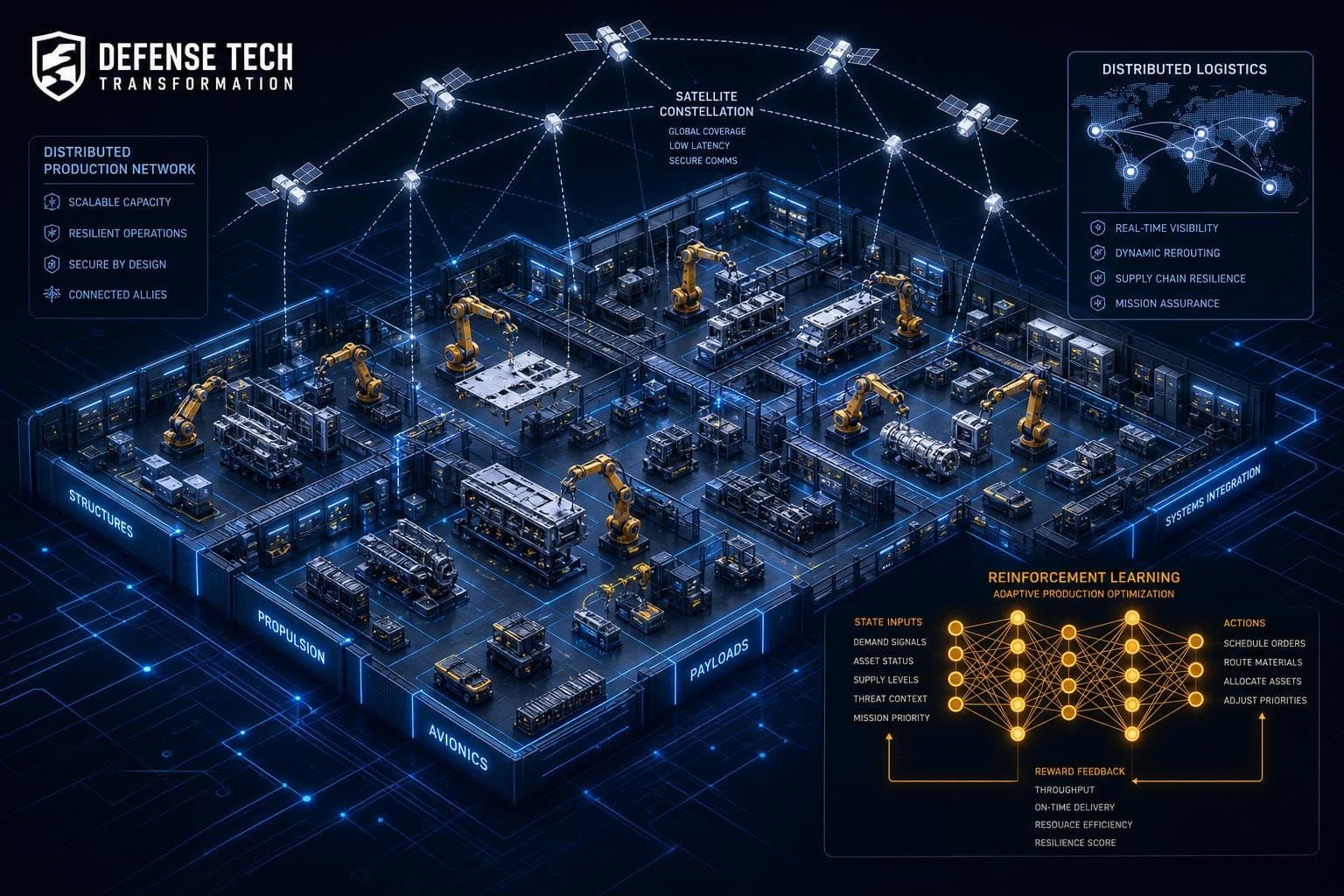

The assigned topic this week — venture-backed supply chain visibility startups winning Pentagon defense industrial base resilience contracts — is a reasonable thesis to investigate. The problem: the source pool doesn't confirm it. No sourced evidence this week names a supply chain visibility startup winning a DIB resilience contract. What the sources do show is something more interesting: the Pentagon's industrial base anxiety is driving contract wins for startups, but the winners are solving adjacent problems — battlefield AI, autonomous logistics, and manufacturing capacity — not supply chain dashboards.
That's worth understanding on its own terms.
The Anxiety Is Real, Even If the Startups Are Different
The clearest window into Pentagon urgency right now comes from Smack Technologies' $61 million Series B, reported by Reuters. The round wasn't driven by a VC thesis about defense tech's moment — it was driven by the Marine Corps and Navy pressing the company directly to speed production this spring. The catalyst, per CEO Andy Markoff: the Defense Department's March declaration that Anthropic was a "supply-chain risk," which sent military branches scrambling to diversify AI vendors and turned startups from afterthoughts into priorities.
That's a supply chain story, just not the one the topic anticipated. The vulnerability wasn't in physical components — it was in AI vendor concentration. And the Pentagon's response wasn't to fund a visibility platform; it was to accelerate production contracts with whoever could deliver working technology fast. Smack's Omega system, which uses reinforcement learning and computer vision to compress fires-planning cycles and repair battle plans in seconds when assets go offline, won two prototyping contracts from the Joint Fires Network and the Marine Corps Warfighting Lab. The values were undisclosed but described as worth more than seven figures combined.
The pattern here — urgency creating contract velocity for startups that solve specific operational problems — is more important than any single deal.
Physical Manufacturing Is Where the Real Resilience Bet Is Being Placed
If you want to understand where the Pentagon is actually putting money to address industrial base fragility, Hadrian's $1.37 billion raise is the clearest signal. CEO Chris Power describes the model as factories-as-a-service: Hadrian builds and operates automated manufacturing facilities on behalf of customers — Navy, Army, Lockheed Martin — who bring the IP while Hadrian handles everything from site selection through a decade of operations.
This is the reindustrialization thesis in its most concrete form. The Pentagon's DIB resilience problem isn't primarily about knowing where components are; it's about having domestic capacity to make them at all. Hadrian's structural answer — at least 80% of its CapEx can be redeployed if a single program disappears, because its factories run as flexible capacity rather than single-line production — is exactly the kind of resilience the Pentagon needs and legacy primes can't easily provide. Three million square feet of planned production space across Los Angeles, Arizona, and an Alabama facility under construction represents a manufacturing bet that dwarfs anything a software visibility platform can offer.
The recent ban on Chinese components in missiles and drones, which Power cited as a regulatory tailwind, is the policy forcing function here. When you can't source from China, you need domestic factories that can actually produce. Visibility into a broken supply chain is less valuable than a working alternative one.
Autonomy Contracts Are the Closest Thing to "Logistics Resilience" in the Source Pool
The Army's Infantry Last Tactical Mile awards — six prototype Other Transaction Agreements to Maren-Go, Overland AI, Forterra, Hendrick's Motorsports, American Rheinmetall, and HDT — come closest to the supply chain resilience framing the assigned topic anticipated. The program's explicit goal is replacing humans with autonomous ground vehicles for logistics resupply and casualty evacuation in contested areas, precisely because human-driven supply runs in the last tactical mile are a vulnerability.
Overland AI's ULTRA platform and Forterra's entry (which I covered in July after its Ukraine deployment) are both competing here. The difference from a supply chain visibility play: these systems don't tell you where your supplies are — they move them autonomously under fire. The Pentagon is betting on physical resilience over informational resilience.
What This Week's Contracts Actually Reveal
The through-line across Smack's AI funding, Hadrian's manufacturing scale-up, and the Army's autonomous logistics awards is a consistent Pentagon posture: the industrial base resilience problem is being solved through production capacity and operational autonomy, not dashboards. The Booz Allen and a16z partnership framing — government signaling to the private sector to "build this, bear the risk, and bring it to us ready to deploy" — captures the procurement philosophy driving all of it.
For investors tracking this space: the contracts going to startups right now reward companies that solve specific operational gaps with working hardware or software, not those building horizontal visibility layers. The Pentagon's urgency is real. The winners are just solving the problem from the production end, not the monitoring end.
Watch for whether the ILTM prototype evaluations, expected to conclude before any downselect, produce a clear winner among the six vendors — that result will tell you which autonomy stack the Army trusts enough to scale.


